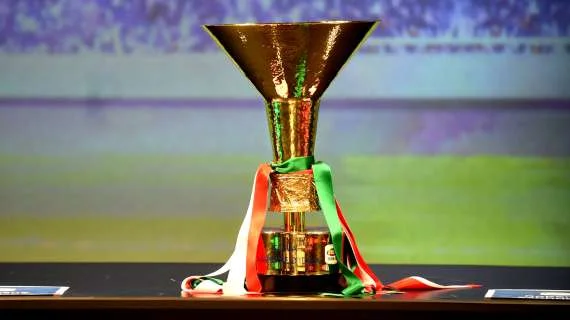
The Serie A trophy is the Coppa Campioni d’Italia, while the Scudetto is the champions’ tricolour shirt shield. Their histories overlap, but they began at different times. Understanding the cup’s name, design and presentation also explains why photographs, shirt symbols and title totals sometimes appear to tell different stories.
What is the Serie A trophy called?
The physical prize awarded to Italy's league champions is the Coppa Campioni d'Italia. Its name means the cup of the champions of Italy. The Scudetto is the small shield in the colours of the Italian flag that the champions wear on their shirts in the following season. In football conversation, winning "the Scudetto" also means winning the championship itself. That shorthand explains why a report can say a captain lifted the Scudetto even though the object in his hands is a cup rather than a shield.
The distinction is clear in Inter's official trophy explainer, which treats the shirt emblem and the physical award separately. It is useful to think of three linked things: the sporting achievement, the presentation object and the emblem that identifies the defending champions. A club earns the achievement through league results; the ceremony makes it visible; the shirt carries the status into the next campaign. None of those stages amounts to a separate competition win.
The word "Coppa" can be misleading to an English-speaking fan. Here it describes the object. It does not turn Serie A into a knockout tournament and it does not make this prize the Coppa Italia. A league trophy rewards the season's championship outcome, while a domestic cup trophy rewards a different tournament. The same club can win both, but those successes belong to separate records and come with different physical awards.
The FIGC's history of championship trophies also shows why the name cannot describe every object ever given to an Italian champion. The modern cup dates to the 1960-61 period, long after the championship began. A supporter visiting a club museum may therefore see earlier cups associated with league wins alongside versions of the modern trophy. Their different shapes tell a story about the award's history; they do not mean those earlier champions won a lesser version of the sporting title.
How the championship became a cup and a shirt emblem
Italian championship history is older than both the modern trophy and the familiar shirt badge. Those timelines have to be separated before comparing old photographs with contemporary celebrations. "Scudetto" is now used retrospectively for early titles, but that does not mean the winners of the first championship were wearing today's emblem or holding today's cup. The language of the achievement outlived several changes to its visible symbols.
The early championship trophies
The first national championship took place in Turin on 8 May 1898. Genoa won it, then won again in 1899 and 1900. The City of Genoa museum's account explains that the resulting three consecutive victories gave the club permanent possession of the Coppa Duca degli Abruzzi, also known as the Challenge Cup or Coppa d'Onore. That arrangement attached ownership of the physical object to a sequence of victories. It was a different idea from the modern original circulating with each new champion.
The federation's historical timeline then identifies other named awards, including the Fawcus and Spensley cups. The important point is not to memorise every donor. It is that championship prestige remained recognisable while the object representing it changed. Early football institutions were building traditions as they went, and a cup could be offered, permanently assigned or replaced without creating a new sporting competition. A modern trophy cabinet can preserve several stages of that process.
There is also a reason to take surviving objects seriously rather than viewing them as decorations around a list of winners. The museum's account records the rediscovery and acquisition of the original Challenge Cup in 2018. An object connected with the first championship can therefore have a later history of loss, rediscovery and museum display. The artefact and the result have separate lives: the result stays in the record even when the cup is not available to photograph.
Genoa and the first Scudetto shirts
Genoa's official history places the first Scudetto on an Italian club shirt in 1924-25. The club was displaying its status from the preceding championship. This sequence still matters when looking at kit photographs: a shield on a shirt identifies the defending champion during that campaign; it is not advance evidence that the team will win that campaign too.
The detailed FIGC account places the first Genoa appearance in the emblem on 10 October 1924 at Marassi and explains that the original design included the royal arms. Its later political and postwar changes are a reminder that the badge is a national symbol as well as a sporting one. Today's green, white and red shield is instantly recognisable precisely because it is compact. Unlike a cup kept away from the pitch between ceremonies, the shirt emblem repeatedly places the championship into ordinary league matches.
The design: gold, blue stone and the names of champions
The modern trophy is recognisable through a contrast between the warm metal body and its blue stone base. It is not simply a tall gold-coloured cup with a competition logo stuck on the front. The central ring includes an allegory of athletes, while the lower part carries the names of championship winners from the trophy's own starting period. Those features give the object both a sporting subject and a developing historical record.
Ettore Calvelli and the trophy's proportions
Inter's official account credits the design to sculptor and medallist Ettore Calvelli in 1960. It describes a blue sodalite base and gives the restyled dimensions as 58 centimetres high and eight kilograms in weight. These measurements are independently consistent with the league's December 2025 comparison of its trophies. An older page quoting a smaller version should therefore not be treated as proof that the contemporary presentation object has those earlier proportions.
Weight is an unusually practical part of this story. Eight kilograms is manageable for a captain, but substantial enough that the familiar overhead photograph represents a real object being handled rather than a lightweight stage prop. A broad base also changes how a trophy is held. Watching where the captain places his hands can help distinguish the championship cup from a taller, differently shaped award in a cropped celebration photograph.
The design also reads differently at different distances. From the stands, the outline and colour carry the message. In a close photograph, the sculptural ring and engraved names become easier to appreciate. That is an editorial reading of the object, rather than a claim about Calvelli's intentions: the official sources document the features, but they do not establish that he designed each one for modern television. The cup's long history should not be reduced to an explanation invented after the fact.
The inscriptions need equally careful interpretation. They begin with champions from 1960-61, so they describe the modern trophy era rather than the whole championship from 1898. A missing early club name on this object does not erase that club's earlier titles. For a museum visitor, the most revealing question is therefore "which period does this cup represent?" rather than "does this surface contain every Italian champion?" The trophy commemorates continuity through a particular design; the full honours record requires a wider historical frame.
When champions lift the trophy
A title can be won on one day and the trophy lifted on another. The first is a consequence of the championship's results and rules. The second is an organised presentation, bringing players, officials, cameras and supporters together. Treating both dates as interchangeable can make even a familiar celebration misleading, especially when photographs circulate without their original captions.
Winning the title and holding the ceremony
Inter's 2020-21 presentation provides a clear example. The league's official ceremony notice scheduled the award for 23 May after Inter'Udinese at San Siro. The championship had already been secured. The final home occasion supplied a setting for the shared celebration, rather than a new match in which Inter had to win the title again. The last fixture remained a competitive league game even though the podium gave it a second significance.
The separation continued in a more recent official example: the league report on Inter's May 2026 clincher against Parma referred to the cup presentation two weeks later. For a travelling supporter, this is a meaningful difference. A game with a mathematical chance of deciding the championship and a game announced for the trophy ceremony are related attractions, but planning around one does not guarantee attendance at the other.
The safest interpretation is therefore season-specific. Read the official award announcement, distinguish the clinching match from the presentation fixture and allow for the surrounding league schedule. A general description of the tradition is helpful background, but it should not be converted into a guaranteed date for a future campaign. The trophy's symbolism is enduring; the logistics of placing it on the pitch are an event decision.
The captain's role in the celebration
The official Inter report identifies Samir Handanovic as the captain who received the cup from league president Paolo Dal Pino on 23 May 2021. His role put one recognisable figure at the centre of a collective achievement. A captain's first lift is a powerful image, but it is not a statistical claim that he alone won the league, nor proof that he contributed the most goals or minutes. The photograph expresses leadership and representation.
The surrounding players and families matter to that reading. A league campaign is accumulated work, while the ceremony compresses it into a few seconds that will represent the season for years. This helps explain why fans remember the person holding the cup almost as clearly as the decisive goals. When comparing historic lifts, keep the captain, championship season and actual ceremony date together. A photograph identified that way tells a precise football story; a generic caption saying "Serie A winners" loses much of what makes it worth looking at.
Why trophy counts and Scudetto counts can differ
A count of modern cups can be smaller than a count of Italian championships without either number being wrong. The first question is where the count begins. The modern cup represents titles from 1960-61 onward; the championship record extends much further back. Genoa's early dominance, for example, belongs to the history of Italian champions even though its original awards were different objects. Counting only the current design would remove part of that history by definition.
Inter offers a useful contemporary illustration. The league's official Inter honours page includes championship seasons before the modern trophy existed as well as later successes. Its total is a sporting honours figure, not a claim that the club received today's object for every listed season. Comparing that total with an old article's count of modern cups requires the same starting year and the same cutoff date. Otherwise, the comparison combines two different questions.
There is a second issue: the official status of a title. An image of a team celebrating on the pitch records a ceremony that happened. It does not independently determine whether the championship remained in the official honours record after later disciplinary decisions. The league's Juventus honours list omits the 2004-05 and 2005-06 championships from Juventus's official total, while the league's Inter page includes 2005-06. A historical presentation photograph should not be used to overturn that distinction.
For readers, the sensible comparison has three parts: define whether the record covers all Italian top-flight history or the modern cup era; state the last completed season included; and follow the official status of the championships. A number without those conditions can sound precise while answering the wrong question. This becomes particularly important in older museum text, anniversary pieces and club discussions, where the author may have assumed a historical scope familiar to the original audience.
Our club championship totals guide and season-by-season winners list are better places to compare the complete sporting record. The trophy's story supplies the material context for that record. It helps explain why the same cabinet may contain early awards, replicas and the contemporary original in different seasons. A football museum is a collection of evidence about achievements; it is not a simple inventory in which every physical item necessarily represents a different championship.
Reading the trophy, the shield and the stars together
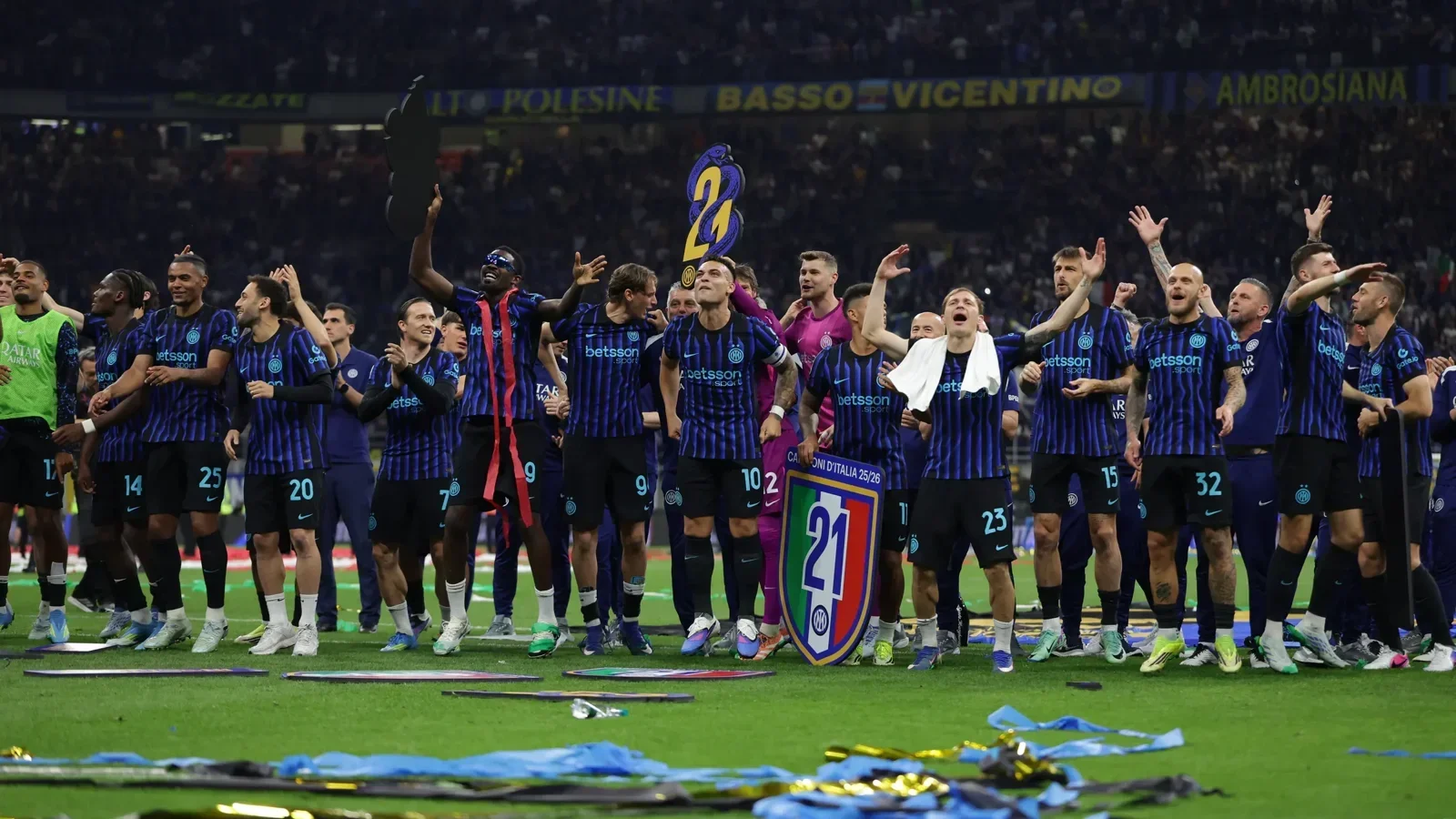
The cup, shield and stars communicate different time scales. The cup is the object presented for a championship. The Scudetto on a playing shirt identifies the defending champions. The stars above a badge recognise accumulated Italian league titles, with each star representing ten. Inter's twentieth championship and second star made that distinction particularly visible: a milestone in the club's whole history could be celebrated alongside the annual championship award.
A star does not disappear when another team wins the next league season, whereas the right to wear the defending champions? Scudetto moves with the championship. That difference helps a reader interpret a kit without knowing the entire honours list. It also explains why a current shirt can contain an enduring record of past success alongside a temporary sign of the latest completed campaign. Neither symbol records European Cup victories, domestic cup wins or total trophies across every competition.
Scudetto versus Coppa Italia and Supercoppa
The league's Coppa Italia trophy history describes a separate vase-inspired award and the cup winner's circular tricolour coccarda. That round shirt symbol is different from the league champion's shield. Both use Italy's colours, so colour alone is an unreliable way to identify the competition in a photograph. Look at the shape of the emblem and the object, then confirm the season and match.
The Supercoppa is another distinct award. The league's trophy comparison describes a taller silver-coloured object, rather than the Scudetto cup's familiar gold and blue combination. A club lifting it has won the Supercoppa event; the image does not by itself show that the club has just become league champion. Supercoppa qualification and formats can change, so the event's own regulations should explain who took part in a particular edition.
For supporters, these distinctions make celebrations richer rather than more complicated. They allow a photograph to be read as an exact achievement instead of a generic success. A captain lifting the Coppa Campioni d'Italia closes the championship story; a Scudetto shirt carries it into the next season; a star places it into a longer line of titles. If you are beginning with the competition itself, our Serie A introduction explains the league framework. The trophy then becomes a recognisable object with its own history, rather than simply the cup at the end of a highlights video.
Join the discussion
Comments
Sign in with Google to comment. Keep the conversation useful and football-focused. New comments are reviewed before they appear.
Loading comments…