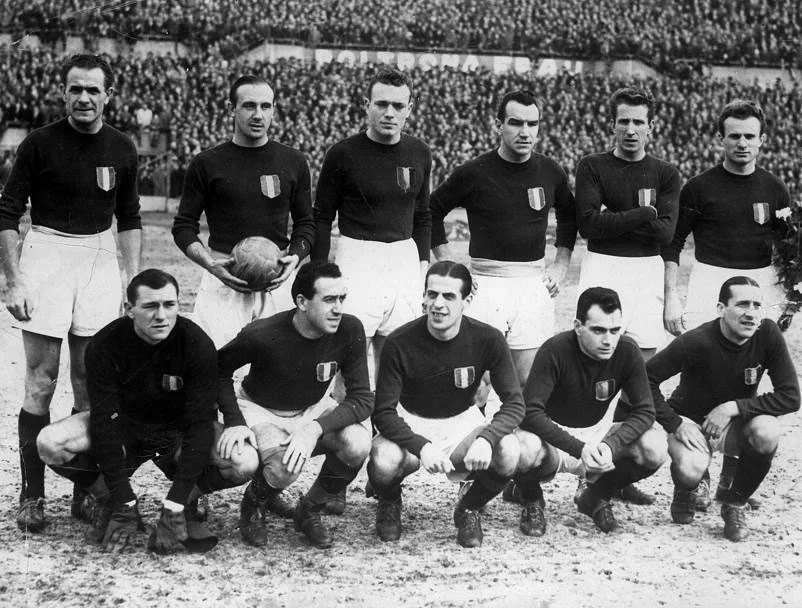
Torino hold the single-season team scoring record in Serie A with 125 goals in 1947–48, across 40 matches. Milan scored 118 in 38 games in 1949–50, while Atalanta reached 98 in 2019–20. The totals become more useful when league size, scoring distribution and the championship result are considered together.
Torino set the record with 125 in 1947–48
The highest team scoring total in a single-division Serie A season is Torino's 125 goals in 1947–48. That was a 21-team championship, so Torino played 40 matches rather than the 38 used in today's 20-team league. Their rate was 3.125 goals per game, or 3.13 when rounded to two decimal places. Both the total and the denominator belong in the answer.
Torino's official Grande Torino history records the 125 alongside 29 victories and only 33 goals conceded. The total concerns league matches in that season. It excludes the Coppa Italia, friendlies and other competitions, and should not be compared with a modern club's all-competition total. The same boundary also keeps unusual wartime tournaments separate from the single-division record.
The schedule explains an opportunity, not the achievement by itself. Two extra games provide additional chances to score, but Torino still had to convert those chances at an exceptional rate across the entire campaign. A reader who dismisses the record because the season was longer misses that distinction. A reader who presents 125 without the 40-match context misses it from the opposite direction.
A raw total rewards accumulation across the official season; goals per game rewards scoring frequency within that season. Neither calculation can reconstruct the strength of every opponent, the conditions of each pitch or the balance of the team's attacks. The record is precise because it asks a measurable question. The broader claim that this was the best attack ever requires more evidence than a division of goals by games.
The value of this historical benchmark is therefore twofold. It supplies a direct answer to the record query and prompts a better comparison with other prolific teams. League size, scoring distribution and championship outcome can all change the interpretation. Torino's extraordinary total remains the starting point, while the context shows why it belongs to a particular team, season and competitive environment.
For a fan accustomed to judging an attack through a star striker, the team number also invites a wider view. It collects every league goal credited to Torino, regardless of whether it came from a leading forward, another teammate or an opponent's own goal. A team record follows the scoreboard for the whole side. It consequently tells a different story from the single-player scoring record.
Why Grande Torino could score at that scale
A team with several sources of goals
Valentino Mazzola scored 25 league goals and Guglielmo Gabetto 23 in 1947–48, according to Torino's historical account. Together that is 48 of the team's 125, leaving 77 from other scoring contributions, including any own goals credited to Torino. Those two leading figures were essential, but their combined total was still substantially below half of the whole attack's output.
This distribution changes how the record should be imagined. It was not one forward reaching an extraordinary personal total while everyone else supplied the ball. A defence facing several credible finishers cannot solve the problem simply by assigning extra attention to the leading scorer. That is an interpretation of the scoring spread, rather than a claim to have measured individual marking arrangements in every historical match.
Mazzola's FIGC museum record places his Torino career between 1942 and 1949 and records 29 goals as league top scorer in 1946–47. His 25 in the following season therefore occurred within an established winning team, rather than explaining a sudden one-season scoring transformation by itself. The record campaign's scale came from the collective becoming exceptionally productive around several important players.
Torino's 2026 memorial history recalls Mazzola arriving with Ezio Loik from Venezia and identifies Egri Erbstein's technical direction in the postwar years. These details locate the attack within a built and sustained team. They provide firmer context than attaching modern tactical terms to old photographs and pretending those terms explain every goal.
Forty matches and a decisive home advantage
At the Filadelfia, Torino won 19 of their 20 league fixtures and took 39 points from the 40 available under the two-points-for-a-win system. That home record is confirmed by the same official memorial. It does not give us a complete home-goals breakdown, but it does show that overwhelming results were repeatedly produced in one setting. The season's output was supported by remarkable consistency, not only by a handful of spectacular afternoons.
One such afternoon came on 2 May 1948, when Torino beat Alessandria 10–0. It remains a striking example of how a dominant team can add a large number of goals in one fixture. Even that result supplied only ten of the final 125. The other 115 still had to be scored across the remaining games, which keeps the record from being reduced to its most memorable scoreline.
The longer schedule and the home dominance consequently work together as context. Forty fixtures increased the number of opportunities; repeatedly winning at home demonstrated Torino's ability to exploit many of them. Neither fact permits a fictional reconstruction of every passage of play. Together with the spread of scorers, however, they explain why the team total deserves to be read as sustained collective production rather than a single isolated attacking feat.
Milan scored 118 without winning the 1949–50 title
Gre-No-Li and the 118-goal attack
Milan's 118 goals in 1949–50 set the benchmark for a 38-match Serie A season. The historical team scoring dataset records that total over 38 games. It produces a rate of approximately 3.11 per match, remarkably close to Torino's 3.13 across 40. The narrower raw-total gap becomes a much smaller rate difference once the schedules are included.
This was the era of Gunnar Gren, Gunnar Nordahl and Nils Liedholm, remembered together as Gre-No-Li. Milan's Nordahl profile identifies his January 1949 arrival and the subsequent Swedish partnership. The point of naming the trio is to place the season's goals within a real group of players, rather than treating 118 as a number that somehow appeared independently of recruitment and on-field relationships.
Nordahl scored 35 league goals in the record campaign. Even such a prolific individual contribution accounts for roughly 30 percent of 118, leaving the larger share elsewhere in the team's total. That does not diminish the striker's importance. It demonstrates how individual scoring and team scoring fit together: a record-class finisher can be the attack's central reference without being its only effective source of goals.
The proximity of Milan's rate to Torino's also encourages restraint in declaring an indisputable winner between the attacks. Torino retains the larger official season total. Milan supplies an exceptional 38-game comparison. The smaller difference in frequency supports a closer discussion, but it does not control for opponent quality or replace the historical context with a complete mathematical judgement.
Juventus won the race on points
Milan nevertheless finished second to Juventus. Juventus's centenary history records the 1950 championship, while Milan's account of the following title season looks back on a spectacular but insufficiently balanced attack. Its remembered 7–1 win in Turin illustrates the danger of using one overwhelming result to explain an entire league race.
The season records make the distinction concrete. Milan had 27 wins, three draws and eight defeats; Juventus had 28 wins, six draws and four defeats. Under the contemporary two-point system those results yield 57 and 62 points respectively. Juventus scored 100, below Milan's 118, but converted the schedule into the better points total. Goals accumulated across a season do not dictate how many separate matches a side wins.
This is more precise than saying that attacking football necessarily sacrifices success. Milan's club history describes the defensive adjustments made before the next championship, not an instruction to stop scoring. The football problem is balance: sustaining enough attacking threat while reducing the circumstances in which that threat is cancelled out by conceding. A higher goal difference cannot always compensate for distributing goals across the wrong results.
Milan's 118 consequently belongs in both a record discussion and a title-race discussion. It was an exceptional attacking season with an unsuccessful championship outcome. Holding those facts together keeps the analysis faithful to the sport: an attack can be historically productive even when its team does not finish first, and a champion can win the season without topping the scoring-record list.
Other league sizes produce different comparisons
A 21-team league creates 40 fixtures for each club; 20 teams create 38; 18 create 34; and 16 create 30. The difference is part of the competition's design. Comparing every season as if the clubs played an identical number of matches gives a longer campaign a built-in advantage in any accumulation record, including goals.
Fiorentina's 95 goals in 1958–59 provide the major 34-match comparison. The season's statistical record gives 95 in 34, a rate of 2.79. Juventus's 75 in 1942–43 illustrate the 30-match era; an archived contemporary newspaper record table identifies that 75-in-30 benchmark. These examples are selected to show format differences, rather than to pretend that four rows form the complete historical ranking.
| Team and season | Teams in league | Matches | Goals | Goals per match |
|---|---|---|---|---|
| Torino 1947–48 | 21 | 40 | 125 | 3.13 |
| Milan 1949–50 | 20 | 38 | 118 | 3.11 |
| Fiorentina 1958–59 | 18 | 34 | 95 | 2.79 |
| Juventus 1942–43 | 16 | 30 | 75 | 2.50 |
The 34-match example demonstrates why a large total needs more than a glance. Ninety-five is 30 below Torino's 125, but Fiorentina had six fewer fixtures. Its rate remains below Torino's, while narrowing the comparison to the actual scoring frequency. That is a useful correction to the raw difference. It does not require inventing goals that Fiorentina would supposedly have scored in matches that never existed.
The same caution applies to the 30-match benchmark. Multiplying 75 by a hypothetical 38-match schedule would describe an extrapolation, not an official Juventus season. It assumes the attack would retain the same rate against an additional set of opponents and through a longer campaign. Readers can use such arithmetic to understand scale, but the extrapolated result should never be placed in a records table as a realised total.
League size also changes who enters the competition and how many different opponents an attack must solve. Removing eight fixtures from a comparison does not remove eight interchangeable games. The mixture of rivals, travel, seasonal conditions and periods of fatigue changes with the schedule. Goals per match handles the denominator; it cannot make the competitive environments identical.
The strongest conclusion is consequently specific. Torino owns the 125-goal single-division season record; Milan's 118 offers the exceptional 38-game comparison; other formats need their own denominators. Keeping those distinctions visible lets a fan appreciate several attacking achievements without replacing the historical record with a falsely universal ranking of quality.
Atalanta made the modern benchmark 98
An attack shared across the front line
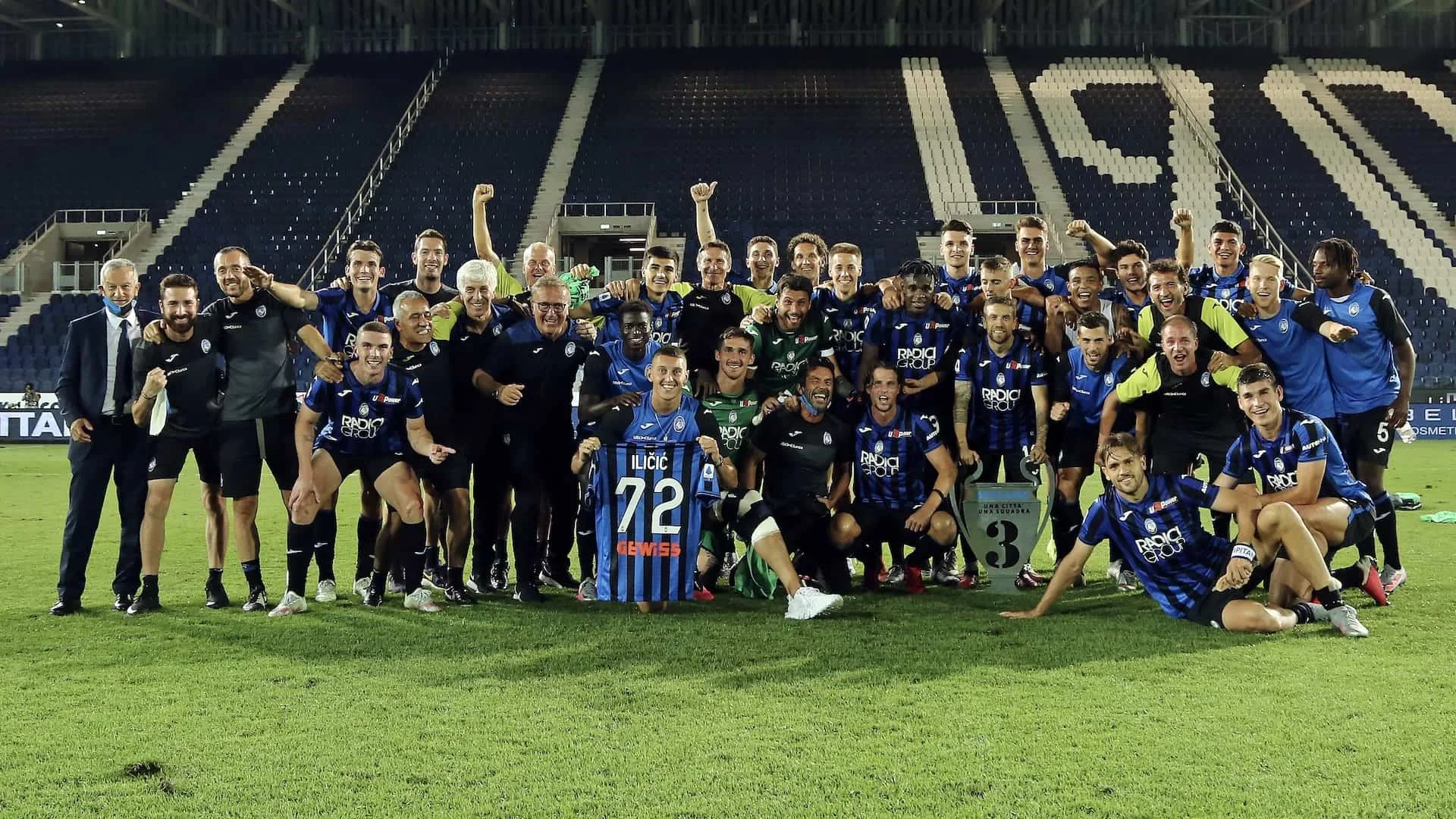
Atalanta scored 98 league goals in 2019–20, the outstanding modern comparison with the postwar totals. The club's season review confirms the figure and its third-place finish. Across 38 matches, 98 is approximately 2.58 per game. It falls well below Torino's 125 while remaining an exceptional output in the contemporary league.
The club's report of league statistics records Duván Zapata and Luis Muriel on 18 goals each, with Josip Iličić on 15. Those three supplied 51, leaving 47 elsewhere in the team total. This is a useful modern example of attacking depth: the leading scorers could be decisive without the whole season depending on one player's pursuit of the individual scoring crown.
A specific match illustrates the wider involvement. In the official report of the 7–0 win at Torino, José Luis Palomino wins possession before providing the opening goal for Iličić, while Robin Gosens adds a volley. The attack includes a defender helping create a chance and a wide player finishing one. That is firmer evidence of shared responsibility than a generic description of the team as simply fearless.
The striking feature is the number of different problems such contributions present to an opponent. Attention to Zapata does not remove Iličić's ability to finish; dealing with those forwards does not automatically cover Gosens arriving elsewhere. The match examples support this interpretation of several sources of danger. They do not supply a precise historical measurement of every movement or justify inventing unrecorded positional data.
Goals did not erase the cost of conceding
Atalanta finished with 78 points, third place and another Champions League qualification. Their season also contained 48 league goals conceded. The comparison with Milan's 1949–50 campaign is therefore useful, although the teams and eras were different: outstanding attacking accumulation did not by itself produce the championship. The final table rewards the distribution of wins and draws, not an award for the most entertaining scoring total.
The 7–2 victory at Lecce provides a concrete example of both sides of that balance. Atalanta reached half-time at 2–2 before pulling away with five more goals. The eventual margin shows the attack's capacity to recover control, while the interval score reminds the reader that creating and conceding can coexist within the same match.
That result does not establish that all of Atalanta's goals came from unusually open games. It does show why seven goals in one afternoon should be read alongside the state of the contest. The attack sometimes had to answer a problem as well as impose one. A complete judgement of the team would examine both processes; a scoring-record article can identify them without pretending that the goal total measures the entire performance.
Atalanta consequently supplies a modern reference point that is valuable on its own terms. Its rate can be calculated on the same 38-match denominator as Milan's 118, while the actual matches reveal a different personnel group and competitive environment. Appreciating 98 does not require calling it 125, or assuming that a modern record-class attack necessarily becomes the league champion.
How to compare a scoring season fairly
Goals per match and the missing context
Start a comparison with the total, the season and the number of league matches. That combination immediately distinguishes Torino's 125 in 40 from Milan's 118 in 38 and Atalanta's 98 in 38. The rate is then a transparent calculation rather than a mysterious alternative record. A reader can check it and understand what it corrects.
The missing context remains substantial. A season with a high scoring average across the league may offer a different environment from one in which chances are harder to create. Player roles, substitution rules, pitches and the wider competitive field also change. The article's selected totals do not quantify those differences, so the honest conclusion is a scoring comparison with clear limits, rather than a definitive ranking of attacks adjusted for every era.
It can help to place the team's finish beside its scoring rate. Torino won the record season; Milan finished second in 1949–50; Atalanta finished third in 2019–20. Those outcomes demonstrate that goal accumulation and championship achievement are separate measures. Combining them produces a more informative view than insisting that the highest scorer must automatically have been the strongest league team.
League goals, all competitions and current-season pace
The competition boundary is equally important. European ties, domestic cups and friendlies add matches against different opponents under different formats. A club's celebratory headline might count all competitive goals, but that figure cannot replace its Serie A total. Atalanta's own review of its league record identifies 98; adding goals from Europe would answer another question.
Team and player records must also stay separate. A forward's goals describe his credited finishing output; the team figure collects the whole side's scoring. The headline “most goals in a season” can point to either measure unless the entity is named. Specifying “by a team” is therefore part of accuracy, not just a longer search phrase. It prevents an individual leaderboard from being mistaken for a record of collective production.
For an ongoing campaign, goals so far and scoring pace describe an unfinished season. Multiplying an early rate by 38 is a projection. It does not add hypothetical future goals to the official record, and it assumes the rate will survive changes in opponents, availability and schedule. A fast opening to 2026–27 can make the historical benchmarks interesting again without establishing that any of them has already been broken.
The current Serie A table keeps games played and goals for together, which is the right starting point for following that progress. Historical comparisons then use completed seasons with fixed denominators. On that basis the answer remains clear: Torino's 125 is the record, Milan's 118 is the great 38-match landmark, and Atalanta's 98 is a leading modern benchmark.
Join the discussion
Comments
Sign in with Google to comment. Keep the conversation useful and football-focused. New comments are reviewed before they appear.
Loading comments…