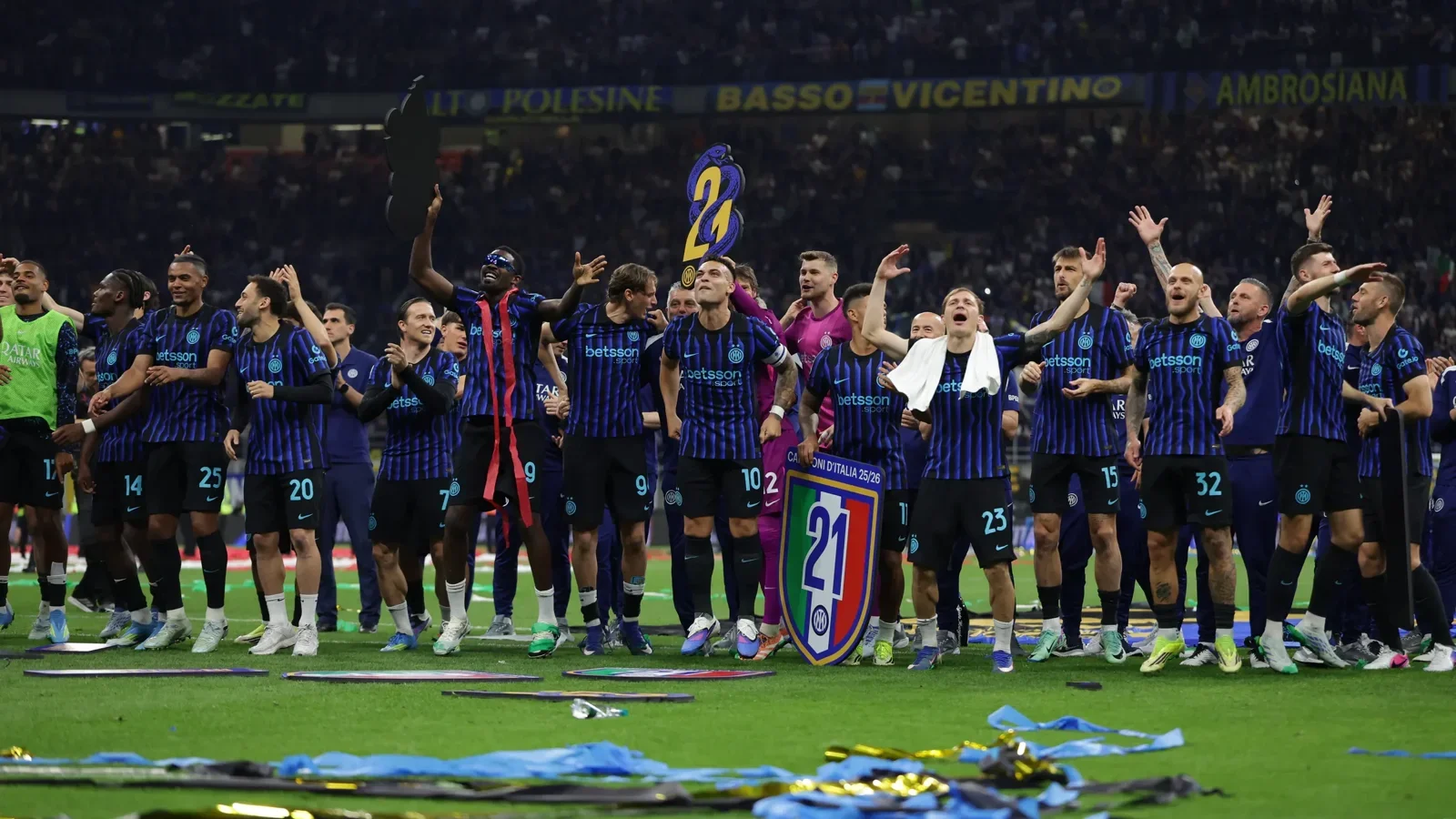
Inter won Serie A in 2025–26, becoming Italian champions for the 21st time. Below is the complete recognised championship chronology from Genoa's first victory in 1898 to Inter's latest title, with a separate quick-reference table for the last ten completed seasons. The record includes the competitions before the single-division Serie A format began in 1929–30, and marks revoked titles, wartime gaps and the two champions of 1921–22.
The last ten completed seasons: 2016–17 to 2025–26
Inter are the latest completed-season champions of Italy. Their 2025–26 title follows Napoli's success in 2024–25, and the distinction matters when someone asks who won Serie A “in 2026”: the answer refers to the campaign ending that year. The 2026–27 competition is a separate season. Its developing Serie A table cannot change the identity of the previous champion.
The ten-season window below runs from 2016–17 through 2025–26. Juventus account for four of those championships, Inter three, Napoli two and AC Milan one. That is a calculation from the dated entries, rather than an all-time ranking. Move the window backwards and Juventus's longer run occupies more of it; move it forwards and one of those four Juventus seasons drops out. A “last ten years” statistic therefore needs an ending season to mean anything useful.
| Season | Champion |
|---|---|
| 2025–26 | Inter |
| 2024–25 | Napoli |
| 2023–24 | Inter |
| 2022–23 | Napoli |
| 2021–22 | AC Milan |
| 2020–21 | Inter |
| 2019–20 | Juventus |
| 2018–19 | Juventus |
| 2017–18 | Juventus |
| 2016–17 | Juventus |
The league's official honours roll supplies the sequence. Read it from bottom to top and the change is striking: a block of Juventus victories gives way to a title that changes hands every season. This does not prove that every recent championship was close. It shows something narrower and more defensible: no club has retained the trophy since Juventus completed the 2019–20 campaign as champions.
Inter settled the latest race on 3 May 2026 by beating Parma 2–0, with three league matches still to play, as recorded in the official clinching-match report. The date of that celebration is different from the date of the final standings. For a season archive, both have their place: one identifies the decisive evening, while the other captures the complete campaign.
There is also a local detail behind the celebration. Inter's account of their championship journey distinguishes the 2026 home fixture from the 2024 derby, when AC Milan were the designated home team at the same stadium. A list can give both seasons one identical word, “Inter”, while the supporters remember two very different nights. That is why the chronology below keeps the precise answer but also restores the football surrounding it.
Before Serie A: every Italian champion from 1898 to 1929
The early championship and its changing format
Italian championship history begins before the modern league format. Genoa won the first national championship on 8 May 1898, at Turin's Velodromo Umberto I, in a tournament completed in a single day. The league's anniversary account makes that starting point explicit. Calling Genoa a nine-time Italian champion is correct; imagining nine victories in a modern, season-long Serie A competition is not.
That distinction preserves the value of the early achievements without flattening the competitions into one format. A championship can belong to the recognised national honours record even when its qualifying structure, travel demands and number of matches differ sharply from today's. Supporters looking for the roots of their club's identity should keep those titles in view. Supporters comparing points totals or the difficulty of a particular campaign need a much more specific question.
| Year or season | Champion or status |
|---|---|
| 1898 | Genoa |
| 1899 | Genoa |
| 1900 | Genoa |
| 1901 | AC Milan |
| 1902 | Genoa |
| 1903 | Genoa |
| 1904 | Genoa |
| 1905 | Juventus |
| 1906 | AC Milan |
| 1907 | AC Milan |
| 1908 | Pro Vercelli |
| 1909 | Pro Vercelli |
| 1909–10 | Inter |
| 1910–11 | Pro Vercelli |
| 1911–12 | Pro Vercelli |
| 1912–13 | Pro Vercelli |
| 1913–14 | Casale |
| 1914–15 | Genoa; interrupted competition, title subsequently awarded |
| 1915–16 | No national championship title |
| 1916–17 | No national championship title |
| 1917–18 | No national championship title |
| 1918–19 | No national championship title |
| 1919–20 | Inter |
| 1920–21 | Pro Vercelli |
| 1921–22 | Pro Vercelli (CCI) and Novese (FIGC) |
| 1922–23 | Genoa |
| 1923–24 | Genoa |
| 1924–25 | Bologna |
| 1925–26 | Juventus |
| 1926–27 | Unassigned; Torino's title revoked |
| 1927–28 | Torino |
| 1928–29 | Bologna |
The split championship and the early record
The 1921–22 row marks an organisational split, not an ordinary exception in the standings. There were two competing championships, won by Pro Vercelli and Novese. The FIGC's history of the split explains the dispute over the organisation and size of the competition, and the subsequent recognition of Pro Vercelli's CCI championship. This was not a shared title produced by a tied final table. Two organisations had run different competitions.
The early rows also challenge a modern fan's instinct about which clubs should appear near the top of Italian history. Pro Vercelli's cluster of victories and Casale's championship are evidence of an earlier competitive map. Their importance cannot be measured by asking whether they are in the current top division. Conversely, a club's prominence now does not retroactively make it central to the sport's first decades. History becomes more interesting when those changes are allowed to stand.
The season labels follow the conventional single-year description through 1909, then the two-year football season. The league's honours database sometimes renders an early single-year championship as a two-year label ending in that year. That is a presentation difference, not an extra trophy. The blank wartime years and the revoked 1926–27 title are included here so that a missing champion cannot be mistaken for an omitted row.
Every champion from 1929–30 to 1969–70
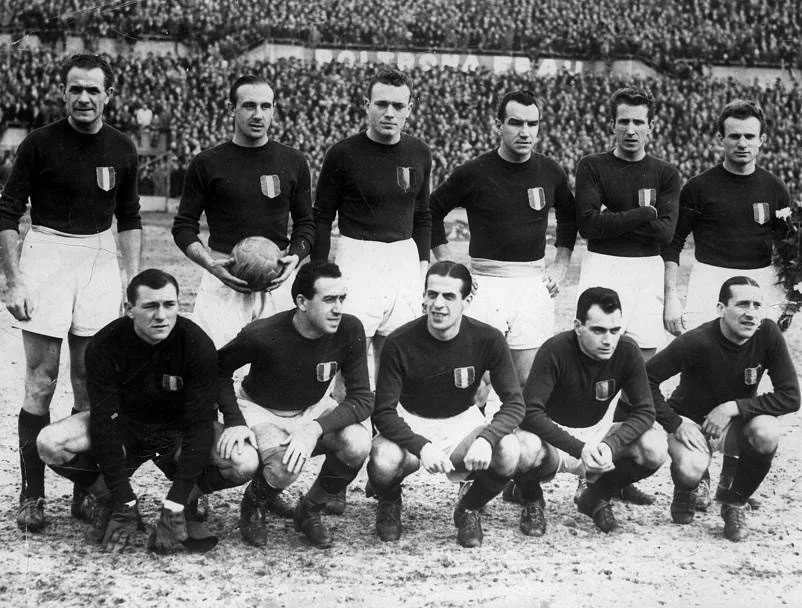
Establishing the league and the Grande Torino sequence
The 1929–30 campaign is the starting point for Serie A's single-division era. Inter, then known as Ambrosiana, won its first edition. For readability, the table uses Inter consistently; the historical name does not describe a different champion. Juventus then won five successive championships, before Bologna and Ambrosiana-Inter shared the remaining titles of the 1930s. The sequence is an early warning against assuming that every period of Italian football had the same leading cast.
Torino's five-title sequence needs particular care. It runs through 1942–43 and then 1945–46 to 1948–49, spanning the interruption of the national competition during the war. The club's history of Grande Torino also explains that the returning 1945–46 tournament included a regional first stage. “Consecutive championships” therefore describes consecutive awarded titles, not an uninterrupted series of identical annual league formats.
| Season | Champion or status |
|---|---|
| 1929–30 | Inter (Ambrosiana) |
| 1930–31 | Juventus |
| 1931–32 | Juventus |
| 1932–33 | Juventus |
| 1933–34 | Juventus |
| 1934–35 | Juventus |
| 1935–36 | Bologna |
| 1936–37 | Bologna |
| 1937–38 | Inter (Ambrosiana-Inter) |
| 1938–39 | Bologna |
| 1939–40 | Inter (Ambrosiana-Inter) |
| 1940–41 | Bologna |
| 1941–42 | Roma |
| 1942–43 | Torino |
| 1943–44 | No ordinary national championship title; wartime competition treated separately |
| 1944–45 | No national championship title |
| 1945–46 | Torino |
| 1946–47 | Torino |
| 1947–48 | Torino |
| 1948–49 | Torino |
| 1949–50 | Juventus |
| 1950–51 | AC Milan |
| 1951–52 | Juventus |
| 1952–53 | Inter |
| 1953–54 | Inter |
| 1954–55 | AC Milan |
| 1955–56 | Fiorentina |
| 1956–57 | AC Milan |
| 1957–58 | Juventus |
| 1958–59 | AC Milan |
| 1959–60 | Juventus |
| 1960–61 | Juventus |
| 1961–62 | AC Milan |
| 1962–63 | Inter |
| 1963–64 | Bologna |
| 1964–65 | Inter |
| 1965–66 | Inter |
| 1966–67 | Juventus |
| 1967–68 | AC Milan |
| 1968–69 | Fiorentina |
| 1969–70 | Cagliari |
Bologna and Cagliari break through
Bologna's 1963–64 success broke the sequence through a match the final league table could not settle. They finished level with Inter and won the championship playoff 2–0 in Rome on 7 June 1964. The club's anniversary record of the match identifies it as their seventh Scudetto. A final points total alone would leave this championship unresolved; the decisive match belongs to the answer. That is one reason historical tables should retain their season-specific rules.
At the end of this period, Cagliari's title carried the championship to Sardinia. Their club history places coach Manlio Scopigno and Gigi Riva within the achievement. It is tempting to compress such a season into a single famous striker. A league trophy, however, requires a whole side to keep producing results, including on the days when its most recognisable player cannot settle the match. The club's account of how the group was assembled is a useful corrective to the lone-hero version.
These rows show why a champions archive should include more than the modern powers. Fiorentina, Bologna and Cagliari interrupt the sequence in ways that become invisible in a short list of the most decorated teams. Their titles are not footnotes merely because they were followed by long waits. They are complete winning campaigns, and in each case the return to the same few names in neighbouring rows helps explain the scale of the breakthrough.
Champions from 1970–71 to 1999–2000
The era of new champions
The 1970s and 1980s are the richest stretch of this list for supporters who enjoy a break in the established order. Lazio, Torino, Roma, Hellas Verona and Napoli all appear between the recurring Juventus and Milan clubs. These were not interchangeable fairytales. Each title belonged to a specific group capable of surviving an entire league campaign, and several of those sides contained footballers who were among the outstanding talents of their generation.
Verona's 1984–85 title remains the sharpest example. Sky's anniversary feature places coach Osvaldo Bagnoli alongside Preben Elkjær, Hans-Peter Briegel, Roberto Tricella, Domenico Volpati and the rest of the champions. The two celebrated foreign recruits were part of a coherent team, not a substitute for one. Remembering the captain and midfield beside the attacking names gives a much better sense of what winning a league demands.
| Season | Champion |
|---|---|
| 1970–71 | Inter |
| 1971–72 | Juventus |
| 1972–73 | Juventus |
| 1973–74 | Lazio |
| 1974–75 | Juventus |
| 1975–76 | Torino |
| 1976–77 | Juventus |
| 1977–78 | Juventus |
| 1978–79 | AC Milan |
| 1979–80 | Inter |
| 1980–81 | Juventus |
| 1981–82 | Juventus |
| 1982–83 | Roma |
| 1983–84 | Juventus |
| 1984–85 | Hellas Verona |
| 1985–86 | Juventus |
| 1986–87 | Napoli |
| 1987–88 | AC Milan |
| 1988–89 | Inter |
| 1989–90 | Napoli |
| 1990–91 | Sampdoria |
| 1991–92 | AC Milan |
| 1992–93 | AC Milan |
| 1993–94 | AC Milan |
| 1994–95 | Juventus |
| 1995–96 | AC Milan |
| 1996–97 | Juventus |
| 1997–98 | Juventus |
| 1998–99 | AC Milan |
| 1999–2000 | Lazio |
Sampdoria's 1990–91 championship has its own defining afternoon. On 5 May they beat Inter 2–0 at San Siro, with Giuseppe Dossena and Gianluca Vialli scoring. The club's match retrospective records the resulting four-point lead over Milan and five-point advantage over Inter, with three games left. In a competition awarding two points for a win, that was a substantial step towards the trophy. Samp had taken points directly from a rival on its own ground, turning an anxious run-in into a position of real authority.
Milan's unbeaten response
Sampdoria's breakthrough was followed by an emphatic response from AC Milan. Their 1991–92 championship account records an unbeaten season and 74 league goals, including a 5–1 victory over the outgoing champions and an 8–2 win at Foggia on the final day. Fabio Capello had inherited the challenge of following Arrigo Sacchi. The results show why his first title cannot be reduced to a cautious successor merely preserving what he had been given. Milan could control a championship and still overwhelm opponents.
The closing years of the century then became a sustained exchange between Milan and Juventus, interrupted by Lazio in 1999–2000. That contrast is part of the appeal of the period: spectacular individual breakthroughs sit beside teams able to return repeatedly to the top. For a football fan, the interesting question is how the rare winner assembled its moment, and how the recurring champion kept renewing itself. The names in adjacent rows give those two stories their shape.
Champions from 2000–01 to 2025–26
Title-winning cores and the long dynasties
Roma began the new century's first full football season by winning the 2000–01 championship. The club's history of that team identifies the combination of Francesco Totti's leadership, Gabriel Batistuta's 20 league goals and Vincenzo Montella's decisive contributions from the bench. Walter Samuel and Emerson were also major arrivals. The title-winning attack was the most visible part of a recruitment drive that strengthened the spine of Fabio Capello's side.
The championship then returned to Turin and Milan before Inter established their five-title sequence from 2005–06 to 2009–10. Its first entry was an awarded title, a distinction explained in the next section. AC Milan won in 2010–11, and Juventus then began the longest uninterrupted sequence in the archive: nine successive championships, ending in 2019–20. Those repeated rows represent considerable change inside the winning club, rather than nine years with a frozen squad.
| Season | Champion or status |
|---|---|
| 2000–01 | Roma |
| 2001–02 | Juventus |
| 2002–03 | Juventus |
| 2003–04 | AC Milan |
| 2004–05 | Unassigned; Juventus's title revoked |
| 2005–06 | Inter; awarded following disciplinary decisions |
| 2006–07 | Inter |
| 2007–08 | Inter |
| 2008–09 | Inter |
| 2009–10 | Inter |
| 2010–11 | AC Milan |
| 2011–12 | Juventus |
| 2012–13 | Juventus |
| 2013–14 | Juventus |
| 2014–15 | Juventus |
| 2015–16 | Juventus |
| 2016–17 | Juventus |
| 2017–18 | Juventus |
| 2018–19 | Juventus |
| 2019–20 | Juventus |
| 2020–21 | Inter |
| 2021–22 | AC Milan |
| 2022–23 | Napoli |
| 2023–24 | Inter |
| 2024–25 | Napoli |
| 2025–26 | Inter |
The 2015–16 Juventus season is particularly revealing. According to the club's campaign history, Andrea Pirlo, Arturo Vidal and Carlos Tevez had departed, while Paulo Dybala, Sami Khedira and Mario Mandžukić were among the arrivals. Juventus were twelfth after ten matches, then won 25 of their next 26 league games. The table's uninterrupted Juventus sequence hides a dramatic recovery: the champion was forced to rebuild its relationships on the pitch before it could reassert its advantage.
Napoli returns and the title changes hands
After the long dynasties, Napoli's 2022–23 breakthrough restored a champion absent from the list since 1989–90. The decisive result was a 1–1 draw at Udinese, where Victor Osimhen equalised after the home team had gone ahead. Napoli's report of the clinching match records Luciano Spalletti's starting side, with Stanislav Lobotka, André-Frank Zambo Anguissa and Khvicha Kvaratskhelia among those around the striker. A new set of names had written a title-winning chapter that could stand beside the Maradona years.
The following three championships went to Inter, Napoli and Inter. That exchange gave the period a different rhythm from the Juventus run, but it should not erase the scale of either club's achievement. Napoli added a second modern-era championship in 2024–25; Inter returned in 2025–26 under Cristian Chivu. For the fans who had lived through long waits between titles, winning again was more than another line in a database. It showed that the previous success could be followed by a fresh championship team.
Voided titles, two champions and the wartime exception
Revoked and reassigned championships
Three rows attract more argument than almost any winning season: 1926–27, 2004–05 and 2005–06. Torino's 1926–27 title was revoked and never reassigned. Juventus's 2004–05 title was also revoked without another champion being installed. The following championship, 2005–06, belongs to Inter in the official record. Removing both Juventus seasons and leaving both blank would therefore be just as inaccurate as counting both for Juventus.
The distinction is supported by the FIGC's notice concerning the 2006 award, which refers to the measure of 26 July 2006 assigning that championship to Internazionale. Juventus continue to describe their history using a different overall title count in some club material. For a neutral winners archive, the governing competition's recognised awards provide the consistent basis. This does not require readers to agree about the politics of Calciopoli; it requires the same counting rule for every club.
Torino's own 2026 anniversary article still disputes the fairness of the 1927 revocation. It also records the crucial facts for this list: the title was removed on 3 November 1927, it was not reassigned, and Torino won again the following season. The club's pride in its team of Julio Libonatti, Adolfo Baloncieri and Gino Rossetti is part of the history. It should be reported alongside the award's status, rather than used to silently change that status.
Spezia's wartime recognition
Spezia's wartime achievement concerns honorary recognition, not the reassignment of an ordinary league title. Their official account of the 1944 competition recalls the firefighters' team beating Torino and the honorary recognition eventually granted in January 2002. That honour preserves an extraordinary sporting story from a fractured country. It does not insert an ordinary national championship into the standard Scudetto totals used here. Calling the season simply “nothing happened” would be poor history; adding Spezia as a conventional Serie A champion would be poor accounting.
The parallel championships of 1921–22
Novese and Pro Vercelli present a third distinct case: in 1921–22 they won concurrent competitions. Their joint appearance is neither a revocation nor a retrospective transfer of one club's trophy to another. These exceptions matter because Italian football's history includes disputes over who could enter, who could govern and what constituted the national championship. The record becomes clearer when each case receives its own explanation instead of one generic asterisk.
What the changing champions tell football fans
The recent exchange of champions contains two very different kinds of winning season. Inter's 2023–24 campaign ended with 94 points, 89 goals scored and 22 conceded. AC Milan were nineteen points behind. Those figures, preserved in the 2023–24 season archive, describe a side that separated itself from the league across the full campaign. The title was the product of sustained superiority at both ends, not simply a famous derby result at the finish.
Napoli's next championship came by a much smaller margin: 82 points against Inter's 81. The final-night Italpress report records the one-point gap. The contrast is useful because both seasons contain the same basic outcome, a new champion, while the experience of following them was entirely different. In one, the leader created distance. In the other, every dropped point threatened to alter who would lift the trophy.
Napoli's recovery was particularly striking after finishing tenth on 53 points in 2023–24. Their account of the 2024–25 championship highlights a seven-match winning run across December and January, including victories over Atalanta and Juventus, and the late equaliser against Inter in March. These were not decorative highlights collected after the fact. Beating direct competitors and salvaging a point from the reigning champion preserved the position from which Napoli could control their final evening.
Scott McTominay and Romelu Lukaku then scored against Cagliari to complete the job. Two years earlier, Osimhen had supplied the goal that made Napoli champions. The change of decisive names captures something essential about sustaining ambition: a club cannot assume that the football which delivered one title will survive every departure and every change of coach. It has to find another functioning combination. Napoli's two recent championships offer different leading players, even though both belong to the same badge and city.
For supporters choosing a historical season to revisit, that is where this archive becomes more than a trophy count. Follow Verona's single breakthrough, Milan's unbeaten response to Sampdoria, Juventus's recovery during their long sequence, or Napoli's return after a difficult defence of their crown. Each route leads to a different football problem and a different solution. The honours list tells us who finished the job; the matches and people explain why those seasons are still worth watching and discussing.
Join the discussion
Comments
Sign in with Google to comment. Keep the conversation useful and football-focused. New comments are reviewed before they appear.
Loading comments…