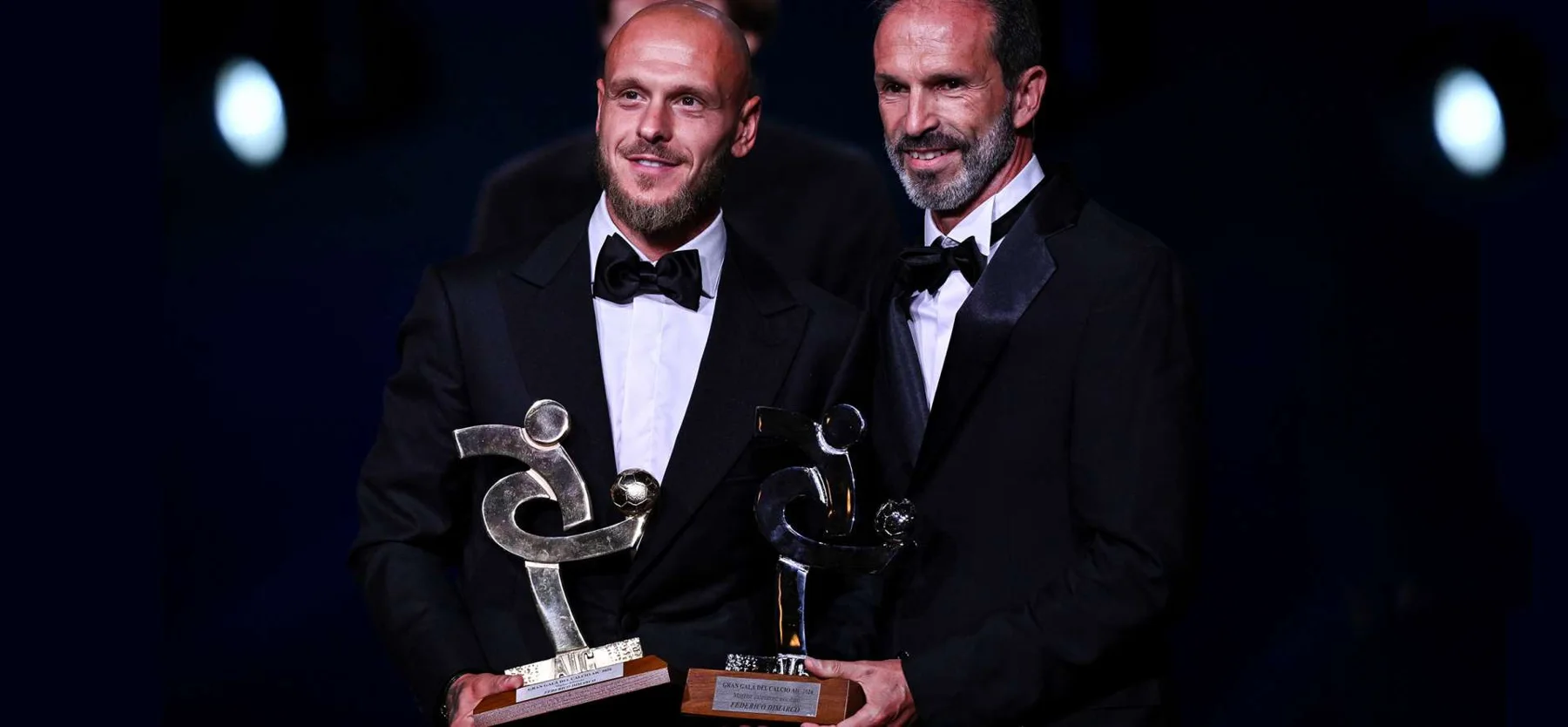
Federico Dimarco won the Lega Serie A Best Overall MVP for 2025–26 and the AIC men's overall award for the same season, confirmed by 5 September 2026. But “Serie A Player of the Season” does not always identify one trophy: the league and the players' association run distinct awards, and their winners sometimes differ. Here are the recent lists, the seasons they recognise and the football behind the most revealing choices.
Which Serie A player award are you looking for?
“Serie A Player of the Season” can refer to two different honours: the league's best-overall MVP and the AIC's player-of-the-year award at the Gran Galà del Calcio. For 2025–26, Federico Dimarco won both. The Lega Serie A announcement names him its overall MVP, while the AIC's September 2026 interview confirms his separate recognition by fellow players. Agreement on the winner does not make the two awards interchangeable.
How the winners are chosen
The league's award uses performance analysis incorporating match events and positional tracking. Its 2025–26 announcement identifies Kama Sport analysis and Hawk-Eye tracking, including work without the ball. The AIC honour is based on the votes of players choosing their colleagues. These are different ways of evaluating a season: one foregrounds a structured analytical process, while the other records professional peers' judgment. Neither should be replaced in a winners list by a newspaper poll, a video game's promotional team or an individual club's supporters' award.
That distinction remains necessary even when institutions collaborate. Lega Serie A supported the 2026 AIC gala, but its report of the event still identifies the honours as AIC awards and explains the direct player voting. The separately named “Vota il Gol” award was decided by fans. Seeing a league logo on coverage is therefore not enough to identify the selection process. The exact award title and organiser tell you more than the general branding around the ceremony.
Which season the award recognises
Identifying the organiser is only half the job: the season label must be equally precise. An award announced in 2025 can honour the 2024–25 season, rather than every match played during the calendar year. The AIC's 2025 winners were announced at its December event; the 2026 edition took place in September. A list that assumes every ceremony happens in the same month risks labelling the latest result incorrectly. This guide is checked through 5 September 2026, after the 2026 AIC gala, and uses explicit season or edition labels rather than the floating phrase “last year.”
Once the recognised season is clear, agree on the award being compared. Was a player the league's overall MVP, one of its positional winners, the AIC's overall choice or merely part of an eleven? Those are all meaningful distinctions. Once they are clear, the debate can move to the interesting part: which performances and responsibilities made that player so valuable to his team?
Lega Serie A overall MVP winners since 2018–19
The modern league awards began in 2018–19. Inter's 2021 announcement of Lukaku's win describes that campaign as the third edition and lists the first three overall winners. The table below follows that specific award through 2025–26. It does not extend the same label backwards onto older AIC honours, and it records the club for which the player earned the award rather than his present employer.
| Season | Winner | Club |
|---|---|---|
| 2018–19 | Cristiano Ronaldo | Juventus |
| 2019–20 | Paulo Dybala | Juventus |
| 2020–21 | Romelu Lukaku | Inter |
| 2021–22 | Rafael Leão | AC Milan |
| 2022–23 | Khvicha Kvaratskhelia | Napoli |
| 2023–24 | Lautaro Martínez | Inter |
| 2024–25 | Scott McTominay | Napoli |
| 2025–26 | Federico Dimarco | Inter |
Eight seasons produced eight different winners. More interesting than that numerical pattern is the range of attacking responsibilities represented. A centre-forward finishing moves, a winger breaking a defensive line and a midfielder arriving from deeper positions can all make the difference between an ordinary possession and a decisive chance. An overall award asks the evaluator to compare those contributions rather than assume that they are measured completely by the same column in a statistics table.
Lukaku's 2020–21 campaign is a useful illustration. Inter's announcement records 24 league goals and 11 assists, combining a substantial scoring contribution with passes that produced goals for teammates. The point is not to turn those totals into a universal formula. It is to notice why a striker's value need not end with his finishing. Protecting possession, attracting a defender and releasing another runner can be part of the same forward's contribution, and a good evaluation needs to recognise the connection between those actions.
The sequence from Leão and Kvaratskhelia to McTominay and Dimarco offers another reason to watch the roles rather than only the names. Different starting positions create different opportunities to influence a match. A wide player may force the opponent to provide extra cover; a midfielder may exploit the space that cover leaves; a player operating down the flank can supply the final ball from farther away. Similar team outcomes can emerge through substantially different jobs.
None of that makes the winners list an official ranking of the best eight footballers of their generation. The honours describe performance within particular seasons, with particular teammates and demands. They do not establish that the 2019 winner would outrank the 2026 winner in a hypothetical shared team, or that every runner-up was less talented. Read the record as a history of influential campaigns. It becomes more useful when paired with an explanation of what each player actually enabled his side to do.
AIC winners: the ceremony year is not always the season
The corresponding AIC list tells a slightly different story. Cristiano Ronaldo retained the players' association's overall award for 2019–20, whereas Paulo Dybala won the league's MVP that season. Neither answer needs to be corrected into the other. The mistake is to publish either name under an unqualified heading and leave readers to assume that Italian football has only one annual individual prize. An awards list should identify its organiser before it asks supporters to draw conclusions about a player's standing.
| Season recognised | AIC edition | Overall winner | Club that season |
|---|---|---|---|
| 2018–19 | 2019 | Cristiano Ronaldo | Juventus |
| 2019–20 | 2020 | Cristiano Ronaldo | Juventus |
| 2020–21 | 2021 | Romelu Lukaku | Inter |
| 2021–22 | 2022 | Rafael Leão | AC Milan |
| 2022–23 | 2023 | Victor Osimhen | Napoli |
| 2023–24 | 2024 | Lautaro Martínez | Inter |
| 2024–25 | 2025 | Scott McTominay | Napoli |
| 2025–26 | 2026 | Federico Dimarco | Inter |
Delayed ceremonies and changing electorates
Read the edition column as a label, not a promise about the day the trophy changed hands. The clearest trap is the AIC's report on its 2021 awards, published on 21 March 2022 and explicitly recognising the 2020–21 season. Romelu Lukaku was the overall winner. Pandemic disruption meant awards were delivered at clubs' training centres. Filing that result as a new award for the 2021–22 campaign would move the recognition into the wrong football season and manufacture a clash with Leão's subsequent success.
The organiser's historical archive confirms the sequence from Ronaldo through Lukaku, Leão, Osimhen, Lautaro and McTominay. Its descriptions also show why selection language needs a date. The 2021 edition involved a jury including coaches, referees and national-team coaching figures, with players central to the process. That is not identical wording to the direct player voting described for 2026. Calling AIC recognition a peer-influenced judgement is useful; asserting that its electorate has remained precisely unchanged would go beyond the evidence.
The right club and comparison window
A late ceremony also creates a less obvious problem with club names. A player can earn a prize at one club and receive it after moving elsewhere. The club in a season-by-season winners table should therefore be the team represented in the recognised campaign, not simply the badge beside the recipient in the latest news photograph. Football achievement belongs to the performances being judged. The presentation is a later event and can take place in a different professional context.
Choosing the comparison window is another editorial decision. This table deliberately covers recent seasons, not the entire history of AIC awards. Its value is that the two lists can be read together without changing the time period midway through the argument. Supporters can then discuss genuine differences in judgement: why one player might stand out through chance creation, another through finishing, and another through the impression left on opponents. Those are worthwhile football debates once the administrative confusion has been removed.
Kvaratskhelia or Osimhen? Why Napoli produced two answers
The most revealing recent split came in Napoli's 2022–23 championship season. Khvicha Kvaratskhelia won the Lega Serie A MVP; Victor Osimhen won AIC's overall prize. This was not a dispute between a glamorous outsider and an overlooked champion. Both played in the same attack, and the distinction directs attention towards a central football question: how much of an attack's value belongs to the player who destabilises the defence, and how much to the player who turns that instability into goals?
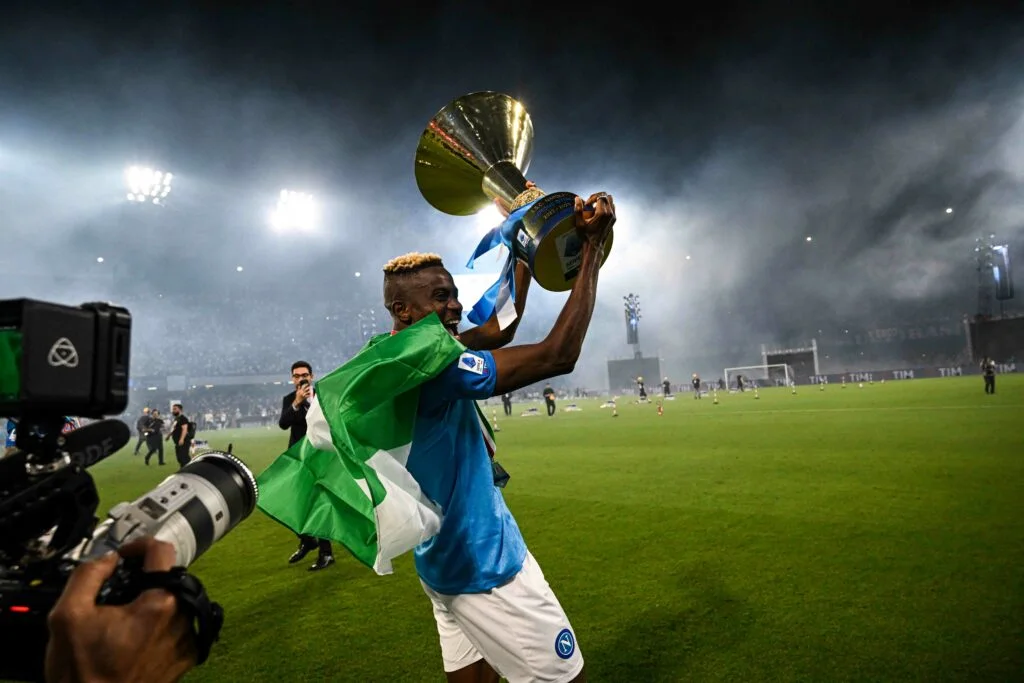
Napoli's season review records 26 Serie A goals for Osimhen and 12 for Kvaratskhelia. It also credits Osimhen with opening the scoring in ten league matches. The second figure sharpens the first: a breakthrough changes the conditions under which everyone else plays. Opponents chasing an equaliser may have to leave spaces that were unavailable at 0–0. A centre-forward's contribution therefore cannot be reduced to adding the finishing touch to situations that would have existed unchanged without him.
Kvaratskhelia's creative contribution becomes easier to understand through a specific example. In its technical analysis of Napoli's 4–2 win over Ajax in October 2022, UEFA describes the winger combining with Piotr Zieliński before supplying Giacomo Raspadori for the second goal. Its observers emphasise Napoli's width, supporting full-backs and midfield combinations. This is a Champions League illustration of the team's attacking mechanisms, not a Serie A statistical sample. It shows why the player delivering the final shot is only one part of the story.
Osimhen supplied another kind of threat in that same European match, pressing Daley Blind into losing possession before scoring late on. That episode is a useful counterweight to the lazy description of an elite scorer as merely a penalty-box passenger. Equally, a winger who attracts defensive attention need not register the last pass to have improved the eventual chance. The analytical task is to trace the sequence: who stretches the back line, who forces an opponent to turn, who opens the passing lane and who executes under pressure?
None of those observations proves exactly why every AIC voter preferred Osimhen or reproduces the league's complete evaluation of Kvaratskhelia. They explain why the two outcomes are football-compatible. Napoli did not win because one star was valuable and the other was replaceable. Their different threats complicated the same defensive problem. Choose a player by goals alone and you miss part of that relationship; choose only the most eye-catching dribbler and you risk overlooking the movement and finishing that make his work pay. The awards split is an invitation to examine those complementary roles, not evidence that one trophy must be illegitimate.
Dimarco in 2025–26: a creator does not have to play centrally
Federico Dimarco's 2025–26 recognition makes a different point. The league's best overall player was a left-sided specialist whose influence ran through delivery, movement and the ability to make Inter dangerous from wide positions. In its MVP announcement, Lega Serie A cited six goals and 18 assists. Those are the figures quoted at the award's announcement, not a claim here about a subsequently reconciled final-season total. The Italian notice explicitly says the evaluation excluded Matchday 38.
How a wide player becomes the creative hub
The important football point is not that an attacking wing-back should be compared with a centre-forward as if they were doing the same job. It is that a team's creative hub can operate beside the touchline. A wide player can give the ball-carrier an outlet, provide the pass that changes the direction of an attack and deliver into the box without having to occupy the central number-ten space. His starting position may be peripheral on a formation graphic while his influence on the sequence is anything but peripheral.
Inter's review of Dimarco's season offers a useful match example against Pisa at San Siro. It describes Inter trailing by two goals inside 23 minutes, Dimarco entering in the 34th minute and the side recovering to lead 3–2 at half-time. After Piotr Zieliński's penalty, crosses from Dimarco supplied headed goals for Lautaro Martínez and Francesco Pio Esposito. The club's account is celebratory, but the actions it identifies are concrete: changing the delivery from the flank changed the quality of service available to the forwards.
For a defender, repeated accurate service creates an awkward choice. Close the wide player aggressively and space can open behind the pressing player; remain narrow to protect the box and the passer has more time to select a target. Aerial targets then make the timing of that decision expensive. This is an explanation of the mechanism illustrated by those crosses, not a claim that every opponent defended Dimarco identically or that every delivery had the same outcome. Quality still depends on the receiver's movement and finish.
What the two awards recognise
Those actions also help explain why the league examines more than goals and assists. It names Kama Sport analysis using Hawk-Eye tracking and describes consideration of positional information alongside technical events. That supports looking beyond the last touch, but it does not provide a public licence to invent individual weighting scores. Off-ball positioning can make the next pass possible; it cannot be translated into an exact award margin unless that margin is actually published. The useful lesson for supporters is to watch the preparation for the cross as well as the cross itself.
By early September, Dimarco had also received AIC's overall award. The association's 4 September interview confirms that recognition for 2025–26. Here the two organisers converged. Their agreement strengthens the historical picture of an exceptional season without making either award a substitute for analysis. The interesting story remains how a player working from the left gave Inter a recurring route to dangerous chances, and how that contribution became substantial enough to stand alongside the achievements of the league's most prominent scorers.
How to read an award without confusing it with a ranking
Separate categories and match awards
Best Overall, Best Striker and top scorer are three different labels. In 2023–24, Lautaro Martínez won the overall league MVP and topped the scoring chart with 24 goals, while Dušan Vlahović received the Best Striker award. The league's own review identifies both awards explicitly. A list that substitutes Vlahović for Lautaro because it found an official striker announcement has not discovered an alternative overall winner. It has moved a recipient from one category into another.
The same discipline applies to the word MVP on a club website. After Inter's January 2021 Coppa Italia victory at Fiorentina, a club supporters' poll selected Andrea Ranocchia ahead of Lukaku as that match's MVP. That is a perfectly intelligible result for a different electorate, event and timeframe. Neither the club badge nor the familiar abbreviation turns it into the league's annual award. Monthly awards, match awards and fan votes can enrich a player's season without being interchangeable entries in the same honours list.
Methods, samples and present form
Identifying the right trophy settles the label, but comparing performances still requires care with methodology. Inter's announcement of Lukaku's 2020–21 league MVP described Stats Perform analysis using Netco Sports tracking and said Serie A, the domestic cup and Supercup were included in the calculation. The 2026 league notice instead identifies Kama Sport and Hawk-Eye, with the final league matchday excluded. The award's continuing name therefore does not guarantee an identical data supplier or competition sample. Compare recognised achievement across years, but do not pretend the underlying inputs are automatically a single unchanged experiment.
For an independent football judgement, start with what you are trying to reward. Total output captures availability and sustained contribution. Per-minute production can highlight exceptional quality in a smaller sample, but it does not replace the missing minutes. A striker's goals should be read alongside the chances supplied to him; a creator's assists depend partly on teammates converting the chances. For a defender, the absence of a shot can be evidence of successful positioning rather than an absence of work. These questions are analytical tools, not a claim to reproduce either organiser's formula.
Finally, keep historical recognition separate from present form. Winning the 2023–24 award is a permanent fact about that campaign, not a promise that the recipient is the league's best player on every later weekend. Current Serie A results and performances belong to a new assessment. A good winners list preserves the achievement accurately; a good football argument explains the role, circumstances and repeated actions behind it. Naming the organiser and season first leaves room for disagreement about the football without arguing over two different trophies by accident.
Join the discussion
Comments
Sign in with Google to comment. Keep the conversation useful and football-focused. New comments are reviewed before they appear.
Loading comments…