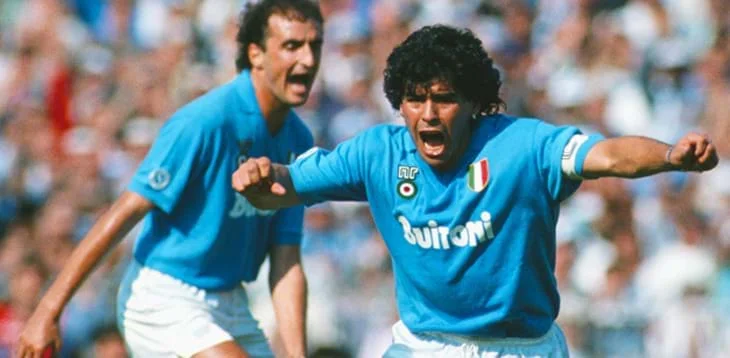
Diego Maradona leads this editorial ranking of the best Serie A players of all time, ahead of Paolo Maldini, Franco Baresi and Gianluigi Buffon. The twenty places assess performances in the Italian league: sustained influence, exceptional peaks and contribution within each player’s role. International honours and success in other leagues are outside the comparison.
A ranking of what players did in Serie A
This is an editorial ranking of men's Serie A performances, with Diego Maradona first. It evaluates the league careers of twenty players rather than ranking everyone who briefly appeared in Italy by their worldwide fame. International trophies and performances for clubs abroad do not supply extra league credit. The focus is what the player repeatedly gave to teams competing in Serie A.
The criteria, in order of importance, are influence on the team's league performance, sustained excellence in Italy, the level reached at the player's peak and the demands of his role. These are football judgements, not a fabricated points model. A defensive organiser must be considered through decisions that limit danger, while a creator must be considered through the chances and scoring positions he helps produce.
Championships support a case but cannot settle it. The league's recognised club honours record identifies winning teams; it does not measure every player's contribution or penalise a great player for belonging to a less dominant club. The same principle keeps awarded and revoked titles clear without treating trophy totals as a substitute for performance.
| Rank | Player |
|---|---|
| 1 | Diego Maradona |
| 2 | Paolo Maldini |
| 3 | Franco Baresi |
| 4 | Gianluigi Buffon |
| 5 | Giuseppe Meazza |
| 6 | Francesco Totti |
| 7 | Roberto Baggio |
| 8 | Michel Platini |
| 9 | Gianni Rivera |
| 10 | Silvio Piola |
| 11 | Gunnar Nordahl |
| 12 | Marco van Basten |
| 13 | Andrea Pirlo |
| 14 | Alessandro Del Piero |
| 15 | Javier Zanetti |
| 16 | Luigi Riva |
| 17 | Omar Sívori |
| 18 | Ruud Gullit |
| 19 | Andriy Shevchenko |
| 20 | Gabriel Batistuta |
The profiles below are grouped by football role and historical context after the complete ranking. That lets the reader compare defenders with defenders and different creative roles with each other, while each numbered profile preserves the position in the twenty. Small changes between adjacent names are reasonable; the useful debate concerns the criteria and the evidence behind each choice.
Maradona changed Napoli’s competitive ceiling
1. Diego Maradona. His place at the top rests on his Napoli league career, not on automatically importing the 1986 World Cup into an Italian ranking. The FIGC biography describes the club reaching a previously unfamiliar competitive level during his seven seasons. Napoli's first two championships, in 1986–87 and 1989–90, give that influence a concrete league outcome.
His 81 Serie A goals in 188 appearances, recorded in the league statistical dataset, are only part of the case. A creative attacker can shape a possession by receiving under pressure, drawing another defender and releasing a teammate before the final shot. Counting only the finish would omit much of what makes that role valuable. The same limitation applies to any attempt to judge him entirely by his number of championship medals.
Maradona's influence should still be understood within a team. Napoli also required defenders, midfielders and other forwards capable of turning openings into sustained league results. Calling either title a one-man achievement would erase the collective conditions that allowed an exceptional player to matter. The stronger claim is that Maradona changed what a credible Napoli challenge could look like, while functioning inside a side good enough to complete it.
That distinction separates this first place from pure fame. Several players below supplied longer Italian careers or more repeated championships. Maradona's case combines a remarkable level of individual attacking authority with the transformation of his club's league standing. This ranking gives that combination slightly more weight than longevity alone. A reader favouring twenty years of defensive excellence could reasonably move Maldini ahead, but would be making a different emphasis explicit.
The comparison remains a judgement rather than an official award. It is supported by a specific league career and a clearly identified team impact, with his achievements elsewhere kept outside the calculation. That produces a more defensible first-place choice than beginning with a worldwide greatest-player list and assuming its order must remain the same when the competition changes.
The defensive standard: Maldini, Baresi and Buffon
2. Paolo Maldini
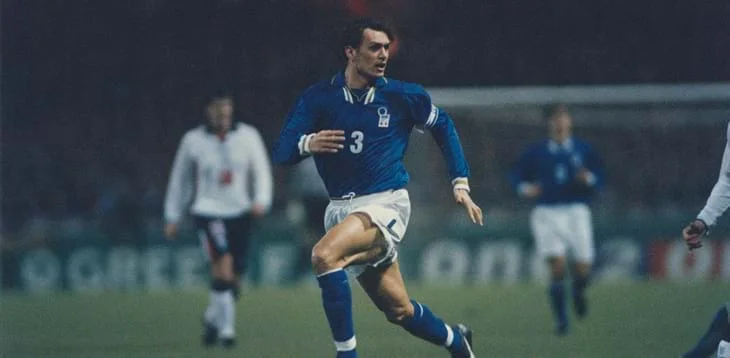
Maldini's Milan career record identifies 647 Serie A appearances across a career beginning in January 1985. His seven league titles accompanied a transition from left-back to central defensive responsibility. That matters more here than counting European finals: he supplied excellent defending over several league generations rather than relying on one particularly celebrated tournament.
His second place rewards the combination of individual quality and adaptability. A full-back must judge the winger's threat and the space behind him; a central defender must manage different distances and relationships. Maldini's career sustained value across those demands. He is narrowly behind Maradona because this ranking gives the Napoli transformation greater weight, while the longevity argument strongly favours Maldini.
3. Franco Baresi
The FIGC's Baresi biography records six championships and identifies his leadership of Milan's defence under Sacchi and Capello. He helped make a collective defensive unit more than a collection of strong tacklers. Organising the line and judging the moment to advance or cover affect the situations in which every teammate must defend.
Baresi's place recognises that influence rather than rewarding a centre-back for attacking statistics he was never selected to accumulate. His league story also crosses Milan's relegations and return to dominance. The Serie B seasons do not add Serie A achievement, but the surrounding career shows how his value survived a profound change in the club's competitive position.
4. Gianluigi Buffon
Buffon's ten recognised league championships span early Juventus success and the later dynasty, with his Parma years establishing the first part of an exceptional Serie A career. The FIGC career account confirms the championship record. His case combines longevity with the goalkeeper's requirement to make accurate, consequential decisions when a match may offer very few chances to correct an error.
His role eventually changed from first choice to supporting Szczęsny after returning in 2019. That later chapter does not define his peak, but it prevents the entire career from being described as one unchanging workload. Fourth place reflects the sustained league standard before that transition, with titles providing context rather than a claim that every winning season contained identical individual responsibility.
The early giants: Meazza, Piola and Nordahl
5. Giuseppe Meazza
Meazza scored 31 goals in 33 appearances when Ambrosiana-Inter won the first single-division championship in 1929–30. The club's official season record identifies his eleven-goal advantage over the next scorer. Fifth place reflects that commanding league peak and his wider importance to Inter's attack, rather than relying on the stadium that later bore his name.
Meazza belongs high in a league ranking because historical influence does not begin with television coverage. His first Serie A season supplied a measurable example of separation from contemporaries. It is less useful to imagine how he would fit into a present-day formation than to recognise how strongly he shaped the competition he actually played in.
10. Silvio Piola
Piola's 274 Serie A goals remain the league's outstanding career scoring benchmark. The FIGC retrospective preserves that record. It provides a substantial case without needing to import his international goals into the league total or require a championship medal as an entry ticket.
Tenth place recognises sustained scoring across several club environments. A forward repeatedly finding a way to score as teammates and circumstances change demonstrates something different from a short period inside one dominant team. Piola's finishing record carries that argument. His placing below some creators reflects their broader influence on the team's attacking possibilities, not a denial of his unmatched accumulation.
11. Gunnar Nordahl
Nordahl's Milan profile separates 210 league goals for the club from 221 in all competitions and records five league top-scorer awards. The competition distinction is essential: the all-competition total is not his Serie A tally. Repeatedly leading the league's scoring provides stronger evidence than a single season of remarkable finishing.
His place also rewards the sustained central threat he supplied to Milan's Swedish partnership. A productive centre-forward gives creators a reference for the final pass and forces defenders to protect the space he wants to finish in. Nordahl's scoring frequency and repeated league-leading seasons support that effect. He sits close to Piola because both cases are substantial, with longevity favouring Piola and scoring intensity strengthening Nordahl.
Four ways to play the number ten role
6. Francesco Totti
Totti's Roma scoring retrospective records 250 Serie A goals, all for the same club. His sixth place combines that extraordinary accumulation with the ability to shape an attack before the finish. Receiving between lines, releasing a runner and arriving to score are connected responsibilities; his career cannot be adequately described by treating the creator and scorer as separate people.
Roma's 2000–01 championship supplies a concrete high point, while the long career either side of it strengthens the case. Totti ranks above several players with more titles because his value was sustained within a club that did not win the league repeatedly. The number of winning opportunities should not be confused with the level of his contribution.
7. Roberto Baggio
The FIGC biography gives Baggio 205 league goals across six Serie A clubs. That range of environments distinguishes him from Totti. His technical authority and scoring remained relevant when the surrounding side changed, so the league case extends beyond the Juventus period associated with his most celebrated individual awards.
Seventh place recognises a creative forward who could solve the last defensive line through a pass or through his own finish. The ability to keep both options alive changes how defenders approach him. Totti's longer single-club accumulation narrowly wins the comparison here; Baggio's portability and peak make the gap small rather than decisive.
8. Michel Platini
Platini won three consecutive Italian golden boots during five Juventus seasons, confirmed by the club museum record. An attacking midfielder repeatedly leading the league's scorers is a particularly strong league-specific achievement. His two championships support the case, while the three European individual awards remain separate recognition rather than extra Serie A goals.
His eighth place is a deliberate trade-off between an exceptional concentrated peak and the longer Italian careers above him. A ranking weighted more heavily toward the best three seasons would move him upward. This one retains substantial value for sustained league service while acknowledging how unusual it was to combine midfield creation with repeated scoring supremacy.
9. Gianni Rivera
Rivera's Milan profile distinguishes 501 league appearances and 122 league goals from his larger all-competition totals. His ninth place rewards the long-lived attacking organiser, rather than using his Ballon d'Or as the whole argument. He supplied a creative reference across several Milan teams and stages of the club's league history.
The comparison with Platini makes the criteria visible. Rivera's duration is stronger; Platini's repeated league-leading scoring gives his peak the narrow advantage. They illustrate different ways a midfielder can influence an attack, which is why counting only goals or only years would produce an incomplete comparison of their Serie A value.
Foreign forwards: peak, movement and sustained goals
12. Marco van Basten
Van Basten's Milan record gives 90 Serie A goals in 147 appearances and two league top-scorer awards. Twelfth place values the level of his finishing and the way a technically complete centre-forward could connect Milan's attack. His goals were the endpoint of moves in which his touch and choice of position could also make the final delivery easier.
His shorter Italian playing span is the reason he does not rise further in this particular twenty. The ranking does not invent the seasons he might have supplied without injury. A peak-focused list could place him considerably higher; a league-career comparison must also account for the completed body of work beside players who maintained a major Italian role for longer.
19. Andriy Shevchenko
Shevchenko's club profile records 127 Serie A goals. That league total, rather than a larger all-competition count, anchors his place. His case combines repeated scoring with the threat created by movement across the defensive line. A forward who can attack a different channel changes the angle and timing of the pass his teammates can attempt.
Nineteenth place gives him credit for sustained high-level Italian finishing while acknowledging the deeper creative or defensive influence claimed by several players above him. The comparison with Van Basten separates two excellent Milan forwards: Van Basten's peak has the stronger claim here, while Shevchenko's larger league accumulation demonstrates the value of a longer productive span.
20. Gabriel Batistuta
Batistuta's Roma Hall of Fame account identifies 20 goals in 28 league appearances during the 2000–01 championship. UEFA's retrospective of the final day places his twentieth in the 3–1 victory over Parma. The title season made a concrete difference to Roma's outcome after his long period as Fiorentina's scoring reference.
His final place rewards a career in which direct scoring authority survived a change of club and attacking partners. It does not require calling powerful finishing a lesser skill than creation. The separation concerns the overall league contribution and the range of ways the player shaped his team's play; Batistuta's sustained goals still make him a strong and defensible final selection.
Long careers with changing responsibilities
Longevity is valuable when a player keeps solving a team’s problems. These three careers show different versions of that achievement: a creator who found a deeper position, a forward who adjusted to a changing attack, and a captain whose usefulness extended across positions and managerial systems.
13. Andrea Pirlo
Pirlo’s six league championships came in two very different environments: two with Milan and four with Juventus. His importance was not confined to supplying the final pass. From a deep position he could receive under pressure, move the ball away from a crowded flank and put an attacking teammate into space before the opposing midfield reorganised. The FIGC profile records 510 Serie A appearances and those six titles, giving the artistic reputation a substantial league foundation.
He ranks below the dominant defenders and forwards here because controlling possession is only one part of a team’s success. It requires runners, protection and coordinated movement around the passer. Yet repeating that influence after moving from Milan to Juventus is a powerful argument for Pirlo: his contribution survived a change of teammates and a new structure. That makes him more than a symbol of one particularly talented Milan side.
14. Alessandro Del Piero
Del Piero offered Juventus a forward who could connect midfield and attack as well as finish moves. His judgement near the penalty area, ability to combine with a strike partner and threat from dead balls made him useful even when he was not the fastest attacker on the pitch. This ranking counts six recognised Serie A championships. Juventus’s museum page includes the two subsequently revoked titles in its larger club tribute, so its championship figure needs that qualification.
The museum’s 705 appearances and 290 goals are also figures across competitions, not Serie A totals. The distinction matters in an assessment restricted to the league. Del Piero’s case rests on years of influence in successful Juventus attacks and his ability to remain a central creative presence as teammates and coaches changed. Staying with the club through its relegation adds context to his story, but Serie B achievements are not points in this ranking.
15. Javier Zanetti
Zanetti’s five league championships belong to the successful final stretch of a much longer Inter career. The club’s Hall of Fame profile describes the combination that made him dependable: stamina, ball carrying, tactical intelligence and the ability to play in defence or midfield. Its 858 appearances cover all competitions and should not be presented as a Serie A record.
He could advance the ball without turning every possession into a risky dribble, then recover into a position that preserved the team’s shape. Those repeatable decisions are less spectacular than a forward’s best goals but valuable across a long campaign. Placing him fifteenth recognises that lasting influence while leaving the highest positions to players who established a stronger claim to being the defining performer of their league era.
The final three choices and the hardest omissions
The closing places reward three different contributions to Italian league football. Riva helped an island club become champion, Sívori supplied an exceptional attacking imagination and Gullit brought power and versatility to a transformed Milan. Their positions are close enough that a different emphasis on peak performance could reasonably change the order.
16. Luigi Riva
Riva’s strongest argument is the 1969–70 championship with Cagliari. This was a striker helping a club outside the usual centres of league power reach the summit. His pace, strength and left foot gave Cagliari a decisive attacking weapon, but his ranking is supported by repeat achievement rather than one romantic season. The FIGC biography records three Serie A scoring titles, in 1967, 1969 and 1970.
Riva therefore combines a historic team result with evidence that he was a leading league scorer before the championship arrived. His Italy scoring record is famous, but it is outside the criteria used here. Sixteenth recognises his exceptional influence at Cagliari while acknowledging that the players above him generally offered a longer span of dominance or a broader influence on how their league teams played.
17. Omar Sívori
Sívori’s changes of direction and willingness to take on defenders gave Juventus an attacker who could disturb a settled defence. The Juventus museum profile connects that creativity to three championships, rather than describing entertainment without a competitive result. His combination of invention and scoring puts him comfortably in this twenty.
Some famous career figures for Sívori include cup matches, so the museum’s goal total is not reproduced here as a Serie A number. The relevant comparison is his role in successful Juventus attacks: he could create a chance through an individual action when a passing move had stalled. That separates his contribution from a striker whose principal responsibility was finishing service supplied by others.
18. Ruud Gullit
Gullit gave Milan an unusual range of attacking options. He could win an aerial contest, carry the ball through contact or move into a position that opened space for another forward. Milan’s official player profile separates his 125 league appearances and 38 league goals from his larger totals across competitions, and records three Scudetti.
His eighteenth place reflects the smaller league body of work compared with many players above him, particularly his Milan teammates Maldini and Baresi. It does not imply that his best football was ordinary. In a ranking limited to the most influential individual peaks, his physical and technical combination would justify moving him considerably higher.
Why Ronaldo, Zidane and Cristiano Ronaldo miss this twenty
Brazilian Ronaldo is the most uncomfortable omission when peak ability receives greater weight. Inter’s 1997–98 season review distinguishes his 25 Serie A goals from 34 across competitions. That first league campaign is an outstanding piece of evidence. This list gives more weight to sustained league influence, which favours forwards who repeatedly delivered across a longer run of Italian seasons.
Zidane’s five-season Juventus spell also has a substantial claim. The club’s farewell retrospective establishes its duration. The editorial choice here favours Platini’s repeated scoring dominance and Pirlo’s longer influence across two championship teams. Zidane’s international reputation and later achievements in Spain cannot settle an Italian league comparison.
Cristiano Ronaldo scored 81 league goals during his Juventus period, as the club’s departure announcement explains separately from his 101 goals across competitions. His scoring output would support inclusion in a list that prioritises efficiency or recent peaks. Three Italian seasons carry less weight in this assessment than the accumulated Serie A work of the selected twenty. Readers who value peak more heavily can move these candidates into the list without changing the underlying league facts.
Join the discussion
Comments
Sign in with Google to comment. Keep the conversation useful and football-focused. New comments are reviewed before they appear.
Loading comments…