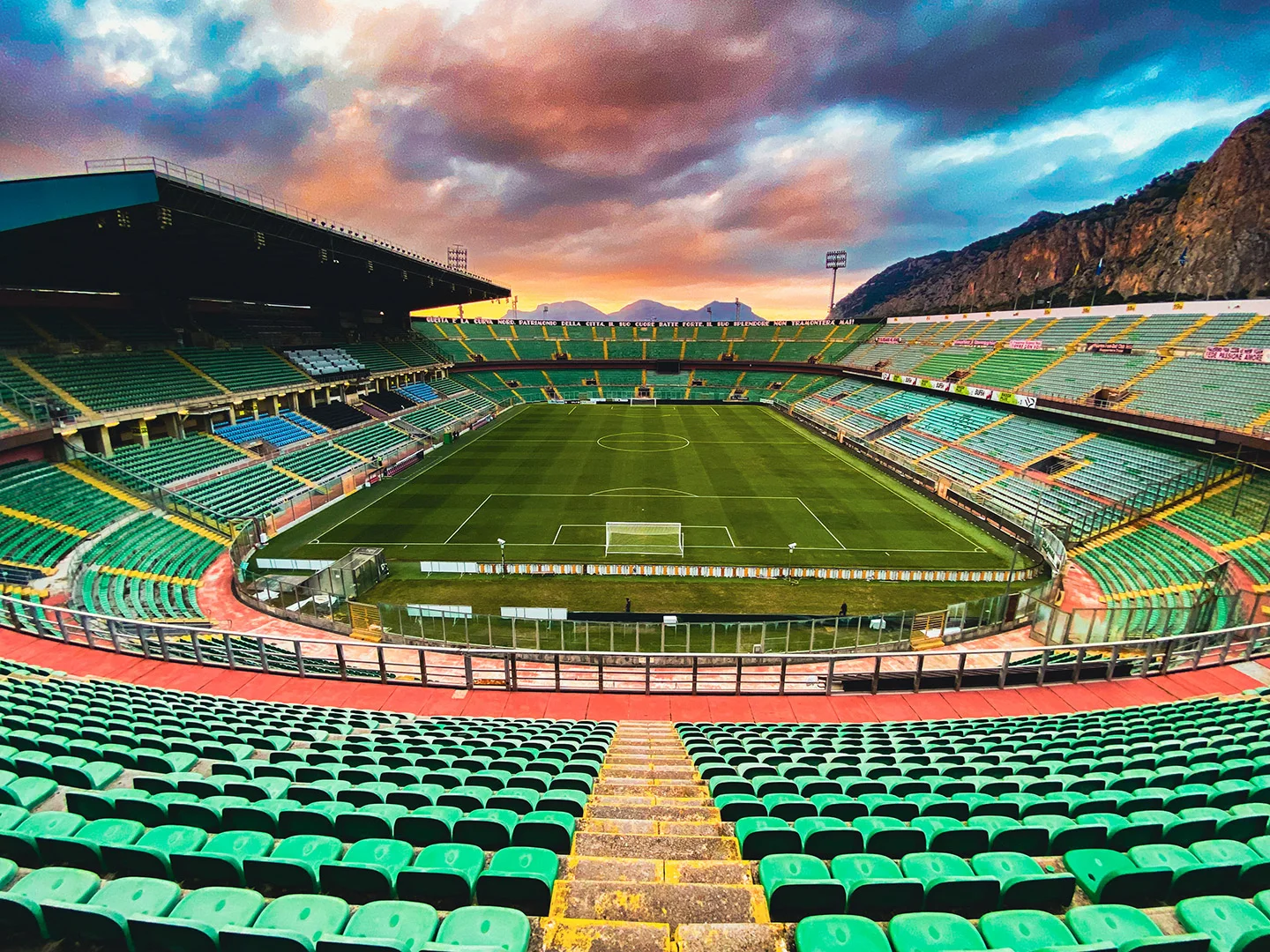
The Serie B teams map for 2026-27 contains 20 clubs, from Sudtirol in Bolzano to Palermo in Sicily. This guide pairs an accurate city map with every club and home ground, explains the main regional clusters, and shows how to turn the geography into a practical matchday trip.
The 20 Serie B clubs and their home grounds
Serie B in 2026-27 stretches from Bolzano in the Alpine north to Palermo in Sicily. The official Lega B club directory confirms 20 participants. Tuscany has four, Veneto and Campania three each, and the remaining clubs extend the competition across northern, central and southern Italy. A map makes that spread easier to understand than an alphabetical list alone.
The numbered markers below represent the clubs' home cities, using retrieved OpenStreetMap coordinates. They are a geographical overview, not stadium entrances, railway stations or road routes. The accompanying table identifies the actual home grounds and links to club or local venue information. That distinction matters when a ground is away from a historic centre or when a ticket directs you to a particular side of the building.
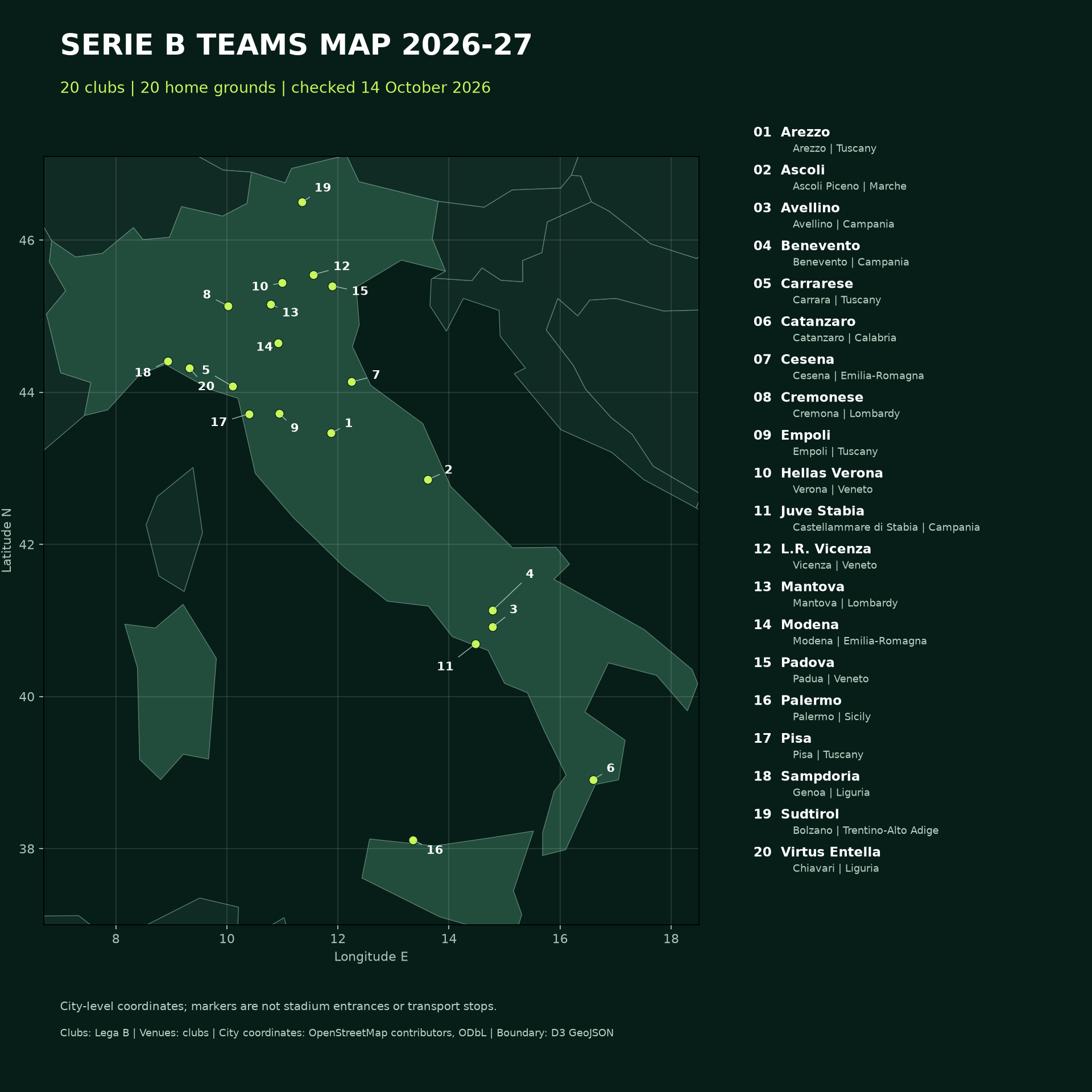
| Map | Club | City | Home ground |
|---|---|---|---|
| 1 | Arezzo | Arezzo | Citta di Arezzo |
| 2 | Ascoli | Ascoli Piceno | Cino e Lillo Del Duca |
| 3 | Avellino | Avellino | Partenio-Adriano Lombardi |
| 4 | Benevento | Benevento | Ciro Vigorito |
| 5 | Carrarese | Carrara | Dei Marmi |
| 6 | Catanzaro | Catanzaro | Nicola Ceravolo |
| 7 | Cesena | Cesena | Orogel Stadium - Dino Manuzzi |
| 8 | Cremonese | Cremona | Giovanni Zini |
| 9 | Empoli | Empoli | Carlo Castellani - Computer Gross Arena |
| 10 | Hellas Verona | Verona | Marcantonio Bentegodi |
| 11 | Juve Stabia | Castellammare di Stabia | Romeo Menti |
| 12 | L.R. Vicenza | Vicenza | Romeo Menti |
| 13 | Mantova | Mantova | Danilo Martelli - Pata Stadium |
| 14 | Modena | Modena | Alberto Braglia |
| 15 | Padova | Padua | Euganeo |
| 16 | Palermo | Palermo | Renzo Barbera |
| 17 | Pisa | Pisa | Arena Garibaldi - Romeo Anconetani / Cetilar Arena |
| 18 | Sampdoria | Genoa | Luigi Ferraris |
| 19 | Sudtirol | Bolzano | Druso |
| 20 | Virtus Entella | Chiavari | Enrico Sannazzari |
Several names deserve a little care. Juve Stabia's Romeo Menti is in Castellammare di Stabia, while L.R. Vicenza's ground with the same name is in Vicenza. Searching the stadium name without its city can therefore send you to the wrong part of Italy. Pisa's Cetilar Arena is the Arena Garibaldi, rather than a separate second venue. Entella's ground in Chiavari is now named for Enrico Sannazzari.
This is the 2026-27 membership, checked on 14 October 2026. A map from the previous season can still be useful history, but promotion and relegation change which clubs belong to the division. Familiar Serie B names from 2025-26 should not be carried into this list automatically. In particular, the present roster does not include a club based in Rome, Naples or Sardinia.
The ground names in the table also do a different job from capacity rankings. A stadium's advertised capacity can differ from the number of places available for a particular fixture, especially during works or when sections are closed. The identity and location of the venue give a dependable starting point; a match's ticket release supplies the actual sectors available.
For a football trip, read the map at two scales. The national view helps choose a region and recognise the long journeys. The club's own stadium information then handles the local approach. Keeping those scales separate makes the geography useful without pretending a single static picture can replace the details of a matchday.
The northern arc: Alpine, Venetian and Po Valley football
The northern part of the map is compact compared with the league's full national spread, but it contains several different football settings. Bolzano belongs to an Alpine context. Verona, Vicenza and Padua form a Veneto group farther south and east. Cremona, Mantova, Modena and Cesena bring the map into the broad northern plain, while Genoa and Chiavari sit on the Ligurian coast. “Northern Italy” is therefore a starting description, not a single interchangeable destination.
Bolzano and the Veneto triangle
Sudtirol's home city, Bolzano, is the northernmost marker in this season's list. Its Druso stadium places second-tier football in a setting quite different from the coastal and southern grounds. The city's Italian and German naming traditions also explain why a visitor may see Bolzano and Bozen used for the same place. That is a local language distinction, not evidence of two clubs or two stadium cities.
The Veneto trio gives the map another useful shape. Hellas Verona play at the Bentegodi, L.R. Vicenza at the Romeo Menti and Padova at the Euganeo. Each is a separate city with its own club identity. A regional grouping makes them natural candidates to consider together when looking at the schedule, but it does not make every pairing a practical same-day visit. The actual dates and the journey back after an evening match still need to fit.
Vicenza's own stadium description emphasises a ground integrated into the urban area and close to the playing surface. Verona's current Bentegodi information supplies season-specific access arrangements. Those differences are part of why two nearby markers can offer distinct visits: the experience depends on the building and its local approach, not just on being in the same region.
Lombardy, Emilia-Romagna and Liguria
Cremonese and Mantova are the two Lombardy participants, while Modena and Cesena represent Emilia-Romagna. The map separates these clubs from the much larger idea of “football in Milan”. A visitor drawn to the second tier is following provincial and city institutions with their own grounds, rather than simply adding another metropolitan club to a familiar Serie A itinerary.
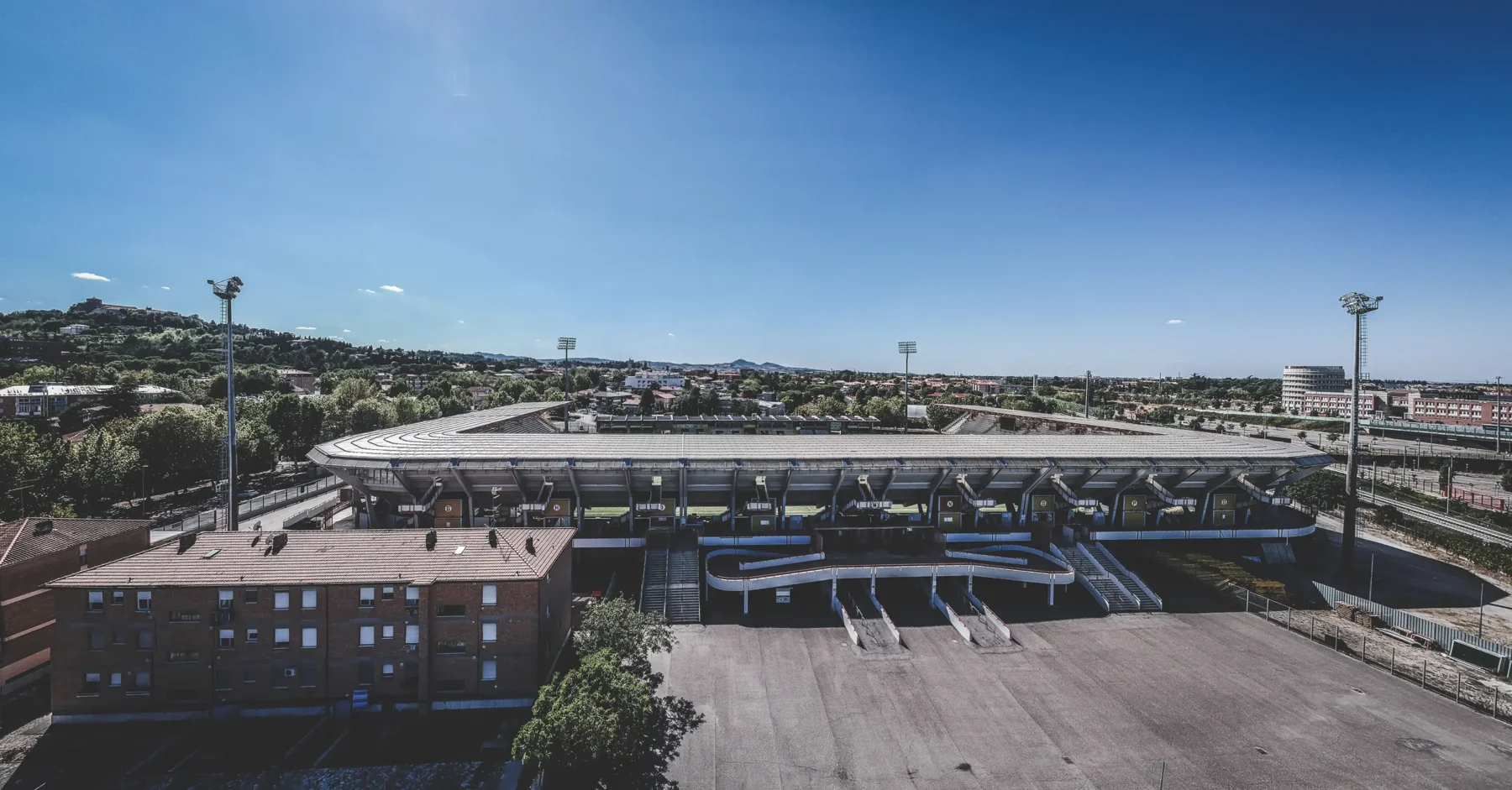
Modena's Braglia page identifies its address on Viale Monte Kosica. Cesena's Orogel Stadium - Dino Manuzzi page describes the covered stands and curves that shape the matchday setting. These venue descriptions add something an abstract point cannot show: how a ground sits in the city and how its structure frames the football.
Liguria's two clubs occupy different municipalities along the coast. Sampdoria are based in Genoa and use the Luigi Ferraris; Virtus Entella are in Chiavari. Putting both under a broad “Genoa area” label would lose a meaningful local distinction. The coastal cluster is useful for choosing a wider base, while the club city and stadium information identify where the match actually takes place. The same principle applies across the northern arc: proximity is an invitation to compare possible fixtures, rather than a promise that every route is short or simple.
Tuscany and the central corridor
Tuscany is the most represented region in the official 2026-27 membership, with four clubs. That gives the central part of the map a useful concentration, but it also shows why a regional label is not precise enough for a football visit. Carrara, Pisa, Empoli and Arezzo are different bases, with their own grounds and different positions relative to the coast and the inland corridor.
Four Tuscan clubs, four different bases
Carrarese play in Carrara, where the Dei Marmi name is closely associated with the club's ground. The club's stadium history also records the temporary use of Pisa's Arena Garibaldi after promotion while works took place at home. That is useful historical context because an older fixture record or photograph may place Carrarese in Pisa. It does not make Pisa the club's current home city or justify merging the two markers.
Pisa's official Cetilar Arena page explains that the named venue is the Arena Garibaldi. A sponsored name and a historic name can coexist in everyday use, and a map works best when it helps the visitor recognise both. There is no need to search for a second stadium simply because a ticket and an older travel article use different labels.
Empoli's Carlo Castellani - Computer Gross Arena adds another example of a historic name alongside a commercial one. Arezzo, farther inland, uses the Citta di Arezzo stadium. The four-club grouping offers variety within one region: a trip can centre on a specific club or compare two different matchday settings if the calendar allows. The map suggests the geography, while the fixtures determine whether that idea can become an actual itinerary.
The important distinction is between being in Tuscany and being near the ground you intend to visit. A base chosen for general sightseeing may still require a separate journey to the football city and another local approach to its stadium. The location of the club should therefore be considered before the accommodation is fixed, especially when the match could be scheduled in the evening.
Ascoli occupies a different part of central Italy. Its city is Ascoli Piceno in Marche, and the home ground is the Cino e Lillo Del Duca. It belongs on the eastern side of this map's central corridor rather than inside the Tuscan cluster. The full city name is valuable here: a shortened “Ascoli” can be familiar in football conversation, but the precise destination is what a traveller needs.
A central-Italy grouping therefore has two uses. It shows where several second-tier clubs can be considered within a wider regional trip, and it warns against flattening the peninsula into a single route. Crossing from one side to the other is a transport question, not a line drawn across the map. Choose the football destination first, then verify the actual connection and the return after the scheduled kick-off.
Campania, Calabria and Palermo: the southern journey
The southern group begins with three Campania clubs, but none of their home cities is Naples. Avellino, Benevento and Juve Stabia belong to distinct municipalities and different local settings. Avellino and Benevento are inland; Juve Stabia are in Castellammare di Stabia. A visitor using Naples as a wider regional base still needs to identify the exact football destination and the ground's local approach.
Avellino's club history describes the Partenio ground and its later dedication to Adriano Lombardi. Benevento's official facilities page places the Ciro Vigorito on Via Santa Colomba. Juve Stabia's Romeo Menti is in Castellammare. Those names carry local history, but their practical value here is equally clear: they turn a broad regional marker into a specific club and venue.
Campania's three entries also demonstrate why football geography should begin with the city rather than the club's most familiar word. Juve Stabia is not a second Juventus in Turin, and the shared Menti stadium name does not place it in Vicenza. Club names, commemorative ground names and municipalities answer different parts of the visitor's question. Keeping all three together avoids mistakes that a simple search result can otherwise encourage.
Catanzaro takes the journey farther south into Calabria. The club's Ceravolo information identifies the stadium on Via Francesco Paglia. That ground belongs to the city context of Catanzaro, so accommodation described broadly by a provincial or coastal label should still be checked against the actual venue. The city marker identifies the football centre; it does not certify that every location carrying Catanzaro in its address is equally convenient.
Palermo is a different kind of boundary. Its Renzo Barbera ground is in Sicily, making it the only island destination in this season's official Serie B list. The map should not be read as if the sea between Sicily and the mainland were simply another stretch of road. A combined trip involving Palermo and a mainland club needs a real transport plan whose timing fits both matches.
The club's stadium history connects the Barbera with the Italia 90 period and its later football life. That gives the visit architectural and sporting context without making the ground a claim about current division status. An internationally familiar stadium can host second-tier football, just as a less globally known ground can have a deep local following. The division's map contains both kinds of recognition.
The southern stretch therefore changes the scale of the planning question. Two northern markers may prompt a comparison of nearby fixtures; Palermo and a distant mainland club may call for separate stages of a trip. Neither choice is inherently better. The important step is to let the actual geography shape the itinerary, rather than treating every pair of clubs in the same league as equally easy to connect.
Using the map to plan a football trip
A useful football map answers where clubs are based and how their locations relate to one another. It cannot settle every matchday detail. Once a region or club has caught your interest, the planning moves from the national picture to the actual fixture, stadium and ticket. Those details determine whether an attractive pairing of dots becomes a workable trip.
A city marker is not a stadium entrance
The map's coordinates are city reference points. Even a stadium-level marker would still be different from the entrance assigned to a ticket. Large grounds can have separate approaches for stands, visiting supporters and accessible seating. A route to the building's general location may therefore leave you on the wrong side for the sector you have bought.
Ascoli's official access information provides a concrete example by distinguishing sectors and a particular approach for supporters using wheelchairs. The relevant lesson is to read the club's instructions for your ticket and circumstances. A national map should not try to replace those locally specific arrangements or assume that every entrance has the same access.
Ground naming is another local check. A commercial name can sit alongside a traditional stadium name, and two cities can have grounds dedicated to the same person. Keep the club, municipality and venue together when searching for directions. The table's two Romeo Menti entries and Pisa's Cetilar Arena alias are reminders of how a familiar name can otherwise create a wrong destination.
Match dates, away allocations and the last leg
Use a confirmed fixture release for the day and kick-off, then the club's ticket notice for the sector offered. A season's list of opponents is not always the final travel date and time. The official Sampdoria ticket page, for example, connects sales information to specific fixtures rather than promising that every home match follows an identical pattern.
Visiting-supporter tickets and general home-area tickets can have different conditions. Capacity displayed on a stadium history page is not proof that a particular sector is available. The host club's current release is the useful source for the purchase being considered. If an away allocation is the goal, verify its actual terms before treating a seat elsewhere as a substitute.
Allow for the last part of the journey as well as the main connection between cities. Getting to Genoa, Palermo or Bolzano is only one step; reaching the ground and leaving after the final whistle are separate parts of the plan. An evening kick-off may fit the arrival but make the return less convenient. This article intentionally gives no unverified journey times: the actual transport timetable is what needs to support the match you choose.
Venue works can also change an otherwise familiar assumption. Modena's July 2026 Braglia announcement recorded works that affected a preseason match. That does not establish that the ground remained closed later, but it illustrates why a current club notice matters more than an undated itinerary. The map is the beginning of the football plan; the confirmed fixture and local stadium information make it concrete.
Join the discussion
Comments
Sign in with Google to comment. Keep the conversation useful and football-focused. New comments are reviewed before they appear.
Loading comments…