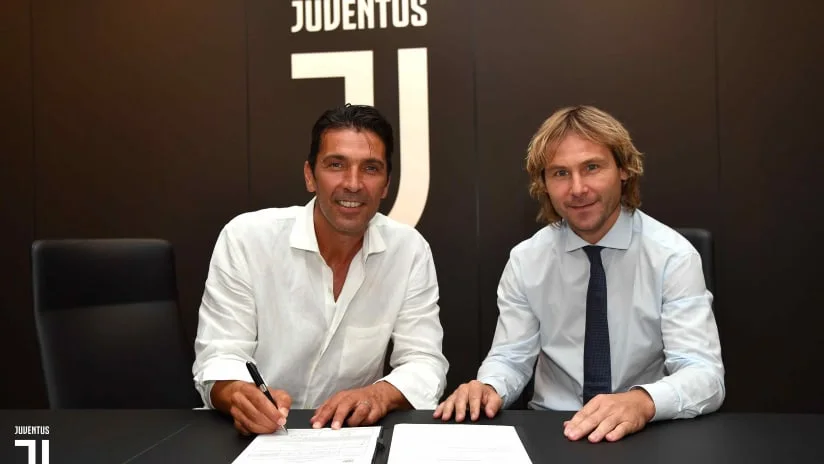
Gianluigi Buffon has won the most recognised Serie A titles by a player, with ten. Giorgio Chiellini and Leonardo Bonucci share the next tier on nine. This ranking explains the leading careers, the difference between consecutive and total titles, and why awarded championships and club celebration counts can produce different answers.
The leaderboard counts recognised championships
Gianluigi Buffon leads with ten recognised Serie A championships. Giorgio Chiellini and Leonardo Bonucci follow with nine. The next group, on eight, consists of Giovanni Ferrari, Giuseppe Furino and Andrea Barzagli. This is a ranking of Italian men's single-division Serie A titles won as players, beginning in 1929–30, through the completed 2025–26 season. A French championship, a Serie B promotion season or a trophy won later as a coach cannot increase this particular total.
The FIGC's Buffon biography identifies ten as the Italian record. For the other leading players, career honours must be read against the league's recognised Juventus championship seasons. That second check matters because some club celebrations retain the two championships removed following Calciopoli. A count can be internally consistent with a club's chosen language and still answer an official-record question incorrectly.
| Rank | Player | Titles | Winning clubs |
|---|---|---|---|
| 1 | Gianluigi Buffon | 10 | Juventus |
| =2 | Giorgio Chiellini | 9 | Juventus |
| =2 | Leonardo Bonucci | 9 | Inter, Juventus |
| =4 | Giovanni Ferrari | 8 | Juventus, Ambrosiana-Inter, Bologna |
| =4 | Giuseppe Furino | 8 | Juventus |
| =4 | Andrea Barzagli | 8 | Juventus |
| =7 | Roberto Bettega | 7 | Juventus |
| =7 | Gaetano Scirea | 7 | Juventus |
| =7 | Ciro Ferrara | 7 | Napoli, Juventus |
| =7 | Claudio Marchisio | 7 | Juventus |
| =7 | Stephan Lichtsteiner | 7 | Juventus |
| =7 | Paolo Maldini | 7 | AC Milan |
| =7 | Alessandro Costacurta | 7 | AC Milan |
Equal totals remain equal ranks. The table does not award Bonucci a higher place than Furino because his titles came more recently, or put an attacker above a defender because goals are easier to count. It also stops at the seven-title tier rather than presenting a selective six-title group as a complete ranking. Below that threshold, several famous careers create a much larger comparison; their absence here says nothing about their quality.
A championship belongs to a team, while a career honours total records a player's association with winning seasons. Those are related measurements, but neither tells us how many decisive interventions that player made. A first-choice goalkeeper, an injured captain and a rotation midfielder may share the same trophy without sharing the same workload. This article follows recognised career honours; it does not invent a minimum-minute rule and retroactively apply it to different eras.
The concentration of Juventus players therefore needs explanation rather than surprise. Long championship cycles create repeated opportunities for established players to accumulate titles. Staying in that squad still requires selection, fitness and usefulness, yet the club context remains part of the result. The most productive way to read this leaderboard is as a history of sustained winning careers, followed by the roles and choices that made those careers possible.
Buffon reached ten through two Juventus eras
The first two and the seven-year run
Buffon's recognised winning seasons are 2001–02, 2002–03, 2011–12, 2012–13, 2013–14, 2014–15, 2015–16, 2016–17, 2017–18 and 2019–20. The arithmetic is two early championships, seven consecutive ones and a final title after returning from France. Setting out the seasons resolves a common confusion: he has the largest career total, but he did not play in all nine seasons of Juventus's uninterrupted championship sequence.
The first title captures the importance of timing. Juventus's retrospective on 5 May 2002 describes a final day on which their win at Udinese combined with Inter's defeat at Lazio to change the championship outcome. A goalkeeper participates in that drama differently from the scorer whose celebration becomes the familiar image. Keeping the possibility of victory alive is part of the same result, even when it leaves a smaller footprint in a highlights reel.
Those early titles also prevent us from reducing Buffon's record to the later dynasty. He already possessed two recognised championships before the winning cycle that began in 2011–12. There was a long interruption between those sets of honours, including Juventus's season in Serie B. Career totals compress that interruption into a single number. Reading the seasons restores the difficulty of remaining relevant while a club changes personnel, expectations and competitive position.
The seven-title run then supplied the largest part of his total. A team's repeated success does not mean its goalkeeper encounters the same game every week. Defending a lead, maintaining concentration during long stretches without an intervention and responding when opponents finally reach the penalty area are different demands from playing behind a defence under constant pressure. The number ten records the outcomes; the long span of winning seasons indicates how often Buffon had to adapt his contribution.
The return that completed the record
Buffon spent 2018–19 at Paris Saint-Germain and returned to Juventus on 4 July 2019. The club's return announcement establishes that break in his Italian career. His French league title belongs in his wider honours record, but it cannot fill the missing Serie A season. Chiellini continued winning in Turin while Buffon was away, which is why the two players lead different comparisons.
On returning, Buffon explicitly accepted Wojciech Szczęsny as first-choice goalkeeper and Chiellini as captain in his first public comments. That is useful context for the tenth championship in 2019–20. It was a player's title earned within a changed role, rather than evidence that he remained the automatic starter throughout his career. Accepting that distinction makes the record more informative: continuity can involve supporting a successor as well as keeping him out of the side.
Chiellini and the uninterrupted nine
Chiellini is the player who connects every championship from 2011–12 to 2019–20. His nine recognised titles are all part of that single consecutive sequence. Juventus's 2022 farewell statistics explicitly list nine Scudetti. That makes him second on the career leaderboard and the central figure in the separate question of who lasted through all nine years of the club's run.
The difference from Buffon is instructive. The goalkeeper had earlier Juventus championships to add, but missed one year of the later sequence. Chiellini's nine are concentrated in it. A larger total and a longer uninterrupted streak consequently belong to different players. Neither record needs to be diminished to explain the other; they reward different forms of continuity, and they can coexist without changing the recognised championship list.
That continuity was also about changing responsibilities. By the final seasons of the run, Chiellini was captain rather than simply an established defender. Juventus's career retrospective traces that leadership period and recalls his winning goal at Parma on 24 August 2019, followed by a serious injury. The example guards against a misleading interpretation of nine trophies as nine seasons of identical availability. Team success continues through injuries and changes in the side.
For a defender, staying useful as teammates and coaches change involves understanding how a collective works. Holding a line, deciding when to confront an attacker and knowing when to protect a partner are relational tasks. A long championship run is therefore more than a test of isolated duels. It gives a veteran repeated occasions to transmit the defensive habits that younger players must learn, while still submitting his own performances to selection.
Chiellini's record also shows why counting staff roles together with player roles would confuse the comparison. Barzagli's later contribution away from the pitch cannot add a ninth playing championship to his eight. The relevant question is what a person won while belonging to the playing career being ranked. Clubs can commemorate a wider lifetime contribution; the leaderboard needs a narrower and consistent boundary.
There is a final caution when consulting official club material. Some Juventus pages give Chiellini ten by retaining 2005–06, whereas the farewell statistics give nine. The difference is a counting convention, not a tenth recognised post-2011 championship hidden somewhere in the calendar. For this table, the league's awarded record controls the total. Explaining the discrepancy is more useful to a reader than silently choosing whichever number appears first in a search result.
Eight-title careers across different eras
Ferrari won with three clubs
Giovanni Ferrari also belongs in the eight-title group. His route is exceptional: five consecutive championships with Juventus from 1930–31 to 1934–35, two with Ambrosiana-Inter in 1937–38 and 1939–40, and Bologna's 1940–41 championship. The FIGC museum biography gives his eight-title total and career sequence; Bologna's club history confirms its championship in the final season of that sequence.
Ferrari is why a record article needs to look beyond the television era. Excluding him would make the table appear cleaner, but would change an all-time question into a recent-history comparison. His championships also show that repeated domestic success can be portable. Eight titles with three clubs record both an outstanding Juventus cycle and further winning opportunities after leaving it. That differs substantially from accumulating eight within one continuous modern dynasty, even though both produce the same total.
Furino before the modern dynasty
Giuseppe Furino's eight championships belong to an earlier Juventus world. The club museum's career record credits eight, alongside a long career in midfield. Unlike the modern players, he did not accumulate them within the nine-season sequence that began in 2011–12. His total is evidence that the pathway to repeated success existed well before that exceptional period.
Furino offers a useful counterweight to a ranking dominated by recognisable modern faces. A midfielder's contribution can consist of making the space around more celebrated attackers usable: recovering possession, covering a teammate's advance and sustaining pressure without becoming the player who finishes the move. Goals and awards alone would struggle to represent those responsibilities. Championship totals at least retain the connection between that kind of work and repeated successful teams.
They still cannot quantify it precisely. Eight titles do not establish that Furino personally caused eight title victories, or provide a statistical model for comparing his tackling with a modern midfielder's pressing. His position in this list rests on the honours record. The football interpretation is that long-term squad value has several forms, and the player entrusted with less glamorous duties can share a sustained winning history with the side's leading scorer.
Barzagli and Bonucci in its defensive core
Barzagli won eight consecutive championships from 2011–12 to 2018–19. Juventus's museum entry confirms that total, while its 2016 contract-renewal report places his arrival in January 2011. His Italian title record consequently begins later in his career than Buffon's and ends before Juventus's ninth successive championship.
Bonucci also won eight at Juventus, but through two spells: six from 2011–12 through 2016–17, then 2018–19 and 2019–20. The August 2018 return announcement confirms the intervening year at Milan. This explains his Juventus total without treating a transfer as a lost trophy that can simply be restored retrospectively.
His complete recognised Serie A career total is nine, because it also includes Inter's awarded 2005–06 championship. The Inter archive records one league appearance in that season and none in 2006–07. He therefore belongs alongside Chiellini on nine, despite the Juventus retirement tribute naturally celebrating only the eight won with Juventus. A club-specific honours total and a career total answer different questions; counting the former as the latter would omit an important early season.
The shared defensive story should not erase those different paths. Barzagli's eight were uninterrupted, Bonucci's Juventus eight were interrupted, and Bonucci's career nine cross club boundaries. Their familiar partnership helps explain why they appear near each other; only the season-by-season record explains exactly where each belongs. That is the difference between using a nickname as shorthand for a successful defence and using evidence to rank its members.
The seven-title tier spans generations
Bettega, Scirea and Ferrara
Roberto Bettega and Gaetano Scirea each won seven recognised championships with Juventus. Their totals are confirmed in the club's Bettega retrospective and its tribute to Scirea. They show how an attacker and a defender can reach the same honours tier through roles that leave very different kinds of evidence in a match.
For Bettega, the connection between forward play and repeated winning teams is readily visible. Scirea requires the reader to value defensive decisions that may prevent a dangerous situation from becoming a shot at all. A title table cannot settle a comparison between them, but it can preserve both within the history of the successful team. Looking only for the leading goalscorer would give a narrower and less convincing account of that success.
Ciro Ferrara's seven divide into two with Napoli and five with Juventus. The FIGC's detailed career biography identifies the Napoli titles in 1987 and 1990 and the Juventus titles in 1995, 1997, 1998, 2002 and 2003. Here the championship's ending year is simply shorthand for its full season. The list demonstrates that a transfer need not reset a player's domestic honours.
Ferrara's career also warns against equating repeated titles with one permanent environment. Moving between winning clubs means establishing value within a different squad and its existing relationships. His seven are not seven Juventus titles, nor are the two Napoli championships a separate record that disappears after his transfer. The career ranking follows the player, while a club history correctly keeps those winning seasons apart.
Marchisio and Lichtsteiner
Claudio Marchisio and Stephan Lichtsteiner both won the first seven titles of Juventus's modern run, from 2011–12 through 2017–18. The Marchisio farewell and Lichtsteiner departure announcement record seven. Their inclusion should not depend on whether a fan's favourite memory is a midfielder's finish or a full-back's repeated advance along the flank.
Lichtsteiner's departure report notes 35 league appearances out of 38 in the unbeaten first title season. That provides a specific example of involvement behind the honours total. A right-sided defender supplies both a defensive reference and an outlet when the team moves forward. Availability gives those relationships time to settle; the trophy total then records the collective outcome, without pretending that a single appearance figure explains all of it.
Marchisio represents another route into the same winning cycle: a player whose association with the club grew through its own development system. The contrast with an arriving senior professional matters because championship squads are assembled from different career pathways. Seven titles can reward both long-established belonging and successful integration. Their identical number is a meeting point, rather than proof that their experiences or responsibilities were interchangeable.
Why familiar names can have different totals
Del Piero and the revoked championships
Alessandro Del Piero has six recognised Serie A titles: 1994–95, 1996–97, 1997–98, 2001–02, 2002–03 and 2011–12. Juventus's twentieth-anniversary career tribute describes eight, retaining 2004–05 and 2005–06. Removing those two from that club count produces the recognised six. This is why a search result for eight does not place him alongside Furino and Barzagli in the official-record table.
The distinction should be applied consistently rather than selectively. Buffon's recognised ten also exclude those two Juventus seasons; Chiellini's nine exclude 2005–06. Bonucci's Inter championship in 2005–06 is included because that title was awarded to Inter. Counting an awarded championship is different from restoring the removed Juventus claim. Readers need the awarded club and the applicable playing season, rather than a rule that indiscriminately discards every player's honours in that year.
Milan greats and winning with more than one club
Paolo Maldini and Alessandro Costacurta join the seven-title tier through Milan's championships in 1987–88, 1991–92, 1992–93, 1993–94, 1995–96, 1998–99 and 2003–04. The FIGC museum record for Maldini and the league's Costacurta retrospective both give seven. Their total covers several successful periods rather than one seven-year uninterrupted streak.
Those different winning cycles matter to a football reader. A defender can become a long-term reference while the attacking personnel change, and can preserve his value under a different coach without performing exactly the same role. Seven championships distributed across that span speak to a different career rhythm from seven collected in successive years. The ranking retains the equal total; the season chronology supplies the distinction.
Andrea Pirlo offers another useful example below the table's threshold. His FIGC honours record gives six Italian championships, combining two at Milan with four at Juventus. Ferrara's seven and Ferrari's eight similarly cross club boundaries. A player ranking therefore cannot be reconstructed simply by taking one club's total during a person's years there. Transfers, loans, interruptions and awarded titles need to be followed individually.
Titles are a career measure, not a performance rating
The starting boundary is the single-division Serie A era, beginning in 1929–30. Virginio Rosetta won eight Italian championships across Pro Vercelli and Juventus, as the City of Vercelli's sporting honours record confirms. Three preceded that format, leaving five within it. An all-history Italian championship list therefore includes him in its eight-title tier; this Serie A-era leaderboard uses the narrower boundary consistently. Early Italian titles are historically valid, but they belong in the broader comparison.
Buffon's ten make him the most decorated player under this championship measure. They do not establish an official ordering of the greatest footballers, any more than Bonucci's early Inter appearance establishes equal responsibility for that title with a regular starter. A greatest-player debate asks about performance, influence, longevity and the difficulty of the role. A trophy ranking asks a narrower question and becomes less useful when it quietly substitutes for the broader one.
For fans comparing eras, the fair next step is to inspect the seasons behind the total. Did the player sustain a continuous role, return successfully after an absence or win in another club environment? The answers make the record readable as football history. They also explain why a celebrated career can have fewer championships than a less celebrated career without the underlying performances becoming less valuable.
The club championship ranking provides the team context, while the season-by-season winners list shows when those opportunities arose. Combining those perspectives preserves the direct answer: Buffon ten, Chiellini and Bonucci nine, followed by the eight-title group. The numbers matter most when the reader also understands precisely what has been counted.
Join the discussion
Comments
Sign in with Google to comment. Keep the conversation useful and football-focused. New comments are reviewed before they appear.
Loading comments…