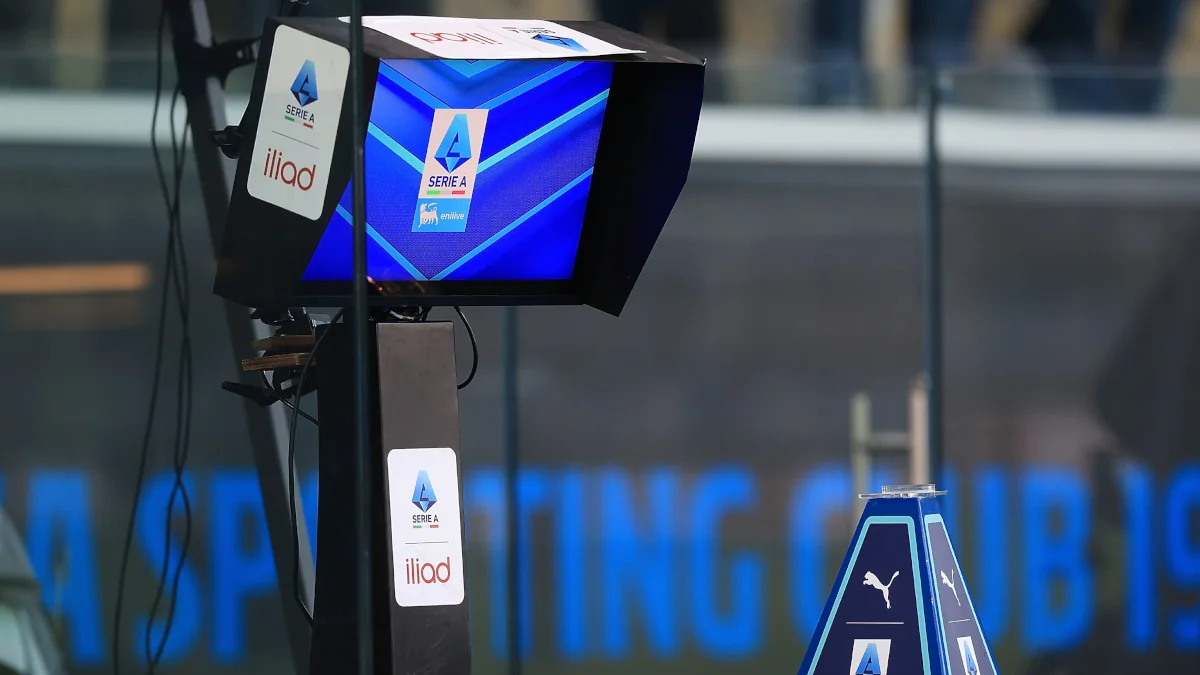
The controversy in one dated snapshot
Serie A did not switch VAR off in 2026–27. What happened was narrower and still extraordinary: the league's first 31 matches produced no penalties and no recommended on-field reviews, the process in which the referee visits the pitch-side monitor. Match 32 then produced both firsts. That makes the opening run a legitimate refereeing story, but not evidence that video officials had stopped checking incidents or that every original call was correct.
This account is frozen on 15 September 2026, so it is a dated explanation rather than a live counter. The numbers developed quickly. After two rounds, Sky Sport counted 20 games without a penalty or an on-field review, something it said had not happened in the opening two matchdays since the league returned to 20 clubs in 2004–05. After three completed rounds, Gazzetta still counted zero in both columns. Its comparison—an average of six monitor reviews and eight penalties at the same point across the previous two championships—made the contrast feel larger than a curiosity.
The drought ended at Marassi on 12 September. In Genoa–Frosinone, referee Antonio Rapuano initially allowed play to continue after the ball struck Giorgio Cittadini's arm. The VAR recommended an on-field review; Rapuano watched the replay and awarded Genoa a penalty. Lorenzo Colombo then dragged the kick wide. Gazzetta identifies that fixture as match 32 of the campaign and the season's first OFR and penalty award.
Even then, Serie A still had no penalty goal. That arrived in match 34, when Daniel Maldini scored for Cagliari in a 2–1 win at Atalanta. The distinction matters: according to Football Italia's dated account, the referee spotted Sead Kolasinac's raised-arm handball in real time. The first successful spot kick was therefore not another example of VAR overturning an on-field decision.
Those details stop three statistics from collapsing into one. A penalty can be awarded without VAR intervention. A VAR can complete a silent check without sending the referee to the screen. An on-field review can end without a penalty, or with one that is missed. The opening debate was really about the threshold for disturbing the referee's first decision—and whether officials had moved from over-analysis to excessive restraint—not about technology disappearing.
The small sample also requires humility. Thirty-one matches are barely eight percent of a 380-match season. A run that unusual invites scrutiny, especially after a summer of new directives, but it does not establish a stable season-long rate. The useful question is not “Where was VAR?” It is “What type of check or review was available, what was the original decision, and did the footage reveal a clear error?” The next section supplies that vocabulary before judging the policy.
Check, review and monitor visit are not the same event
The loudest misunderstanding in the 2026–27 argument is linguistic. Television viewers see a delayed restart, the referee's hand at the earpiece or a walk to the screen and call all three “VAR.” The official process uses narrower terms. Counting only monitor visits measures one visible branch of video assistance, not everything the video team examined.
The silent check fans rarely notice
Under the IFAB VAR protocol, the video assistant automatically checks eligible match-changing situations: goals, penalty incidents, sending-off incidents and mistaken identity. The check happens after an on-field decision, including the decision to let play continue. A coach does not possess a challenge flag, and players do not need to draw a television rectangle in the air to trigger the process.
Most checks produce nothing visible because the pictures support the original decision or do not reveal a sufficiently clear error. IFAB calls that a silent check. If the restart must wait, the referee holds a finger to the headset and extends the other arm to signal that information is arriving. If the check finishes before a meaningful delay, supporters may never know it happened. That is why “zero on-field reviews” cannot honestly be shortened to “VAR did nothing.”
The boundary also matters. Video officials are not a second referee for every throw-in, midfield trip or first yellow card. Their jurisdiction begins with defined match-changing categories. A debatable contact can be inside the penalty area and therefore checkable, yet still remain with the original call because replays do not demonstrate a clear mistake. Disagreement after the check is not proof that no check occurred.
When the referee goes to the monitor
A check becomes a review when the referee initiates the formal process, normally after the VAR identifies a probable clear and obvious error or serious missed incident. The VAR can recommend; the referee decides whether to review and always owns the final call. That design protects the on-field official from becoming a spectator waiting for instructions from Lissone.
There are two review routes. In a VAR-only review, the referee acts on factual information from the video team—for example an offside position, whether contact occurred inside or outside the penalty area, or whether the ball went out. In an on-field review, the referee watches footage at the referee review area. IFAB says subjective judgements, such as the intensity of a challenge, possible handball or interference in an offside position, normally suit an OFR. A factual issue can still go to the screen when that helps manage players or communicate a decisive late call.
| Stage | What happens | What fans may see | Who decides |
|---|---|---|---|
| Silent check | Eligible footage is examined; no probable clear error is found | Often nothing, unless restart is delayed | Original decision stands |
| VAR-only review | Factual information is communicated without a monitor visit | TV signal and corrected/confirmed decision | Referee |
| On-field review | Referee views replay, normally for a subjective judgement | Walk to the pitch-side screen | Referee after viewing |
Replay speed is part of the philosophy. Slow motion helps establish facts such as the point of contact or whether a ball struck an arm. Normal speed better conveys the force of a tackle and the natural movement around a possible handball. A higher threshold is meant to stop a frozen frame from manufacturing certainty that the live action does not support. It is not permission to ignore a clear foul.
What the 2026-27 protocol added
The AIA/FIGC 2026–27 circular, effective 1 July, expands the list in two targeted ways. VAR can address a clearly incorrect second caution that has been shown and caused a dismissal. It still cannot intervene because the referee missed an ordinary cautionable offence that would have become a player's second yellow. The new protection corrects a clearly wrongful sending-off; it does not make every possible booking video-reviewable.
The other addition is a clearly incorrectly awarded corner, provided it can be corrected immediately without delaying the restart. IFAB makes this a competition option, and Serie A adopted it. The restriction is the point: video can fix an obvious wrong corner while the ball is still dead, but it cannot rewind play several phases later because an earlier restart might have been a goal kick. Once play restarts, the opportunity is gone.
Neither addition explains away the first 31 matches. They enlarge two edges of the protocol while leaving its core intact: the on-field team makes a decision, VAR checks defined incidents, and a review follows only when the evidence meets the threshold. Serie A can demand fewer weak interventions without changing “clear and obvious” into “never intervene.” That distinction is where the football argument lives.
Genoa-Frosinone ended the drought without ending the argument
The first monitor visit arrived in a situation that shows why simple counts cannot settle a VAR debate. Frosinone led at the Luigi Ferraris through Giorgi Kvernadze when Tommaso Baldanzi shot from the edge of the area late in the first half. The ball struck Giorgio Cittadini's arm. Referee Antonio Rapuano had not awarded a penalty in real time, but the video team recommended that he look again.
Rapuano went to the referee review area, watched the footage and changed the decision. That sequence matters more than saying “VAR awarded it.” The VAR identified a probable error and recommended a review; the referee assessed the subjective handball question and made the final call. Gazzetta records it as the first OFR and first penalty award of the Serie A season, in match 32.
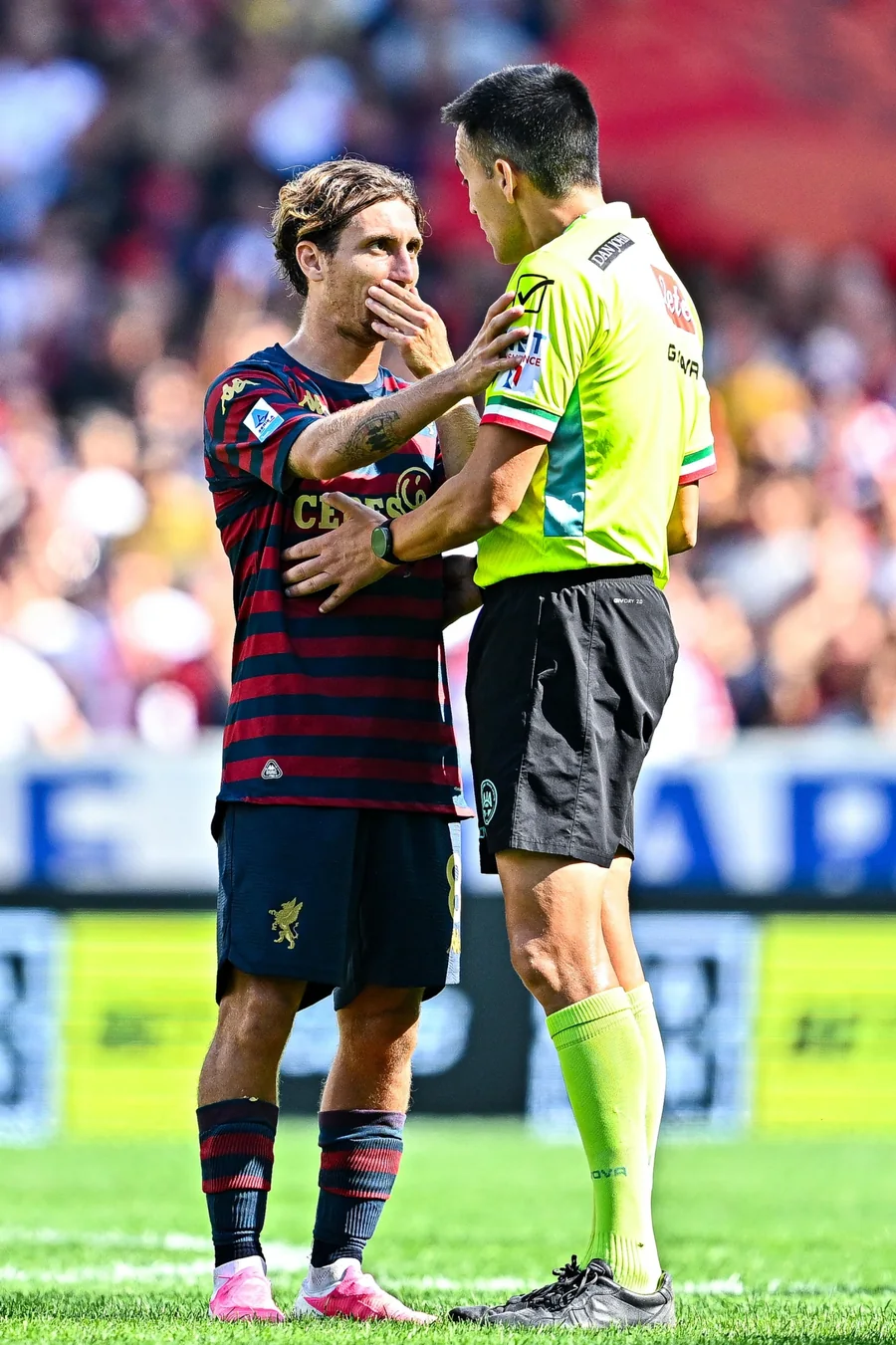
The sporting impact stopped short of a goal. Lorenzo Colombo sent the penalty wide with Frosinone still 1–0 ahead. Genoa equalised after half-time through Johan Vásquez and the match finished 1–1. That outcome is a useful corrective to the phrase “VAR changed the game”: the review changed a decision and created a major chance, but the player still had to convert it. Decision process and scoreboard consequence are related, not identical.
Nor did the successful intervention make the handball interpretation uncontroversial. The arm position, the body's movement and the distance from Baldanzi's shot remained matters supporters could view differently. A monitor visit is not a certificate that the answer is obvious to everyone. It means the referee was shown footage because the video official considered the original decision probably clearly wrong; Rapuano then accepted that case after seeing the incident himself.
The next milestone underlined the categories again. In match 34, Daniel Maldini scored the campaign's first successful penalty as Cagliari beat Atalanta 2–1. The contemporary account says the raised-arm handball was spotted on the field. That penalty did not require the season's second monitor visit simply because it became the season's first penalty goal.
For the wider argument, Genoa–Frosinone proves only two firm things. The review mechanism remained available, and officials were prepared to use it when their threshold was met. It cannot retrospectively validate every decision in the first 31 matches, and it cannot show that the new threshold had found perfect balance. One intervention after a conspicuous drought may reassure supporters that VAR was not dormant; it can equally sharpen the question of why this handball crossed the line when other disputed contacts did not.
A higher threshold can improve flow and still miss fouls
Serie A's early numbers make sense only beside the message officials heard before kickoff. The emphasis was not “use no VAR.” It was to make stronger first decisions and reserve intervention for a clear mistake. That can correct a real frustration with forensic re-refereeing, but a low intervention count is an output, not proof that the threshold was applied well.
Why referees were told to protect the on-field decision
At the August referees' camp in Cascia, new Serie A and Serie B designator Daniele Orsato described the referee as the central figure and video as exceptional support for clear and obvious errors. Sky reported his formulation as continuity with FIFA and UEFA guidance, not an Italian rewrite of the law. The IFAB protocol already says the referee must make the first decision and the video team should not replace it with a preferred judgement.
The football logic is persuasive. Contact sports look different frame by frame. A defender's arm can appear dramatically separated from the body at the instant a ball arrives even when normal-speed movement gives a more nuanced picture. A late challenge can look brutal when a replay removes its speed and sequence. IFAB accordingly says slow motion is mainly useful for facts such as a point of contact, while normal speed should inform intensity and handball judgement.
Keeping the whistle and final authority on the field can also improve rhythm. Players have less incentive to appeal every touch as a route to a second trial, and referees are encouraged to find positions from which they can decide rather than defer. Sky's early-season analysis observed more effective playing time through fewer whistles and faster restarts. That is encouraging evidence, though not yet a controlled season-long result that can be credited solely to VAR restraint.
The risk lies in turning “do not re-referee” into “do not correct.” Orsato's July explanation kept both halves: better on-field precision should reduce video work, but VAR remains there when the referee evaluates wrongly or cannot see the incident. A system that protects judgement must also protect the clear-error escape valve, or deference becomes an excuse rather than a principle.
The two-round warning against declaring success
The first internal audit already exposed that tension. In its report after 20 matches, Sky said Orsato's assessment was that two penalties should have been awarded. One concerned Nikola Vlasic's handball in Torino–Milan; the other concerned Radu Dragusin's challenge on Ilario Monterisi in Fiorentina–Frosinone. According to that account, both should first have been recognised by the on-field referee and, once missed, corrected through VAR.
That detail is more revealing than the zero. It means the same refereeing leadership advocating a high threshold did not treat non-intervention as automatically correct. Sky's distinction between interpretive direction and errors gives supporters a fair standard: accept stronger tolerance for ordinary contact while still expecting the video team to act on a genuinely clear miss.
The report also treated the Alajbegovic–Keita contact in Juventus–Parma as correctly left alone. That example prevents the critique from becoming a demand for constant monitor visits. A well-calibrated threshold should produce both outcomes: some loud appeals die in a silent check because the original decision is defensible; other incidents cross the clear-error line even if the season's broader instruction favours flow.
Raw comparison cannot settle that calibration. Gazzetta counted no OFRs or penalties through three rounds, against same-stage averages of six and eight across the two previous championships. The difference is striking, but it combines player behaviour, incident mix, first-call accuracy, referee interpretation and video threshold. Without reviewing every eligible incident under a consistent standard, assigning the whole change to one cause would be guesswork.
The sensible verdict at this cutoff is provisional. Serie A appears to have corrected away from soft interventions and microscopic slow motion; it also overshot on at least two calls acknowledged in contemporary refereeing coverage. Supporters should want neither a monitor pilgrimage after every collision nor a prestige target of zero reviews. The goal is fewer unnecessary interruptions while preserving correction when the first decision is clearly wrong.
More explanation is not the same as open access to VAR audio
Serie A has several transparency layers, and calling all of them “hearing VAR” creates another false equivalence. A stadium message explains the decision that emerged from a review. A later programme can play selected referee–VAR conversations. Neither gives supporters a live, complete feed from the video operation room.
What the stadium announcement tells supporters
The current IFAB protocol permits public explanations after a VAR review or a lengthy check. Serie A had already introduced referee explanations for spectators in the stadium and viewers at home in 2025–26, and implementation reporting says the public-announcement system continues in 2026–27 for on-field reviews and especially long checks.
The useful part is immediacy. After looking at the monitor, the referee can identify the offence and announce the final outcome instead of leaving a crowd to infer it from a television rectangle and a hand signal. At a noisy ground, that can clarify whether a goal was disallowed for attacking handball, a penalty cancelled for simulation or a card changed after review. Broadcast viewers receive the same short explanation.
What they do not hear is the entire deliberation. The announcement is closer to a ruling than an open microphone: it tells people what the referee decided and why at a high level. It will not necessarily reveal which camera angle persuaded the VAR, whether the officials first discussed a different offence, or how strongly they disagreed. That narrower format can still be valuable, provided it is not marketed in the reader's mind as total access.
What OPEN VAR releases later
OPEN VAR is a different product. Created through DAZN, FIGC, AIA and Lega Serie A, it pairs selected match footage with audio from conversations between referees and video officials, then adds an AIA explanation. By 2025–26 it had become weekly on-demand programming. It can show how a key decision developed in a way the short stadium statement cannot.
“Selected” is essential. AIA's own descriptions refer to the principal or most relevant episodes. The programme is not a searchable archive of every automatic check, and its existence does not mean the full audio of a disputed match is available immediately. Selection creates an inevitable editorial question: why was one exchange included and another omitted? Asking that question is legitimate; assuming omission proves misconduct is not.
There is a third distinction around referee cameras. The 2026–27 AIA circular permits competition-controlled bodycams and says their pictures or sound may be available to competent authorities for disciplinary purposes. It also explicitly prohibits using a bodycam microphone to transmit VAR communications. A referee's perspective camera, a decision announcement and the VOR intercom are separate signals with separate rules.
For supporters, transparency should therefore be judged in layers. Did the big screen show that a check was happening? Did the referee explain the final call after a formal review? Was the relevant exchange later selected for OPEN VAR, and did the explanation address the disputed criterion? Each layer can improve understanding, but none substitutes for the others.
The early no-OFR run made that architecture less visible: no trip to the monitor meant fewer occasions for the most recognisable announcement. Silent checks could still occur, while later audio coverage depended on which incidents the programme selected. The absence of a public speech was therefore no more proof of an inactive VAR than the presence of a speech would be proof that the full conversation had been disclosed.
The 2026 referee investigation is background, not a verdict on this season
The spring investigation belongs in an account of Serie A's trust problem, but it does not explain the opening weeks by itself. It concerned alleged conduct centered on 2024–25, whereas the zero-penalty and zero-recommended-OFR sequence occurred under a new refereeing leadership in August and September 2026. Treating the two stories as one proven chain would replace evidence with chronology.
What was alleged and why Rocchi stepped aside
On 27 April, CBS reported that Gianluca Rocchi, then the designator responsible for Serie A and Serie B referees, and other officials were being investigated in Milan over alleged participation in sports fraud. Reporting traced the case to a May 2025 complaint and described questions about appointment preferences and earlier VAR-room conduct. One allegation concerned an intervention around the Lissone video-operation room during Udinese–Parma.
Those were allegations being examined, not established facts. Rocchi said that he had received notice of the investigation, expressed confidence in the judicial process and voluntarily suspended himself. Andrea Gervasoni, who held responsibility connected to VAR appointments, also stepped aside. The Guardian's contemporary account reported both the accusations and the responses disputing them. Its reference to memories of Calciopoli captured the public sensitivity around refereeing in Italy; it did not establish that the two episodes were equivalent.
The scope also matters. Contemporary reports said the examined episodes primarily related to the 2024–25 campaign. They further said that Inter, its directors and players were not under investigation, despite online theories that pulled the club into the story. That distinction is important because repeating an allegation beside a club name can create an implication the investigation itself did not support.
What happened next
On 7 July, the FIGC appointed Daniele Orsato to lead the commission responsible for Serie A and Serie B officials. Its notice said Orsato succeeded Rocchi following the latter's April self-suspension. That is an official administrative record, but a replacement appointment is not a judicial ruling on the allegations.
The legal reporting then moved in the other direction from the most dramatic early headlines. On 8 July, Football Italia said the matter was expected to be shelved for insufficient evidence and reported that a specific accusation about opening a VAR-booth window had been removed. A later Associated Press report published by ESPN on 15 July said the Milan public prosecutor had dismissed the case against Rocchi and Gervasoni. According to that report, prosecutors found no evidence of a structured system intended to interfere with referee appointments.
There is a procedural qualification. AP also reported that documents about the narrower VAR-booth episode were sent to prosecutors in Monza because that was the relevant jurisdiction. The accurate conclusion at this article's 15 September cutoff is therefore that the Milan case was dismissed and the reported evidence did not establish a structured appointment-interference system—not that every allegation in every jurisdiction received one identical final order.
Nor did the sequence implicate a Serie A club in the way some social-media narratives suggested. The reporting consistently said Inter were not implicated. Readers should apply the same standard to officials and teams: distinguish a notice of investigation from a charge, a charge from a finding, and a personnel decision from proof of guilt.
Most importantly for the 2026–27 VAR debate, none of these developments demonstrates that the April case produced September's intervention pattern. Orsato's leadership, a publicly discussed higher threshold and the first rounds' statistics can be placed on one timeline. A causal claim would require evidence that has not been published. The early calls should be assessed against the current protocol and the incidents themselves, while the investigation should be recorded with its later outcome and proper legal caution.
A practical test for the next disputed Serie A call
The next flashpoint will be easier to discuss if supporters begin with the process instead of the final freeze-frame. Use this seven-question test before deciding that VAR failed, rescued the referee or never became involved:
- Is it reviewable? Put the incident into a protocol category: goal, penalty, direct red card, mistaken identity, a clearly incorrect second caution already shown, or the competition's limited corner option. VAR cannot reopen every foul or missed yellow simply because television has a better angle.
- What was the on-field decision? The clear-and-obvious test starts from the referee's call. “I would have decided differently” is not the same claim as “the original decision cannot reasonably stand.”
- Was there only a check, or a review? An eligible incident can be checked silently and cleared within seconds. A formal review begins when the VAR identifies a probable clear error or serious missed incident. No monitor visit does not prove there was no check.
- Is the question factual or subjective? An objective offside line can normally be resolved by a VAR-only review. The intensity of a challenge or whether a hand position is punishable usually requires the referee to reassess the judgement at the monitor.
- Had play restarted? The protocol generally prevents a review once the match has restarted, apart from narrow exceptions such as mistaken identity or certain sending-off situations. A compelling replay shown too late does not automatically create authority to rewind the game.
- What explanation actually exists? A referee's stadium announcement can state the ruling after a review. A later OPEN VAR programme may publish selected conversation. Neither should be mistaken for a live, complete record of everything said in the video room.
- What remains unknown? Note unavailable angles, missing audio and the difference between a reported judgement from the refereeing body and an independent rule analysis. Uncertainty is a more accurate conclusion than inventing motive.
This framework does not make every decision uncontroversial. It makes disagreement testable. A strong critique identifies the reviewable category, the original decision, the relevant evidence and why the error cleared the intervention threshold. A weak one treats every replay as a missed OFR or uses the early zero totals as an accuracy grade.
This article is a rules-and-evidence snapshot through , not a live VAR counter. As later matchdays add penalties, reviews and explanations, use the site's Serie A results page for changing scores, then evaluate each disputed call against the current IFAB protocol rather than against a frozen headline number.
Join the discussion
Comments
Sign in with Google to comment. Keep the conversation useful and football-focused. New comments are reviewed before they appear.
Loading comments…