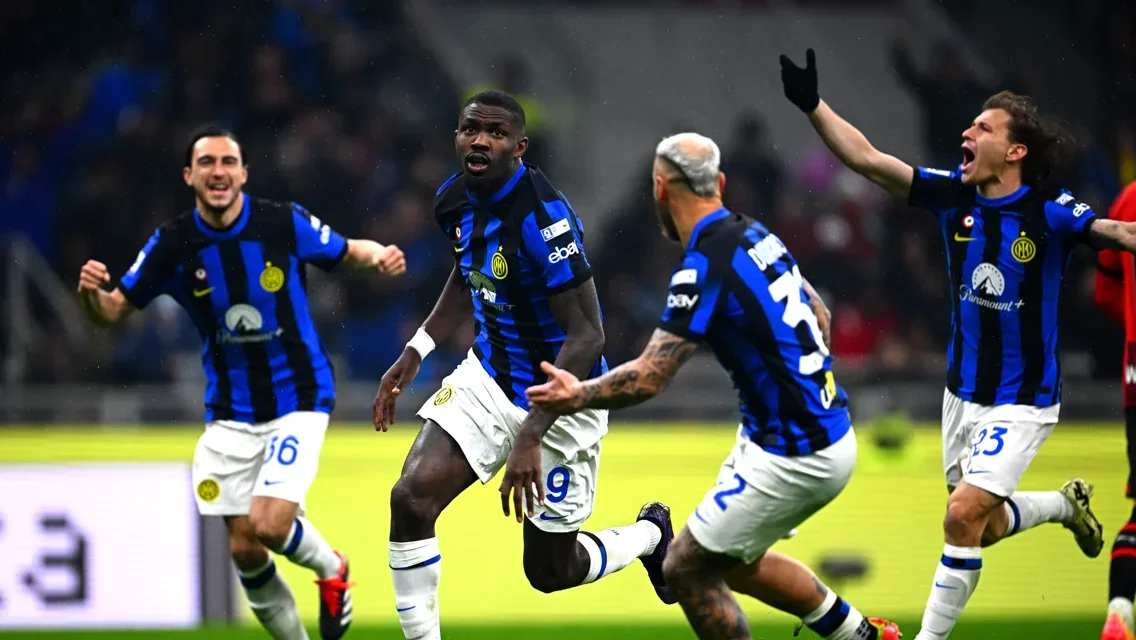
Inter won Serie A 2023–24 with 94 points, nineteen clear of AC Milan, and Lautaro Martínez led the league scoring chart with 24 goals. Bologna joined the Champions League qualifiers, while a late Empoli winner helped decide the final relegation place. This completed season review includes all twenty clubs, league-only leading scorers and the reasons the positions mattered.
Serie A 2023–24: the complete final table
Inter won Serie A 2023–24 with 94 points, finishing nineteen ahead of second-placed Milan. Juventus, Atalanta and Bologna completed the top five. Frosinone, Sassuolo and Salernitana were relegated. The table below preserves the completed campaign, with every club having played 38 matches; it includes the postponed Atalanta–Fiorentina fixture played after the other clubs had finished. The historical standings supply the match records, goals and final points.
| Pos | Club | P | W | D | L | GF | GA | Pts |
|---|---|---|---|---|---|---|---|---|
| 1 | Inter | 38 | 29 | 7 | 2 | 89 | 22 | 94 |
| 2 | AC Milan | 38 | 22 | 9 | 7 | 76 | 49 | 75 |
| 3 | Juventus | 38 | 19 | 14 | 5 | 54 | 31 | 71 |
| 4 | Atalanta | 38 | 21 | 6 | 11 | 72 | 42 | 69 |
| 5 | Bologna | 38 | 18 | 14 | 6 | 54 | 32 | 68 |
| 6 | Roma | 38 | 18 | 9 | 11 | 65 | 46 | 63 |
| 7 | Lazio | 38 | 18 | 7 | 13 | 49 | 39 | 61 |
| 8 | Fiorentina | 38 | 17 | 9 | 12 | 61 | 46 | 60 |
| 9 | Torino | 38 | 13 | 14 | 11 | 36 | 36 | 53 |
| 10 | Napoli | 38 | 13 | 14 | 11 | 55 | 48 | 53 |
| 11 | Genoa | 38 | 12 | 13 | 13 | 45 | 45 | 49 |
| 12 | Monza | 38 | 11 | 12 | 15 | 39 | 51 | 45 |
| 13 | Hellas Verona | 38 | 9 | 11 | 18 | 38 | 51 | 38 |
| 14 | Lecce | 38 | 8 | 14 | 16 | 32 | 54 | 38 |
| 15 | Udinese | 38 | 6 | 19 | 13 | 37 | 53 | 37 |
| 16 | Cagliari | 38 | 8 | 12 | 18 | 42 | 68 | 36 |
| 17 | Empoli | 38 | 9 | 9 | 20 | 29 | 54 | 36 |
| 18 | Frosinone | 38 | 8 | 11 | 19 | 44 | 69 | 35 |
| 19 | Sassuolo | 38 | 7 | 9 | 22 | 43 | 75 | 30 |
| 20 | Salernitana | 38 | 2 | 11 | 25 | 32 | 81 | 17 |
Inter's lead was larger than the entire gap between second-placed Milan and eighth-placed Fiorentina. That comparison gives the title race its proper scale. There was meaningful competition for the positions below first, but the champions had established a separate level of consistency. Their official statistical review confirms both the 94 points and the combined strength of an 89-goal attack and a defence that conceded only 22.
The differences between the next teams are instructive too. Juventus lost fewer matches than Milan, five against seven, yet finished four points behind them because fourteen draws limited their total of wins. Atalanta lost eleven times but won twenty-one, taking fourth ahead of Bologna. There was no single successful balance of wins, draws and losses underneath Inter: different teams reached similar neighbourhoods of the table through distinctly different results.
Udinese provide the sharpest example farther down. Their nineteen draws accounted for just over half their 37 points. Avoiding defeat repeatedly kept them involved in the survival fight, but six victories across the whole campaign left them exposed to the final round. Empoli's nine wins produced a point fewer overall, yet their last victory put them above Frosinone when it mattered. The value of a result depends on the rest of a club's record, as well as on its place in the calendar.
Read the published order as well as the points. Torino and Napoli both ended on 53, Verona and Lecce on 38, and Cagliari and Empoli on 36. The table retains their established final positions rather than resorting them by overall goal difference. For a later campaign, the current standings page supplies a live view; this archive keeps the outcome and the competitive context of 2023–24 together.
Inter's twentieth title was built across the pitch
The derby delivered the second star
Inter secured the championship by beating Milan 2–1 on 22 April 2024. Francesco Acerbi and Marcus Thuram scored, and the victory delivered the club's twentieth Italian league title with five games remaining. The official derby report preserves the occasion and the result. The second star represents the twentieth championship; it is a historical milestone, rather than another competition won on the same evening.
The setting added something that the nineteen-point final margin cannot convey. Milan were the designated home side at a stadium both clubs use, and Inter clinched the title against their closest city rival. For supporters, the achievement combined season-long superiority with the immediate emotions of a derby. Those are related stories, but the championship was already founded on months of results before the teams entered San Siro that night.
That early clincher also separates 2023–24 from a title decided through final-round permutations. Inter could finish the remaining matches as confirmed champions. Their final 94 points are therefore the completed record of the whole campaign, while the April derby identifies the moment when their lead became mathematically unassailable. Keeping those dates separate avoids treating the final table as though every major outcome stayed open until May.
Why the attack and defence belonged together
Simone Inzaghi's side combined the division's most productive attack with its fewest goals conceded. Eighty-nine scored and twenty-two allowed describe a team winning control at both ends. The derby lineup used three centre-backs, two wing-backs, three midfielders and Lautaro Martínez alongside Thuram. Naming that formation helps locate the roles, but the movements between them explain more than the diagram alone.
A same-season example comes from UEFA's technical analysis of Inter against Atlético. It describes coordinated movement creating space around the wing-backs and defenders advancing into useful positions. Inter could draw an opponent towards the ball and then connect with a player beyond that pressure. This European match illustrates the squad's attacking mechanisms; its statistics should not be mixed into the Serie A totals.
The UEFA analysis of the Benfica away game identifies another version of the same spatial problem: movements by a midfielder or forward could free room for a wing-back. For the defender facing Inter, covering the first receiver did not necessarily close the next passing route. Attacking cooperation meant that the team could create width without leaving every move to an isolated winger beating his marker.
The defensive record matters alongside that freedom. Advancing a defender or wing-back requires teammates to retain enough cover if possession is lost. The final numbers do not tell us exactly how often each movement succeeded, but they show that attacking ambition and defensive reliability coexisted over the domestic campaign. Inter's title was compelling because those qualities supported each other, rather than requiring a choice between creating chances and protecting the result.
Why Italy had five Champions League qualifiers
The final European picture was unusually generous to Serie A: Inter, Milan, Juventus, Atalanta and Bologna qualified for the 2024–25 Champions League. Roma and Lazio entered the Europa League, while Fiorentina earned a Conference League qualifying place. Eight Italian clubs therefore had European commitments arising from the completed season. Those destinations need to be read alongside the standings, because the competition allocation had changed with UEFA's expanded format.
Bologna's return and Atalanta's fourth place
Bologna's fifth place was one of the season's major achievements. Thiago Motta's side lost only six league games and drew fourteen, combining resistance to defeat with eighteen wins. That record shows why their success should be viewed as sustained work across the calendar. A club can occasionally upset a stronger opponent; finishing above Roma, Lazio and Fiorentina over thirty-eight matches requires results against many different kinds of opposition.
The club announced qualification on 12 May 2024. The modern Champions League was new territory for Bologna, although the club had played in the European Cup in 1964–65. Atalanta ultimately finished one point above them in fourth. Their records offer a useful comparison: Atalanta won three more matches but also lost five more. Bologna's greater number of draws kept them close, while Atalanta's ability to turn more afternoons into victories supplied the narrow final advantage.
The performance place and Atalanta's European trophy
Italy received an additional Champions League place because its clubs finished among the two strongest associations in UEFA's 2023–24 European performance ranking. This was a collective European result, separate from the domestic league's scoring system. UEFA's final explanation identifies fifth-placed Bologna as Italy's European Performance Spot recipient. The four clubs above them qualified through the usual league route.
Atalanta also won the Europa League, beating Leverkusen 3–0 with a Lookman hat-trick. That trophy was a separate, substantial achievement. It did not produce a sixth Italian Champions League participant once Atalanta finished in the domestic top four. For a retrospective table, the actual finishing positions settle the question more clearly than the alternative scenarios discussed before the final matches.
Roma, Lazio and Fiorentina's destinations
Juventus won the Coppa Italia final against Atalanta, decided by Vlahović's early goal. Since Juventus already held a Champions League place, the cup's Europa League allocation passed through the league standings. Sixth-placed Roma and seventh-placed Lazio consequently entered the Europa League; their participation is recorded in UEFA's 2024–25 competition results.
Fiorentina's eighth place took them into Conference League qualifying. It was an opportunity to reach the main competition, rather than an automatic league-phase berth awarded directly by the domestic table. Torino and Napoli, both on fifty-three points, finished outside these European places. The distinction between eighth and ninth mattered even though neither club was close to the title: league position can carry a valuable consequence far below the top row.
Lautaro won the scoring title by eight goals
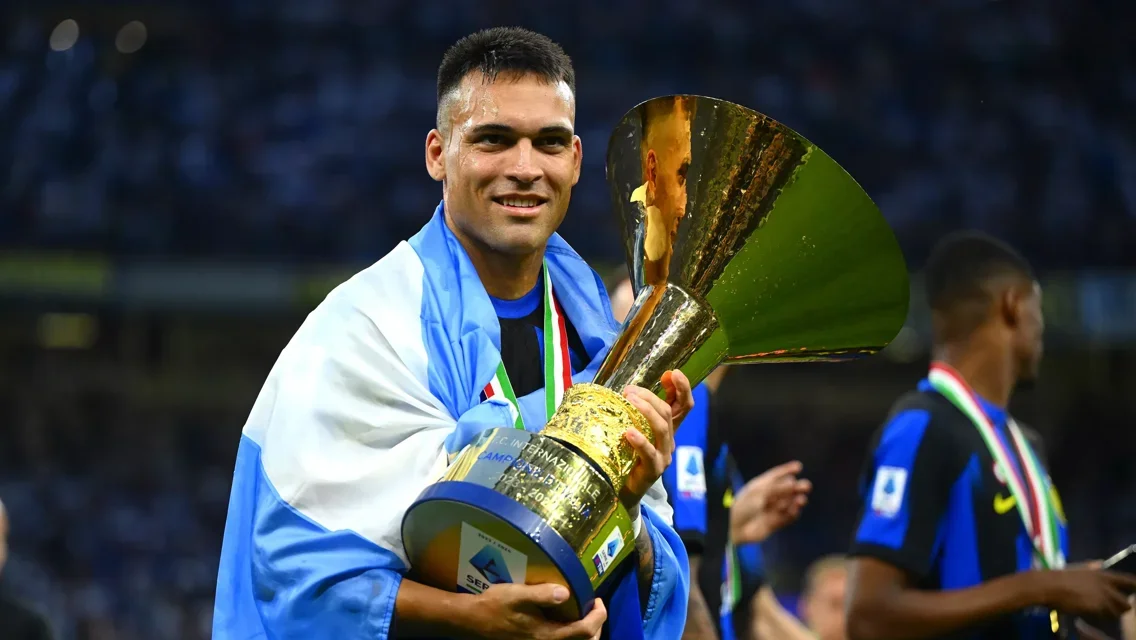
Lautaro Martínez finished as Serie A's leading scorer with twenty-four goals, eight ahead of Dušan Vlahović. The gap was substantial: the runner-up would have needed to increase his final total by half just to draw level. Lautaro's scoring title accompanied Inter's championship and his overall league MVP award, as Inter confirmed after the season. These were three different distinctions, even though they belonged to the same successful campaign.
The league-only leading scorers
| Rank | Player | Club in this season | League goals |
|---|---|---|---|
| 1 | Lautaro Martínez | Inter | 24 |
| 2 | Dušan Vlahović | Juventus | 16 |
| 3= | Olivier Giroud | AC Milan | 15 |
| 3= | Victor Osimhen | Napoli | 15 |
| 5 | Albert Guðmundsson | Genoa | 14 |
| 6= | Duván Zapata | Atalanta / Torino | 13 |
| 6= | Hakan Çalhanoğlu | Inter | 13 |
| 6= | Marcus Thuram | Inter | 13 |
| 6= | Paulo Dybala | Roma | 13 |
| 6= | Romelu Lukaku | Roma | 13 |
These totals count Serie A goals only. Cup ties, UEFA competitions and international matches are excluded. Zapata's thirteen includes one goal for Atalanta before his move and twelve for Torino; assigning all thirteen to Torino would blur the club-specific record. The historical scoring chart preserves that split. Likewise, Lookman's Europa League final hat-trick belongs to the European trophy story, rather than this domestic list.
Lautaro provided approximately twenty-seven percent of Inter's eighty-nine league goals. That leaves sixty-five goals from other players and opposition own goals, a useful reminder of how much the champions offered beyond their captain. Thuram and Çalhanoğlu also reached thirteen. A scoring leader can be the most visible part of a strong attack without carrying its entire burden; Inter had more than one route to a decisive finish.
The shape of the list also prevents a simple equation between individual goals and team position. Osimhen's fifteen placed him alongside Giroud, yet Napoli finished tenth while Milan finished second. Guðmundsson's fourteen helped a promoted Genoa side that ended in eleventh. Each number describes finishing output within a different team environment. It does not, by itself, measure defensive contribution, the quality of chances supplied or how frequently a player started.
Nor does a large final tally mean the goals arrived evenly. Lega Serie A's season review highlights Lautaro's four goals after coming off the bench against Salernitana. One exceptional evening could therefore account for a significant share of his total. The season-long conclusion remains clear, but match distribution and opportunity matter when comparing forwards. For the scoring title itself, the rule is simpler: Lautaro finished with the highest league total, and nobody approached it closely enough to require a tie.
Empoli survived while Frosinone, Sassuolo and Salernitana fell
The title had been settled weeks earlier, but survival still depended on the final evening. Empoli beat Roma 2–1 through M'Baye Niang's stoppage-time winner, while Udinese won 1–0 away at Frosinone. Those results left Empoli seventeenth on thirty-six points, Udinese fifteenth on thirty-seven and Frosinone eighteenth on thirty-five. Frosinone joined Sassuolo and Salernitana in relegation to Serie B. There was no need for a survival play-off: the final points totals separated the clubs on opposite sides of the boundary.
Niang's goal arrived in the third minute of added time, as the final match record confirms. Its value can be measured directly. Had Empoli's match finished level, their final total would have been thirty-four, because replacing a win with a draw removes two points. Frosinone's thirty-five would then have been sufficient to finish above them. The late goal changed who occupied the last relegation position, rather than merely changing the order of two already safe sides.
The other decisive scorer was Keinan Davis, whose goal at Frosinone secured Udinese's victory. His post-match club interview describes an injury-disrupted campaign ending with his first goal for Udinese. That is a striking contrast between season totals and individual moments: a player did not need a place near the top of the scoring chart to deliver one of the league's most consequential finishes.
Udinese's full record is equally revealing. They won only six matches, fewer than Frosinone's eight, but collected nineteen draws. Those draws contributed nineteen points and limited the damage on many afternoons when victory escaped them. Empoli followed a different route, winning nine times and drawing nine. The comparison explains why counting wins alone cannot settle a survival argument: every earned draw still contributes to the same final points column.
Empoli also survived with only twenty-nine goals, fifteen fewer than Frosinone. They conceded fifty-four against Frosinone's sixty-nine, leaving both clubs with the same minus-twenty-five goal difference. Similar goal differences can conceal very different scoring environments and distributions of results. Empoli's final advantage was in points, so their lower attacking total did not undo the narrow escape. Stronger scoring can still accompany relegation if too many matches end in defeat.
Roma's coach acknowledged after the match that Empoli had committed more forwards and that his own side had failed to exploit counter-attacking opportunities, in the club's published reaction. Empoli's urgency therefore came with risk, even though it ultimately worked. Farther down the table, Sassuolo's thirty points and Salernitana's seventeen tell a less marginal story. Their deficits were too large for one late goal to repair; Frosinone's relegation, by comparison, remained tied to the final minutes elsewhere.
Reading the season beyond the champions
Inter's large margin can make the rest of the season look like background, but the complete table contains several different standards of success. Bologna reached the Champions League, Atalanta combined fourth place with a European trophy, and Empoli remained in the division. Those outcomes cannot be judged by the same expectation. A useful season review asks what a finishing position delivered, then looks at the record that produced it.
Milan's second place and Napoli's tenth
Milan finished second with seventy-five points and the league's second-highest scoring total, seventy-six. Their historical club standings page also records forty-nine goals conceded. The attacking difference from Inter was thirteen goals; the defensive difference was twenty-seven. That comparison does not identify every tactical cause, but it makes clear why Milan's productive attack was insufficient to bring them close to the champions.
Second place was therefore both a strong league position and a distant finish in the title contest. The nineteen-point gap matters alongside the ordinal rank. Calling Milan simply runners-up can hide how far away they were; calling their league campaign unsuccessful without qualification can hide that they finished above eighteen clubs and secured the Champions League. The two observations describe different parts of the same record.
Napoli's tenth place was a much sharper reversal for the defending champions. They finished with fifty-three points, fourteen draws and only thirteen wins. Their fifty-five goals were actually one more than Juventus scored, yet Juventus finished eighteen points above them. The comparison underlines how the distribution of goals and results affects a league campaign. Napoli's closing 0–0 against Lecce left them outside Europe, with a scoring total that had never become a dependable points return.
What the defining results can tell us
Inter's 5–1 derby victory in September offered an early example of their strength. Their April derby win then delivered the title itself. The first match did not mathematically decide a championship with months still to play; the second did. Reading both together captures the difference between an early warning of a team's level and the later result that confirms its achievement.
The schedule also continued beyond the main final-round weekend. Atalanta hosted Fiorentina in a rearranged match on 2 June and lost 2–3. A victory would have taken Atalanta above Juventus, but the actual defeat left them fourth and completed the standings shown here. A genuinely final table therefore includes that last fixture, even though survival had already been settled on 26 May.
The season can be remembered through those different finishes: Inter's decisive derby, Bologna's qualification, Atalanta's European final and Empoli's stoppage-time escape. The standings connect them without making their achievements identical. For matches being played now, consult the current Serie A schedule; for an updated league position, use the current standings. The 2023–24 figures above remain a completed historical record.
Join the discussion
Comments
Sign in with Google to comment. Keep the conversation useful and football-focused. New comments are reviewed before they appear.
Loading comments…