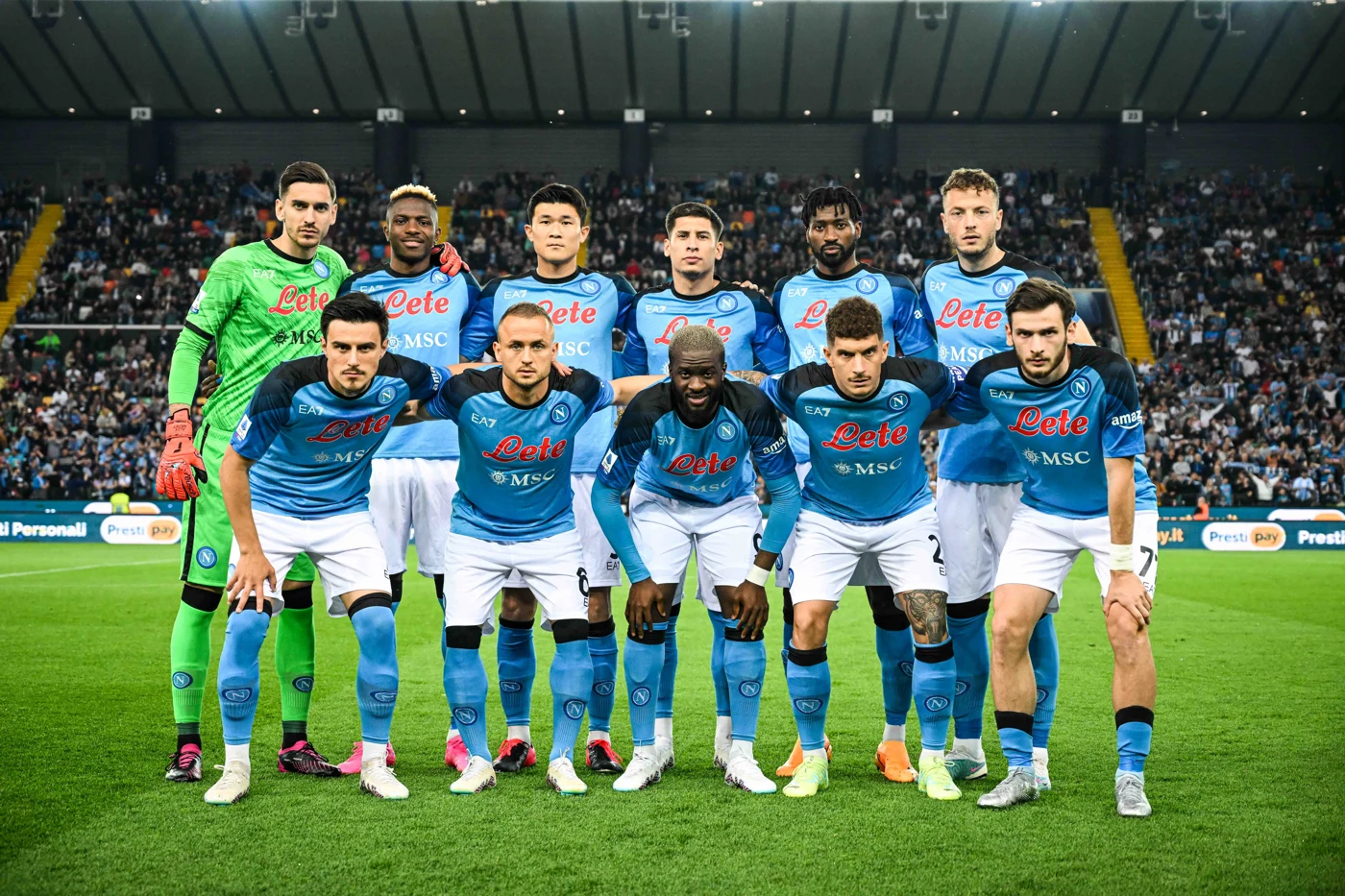
Napoli won Serie A in 2022–23 with 90 points, finishing sixteen clear of Lazio, while Victor Osimhen led the scorers with 26 goals. The final classification also requires two qualifications: Juventus retained 62 points after a ten-point deduction, and Verona stayed up by beating Spezia in a separate relegation play-off. Below are the complete table, league scoring leaders and the football stories behind those outcomes.
The complete Serie A 2022–23 final table
Napoli finished the 2022–23 Serie A season with ninety points, sixteen ahead of Lazio. Inter and AC Milan completed the top four. At the bottom, Spezia, Cremonese and Sampdoria were relegated, while Hellas Verona survived through a play-off against Spezia. The table below uses the thirty-eight league matches for every statistical column and reflects the eventual survival outcome in the ordering of Verona and Spezia.
| Pos | Club | P | W | D | L | GF | GA | Pts |
|---|---|---|---|---|---|---|---|---|
| 1 | Napoli | 38 | 28 | 6 | 4 | 77 | 28 | 90 |
| 2 | Lazio | 38 | 22 | 8 | 8 | 60 | 30 | 74 |
| 3 | Inter | 38 | 23 | 3 | 12 | 71 | 42 | 72 |
| 4 | AC Milan | 38 | 20 | 10 | 8 | 64 | 43 | 70 |
| 5 | Atalanta | 38 | 19 | 7 | 12 | 66 | 48 | 64 |
| 6 | Roma | 38 | 18 | 9 | 11 | 50 | 38 | 63 |
| 7 | Juventus | 38 | 22 | 6 | 10 | 56 | 33 | 62 |
| 8 | Fiorentina | 38 | 15 | 11 | 12 | 53 | 43 | 56 |
| 9 | Bologna | 38 | 14 | 12 | 12 | 53 | 49 | 54 |
| 10 | Torino | 38 | 14 | 11 | 13 | 42 | 41 | 53 |
| 11 | Monza | 38 | 14 | 10 | 14 | 48 | 52 | 52 |
| 12 | Udinese | 38 | 11 | 13 | 14 | 47 | 48 | 46 |
| 13 | Sassuolo | 38 | 12 | 9 | 17 | 47 | 61 | 45 |
| 14 | Empoli | 38 | 10 | 13 | 15 | 37 | 49 | 43 |
| 15 | Salernitana | 38 | 9 | 15 | 14 | 48 | 62 | 42 |
| 16 | Lecce | 38 | 8 | 12 | 18 | 33 | 46 | 36 |
| 17 | Hellas Verona | 38 | 7 | 10 | 21 | 31 | 59 | 31 |
| 18 | Spezia | 38 | 6 | 13 | 19 | 31 | 62 | 31 |
| 19 | Cremonese | 38 | 5 | 12 | 21 | 36 | 69 | 27 |
| 20 | Sampdoria | 38 | 3 | 10 | 25 | 24 | 71 | 19 |
P means played; W, D and L are wins, draws and losses; GF and GA are goals scored and conceded. A win earned three points and a draw one. Juventus are the exception to calculating the displayed points directly from results: twenty-two wins and six draws earned seventy-two, before a ten-point domestic deduction reduced the total to sixty-two. Their results columns are not rewritten to simulate extra defeats.
The historical club standings show Verona above Spezia following the survival decision. Both clubs ended the regular programme on thirty-one points. Verona's later 3–1 play-off win settled which club stayed in Serie A; its goals and victory are not added to the figures above. Consequently, Verona still have thirty-eight games, seven wins and thirty-one points in this table.
These distinctions matter when comparing historical archives. A table captured before the play-off can place Spezia ahead of Verona under the regular-season comparison, while a completed season account must explain that Verona survived. Similarly, a Juventus table taken before the final sanction can show a different points figure. Neither intermediate snapshot should be treated as the complete season outcome without its date and context.
Napoli's advantage is clear without either complication. They combined the highest scoring total with the fewest goals conceded, and won six more matches than second-placed Lazio. The middle of the table was much closer: Bologna, Torino and Monza were separated by only two points. Position therefore communicates different degrees of separation in different parts of the league. For a table that updates during current matches, use the current Serie A standings; this article preserves the fixed 2022–23 record.
Napoli's title ended a thirty-three-year wait
Napoli's third Italian league title was the defining achievement of the season. The previous championship had come in 1990, so the thirty-three-year wait belonged to more than a single squad or coach. Luciano Spalletti's team finally replaced an inherited memory with a new title-winning campaign. Its ninety-point finish was also convincing on its own terms: the champions led the league in scoring and conceded fewer goals than any other club.
Osimhen's equaliser made the title certain
The mathematical confirmation came at Udinese on 4 May 2023. Napoli needed a point and earned it through a 1–1 draw. Sandi Lovrić had put Udinese ahead, before Victor Osimhen equalised in the fifty-second minute. Five league matches remained, meaning Napoli could celebrate the championship without requiring a successful final-day calculation.
A draw was enough because the earlier campaign had already created the necessary cushion. That is the central point of the clinching match: Osimhen supplied the decisive goal, but its championship value rested on months of accumulated results. Napoli finished with twenty-eight wins and only four defeats. The occasion at Udine was the moment the arithmetic became irreversible, rather than the beginning of their superiority.
How the attack opened space for different threats
Spalletti's attacking structure gave Napoli different ways to reach goal. Osimhen threatened the central defenders and attacked deliveries into the area, while the wide forwards could advance on either side. Those roles create a practical dilemma for a back line: protecting the middle can allow a winger to carry the ball forward, while moving across to stop the winger can leave a central run harder to track. This is a description of the relationship between roles, rather than a claim that every opponent defended identically.
A same-season European example shows the relationship clearly. In Napoli's 2–0 win at Frankfurt, Lozano's advance down the right produced the cross for Osimhen's opening goal. The second involved Anguissa and Kvaratskhelia, whose back-heel released Di Lorenzo to finish. That later goal came after Frankfurt were reduced to ten men, so its context matters. Even with that qualification, the two moves illustrate different recipients and routes within the same attack.
The return leg offered another variation: Politano supplied Osimhen's headed opener in a 3–0 victory. The striker's finishing remained central, but Napoli did not need the same winger or the same type of final touch each time. Width, central movement and a full-back's arrival could all contribute. These European matches illustrate the team's attacking options; they are not extra goals added to Napoli's Serie A total.
The defensive record supplied the other half of the title. Twenty-eight goals conceded meant their attacking quality rarely had to overcome repeated defensive damage across the entire schedule. Yet dominance in a league did not guarantee success in every competition: Milan eliminated Napoli in the Champions League quarter-finals. The Scudetto remains the strongest season-long verdict because it reflects the full domestic campaign, including its setbacks.
Osimhen led a scoring race with wider league stories
Victor Osimhen won the Serie A scoring title with twenty-six goals, finishing five ahead of Lautaro Martínez. Boulaye Dia was third with sixteen. Lega Serie A's Striker of the Season announcement records Osimhen's leading tally. His success connected the league's leading finisher to its championship team, but the rest of the scoring chart shows how individual achievement could belong to very different club campaigns.
The league-only leading scorers
| Rank | Player | Club | League goals |
|---|---|---|---|
| 1 | Victor Osimhen | Napoli | 26 |
| 2 | Lautaro Martínez | Inter | 21 |
| 3 | Boulaye Dia | Salernitana | 16 |
| 4 | Rafael Leão | AC Milan | 15 |
| 5= | Ademola Lookman | Atalanta | 13 |
| 5= | M'Bala Nzola | Spezia | 13 |
| 5= | Olivier Giroud | AC Milan | 13 |
The table includes every player who reached thirteen goals, preserving the three-way tie rather than giving a misleading unique fifth place. It counts league goals from the ordinary season. European matches, domestic cups, national-team appearances and the relegation play-off are excluded. The historical scoring chart provides the complete season list beyond this leading group.
Osimhen supplied approximately thirty-four percent of Napoli's seventy-seven goals. Kvaratskhelia added twelve, as the club's season scoring breakdown records. Together they accounted for just under half of the team total. That helps explain their prominence without erasing the rest of the attack: more than half of Napoli's goals still came from other scorers and opposition own goals.
Dia's sixteen goals represented exactly one-third of Salernitana's forty-eight. His club finished fifteenth, safely above the relegation tie. A player in that environment could be central to achieving security even when his team was nowhere near the Champions League places. By contrast, Nzola reached thirteen for Spezia, whose season ended in relegation after the play-off. Similar individual productivity therefore carried different final outcomes, shaped by everything else the team did.
Leão and Giroud gave Milan two players in this leading group. Their combined twenty-eight goals were a substantial part of Milan's sixty-four, but Milan finished fourth rather than defending their championship. The comparison offers another reason to read the player list alongside the team table. It tells us who finished chances, while the league record includes conceding goals, protecting leads and collecting points on days when the leading striker did not score.
A raw goal total also leaves some comparisons unresolved. Players did not necessarily receive equal playing time, equal penalty responsibilities or equally good service. Without those measures, this chart should not become a claim about who was universally the most efficient forward. Its direct conclusion is firm enough: Osimhen scored the most Serie A goals in 2022–23, and his five-goal margin was clear.
Juventus's deduction and the final European allocation
Juventus finished seventh with 62 points, but their match record produced 72 before the sporting sanction. European qualification then changed again after the league had ended. Keeping those two events in their actual order explains both the unusual points arithmetic and why Fiorentina, rather than Juventus, eventually entered the following season's Conference League. A table without that chronology gives an incomplete account of the consequences of the campaign.
Why seventy-two earned points became sixty-two
On 22 May 2023, the FIGC announced a ten-point penalty for Juventus in the capital-gains case, to be served in the current sporting season. That final deduction is the adjustment relevant to this table. Adding an earlier disciplinary figure to it would produce a different and incorrect total. The finished season must be read with the sanction that applied to its final classification.
The calculation is straightforward: 22 victories supplied 66 points, six draws supplied another six, and the deduction reduced 72 to 62. Juventus's wins, draws, defeats and goals remained their results over 38 matches. The gap between points earned on the pitch and points retained in the classification therefore comes from the penalty, rather than an unexplained extra defeat or missing fixture.
Without that adjustment, their match points would have equalled Inter's 72. That is a useful measure of how strongly the sanction affected the standings, but it does not establish an alternative official third place: tied teams still require the applicable ranking criteria. The historical result to preserve is seventh on 62, with the deduction stated alongside the record.
Who actually entered the 2023–24 UEFA competitions
Napoli, Lazio, Inter and AC Milan took Italy's four Champions League places. Atalanta and Roma entered the Europa League. Inter had also beaten Fiorentina 2–1 in the Coppa Italia final on 24 May, while already occupying a Champions League position. The resulting Europa League allocation extended through sixth place in the league. Losing the cup final did not itself grant Fiorentina a European berth.
A separate UEFA decision on 28 July 2023 excluded Juventus from the 2023–24 men's club competitions following violations of UEFA's regulatory framework and their settlement agreement. This was a decision about entry to the next European season. It did not apply another points deduction to the completed Serie A table or turn Fiorentina's eighth place into Juventus's seventh.
Fiorentina consequently received the Conference League qualifying play-off place, as their admission announcement on 31 July confirmed. Qualification for that round still required a subsequent tie before reaching the group stage. Thus the accurate historical summary needs two dates and two different effects: May changed Juventus's domestic points total; July changed which Italian club could take the Conference League entry.
Verona survived the thirty-one-point tie
Hellas Verona stayed in Serie A by beating Spezia 3–1 in the survival play-off on 11 June 2023. Both clubs had finished the league programme with 31 points, leaving one final match to decide which would join Cremonese and Sampdoria in Serie B. This is the essential qualification to the bottom of the table: Verona's survival was decided after the regular fixtures had ended.
The play-off was separate from the league table
The Lega's official pre-match booklet records both teams' totals after 38 games. Verona had seven wins and ten draws; Spezia had six wins and thirteen draws. Those different routes produced the same 31 points. Neither reached a points total that guaranteed survival without reference to the other, and neither club's lower-table record could answer the final question alone.
Spezia had actually taken four points from the two league meetings: a 2–1 victory away to Verona and a goalless draw at home. Those head-to-head results were useful context for the rematch, but they did not grant Spezia safety. The decisive fixture took place at the neutral Mapei Stadium in Reggio Emilia. It offered Verona another way to survive despite their inferior return in those earlier meetings.
The play-off outcome must also remain separate from the season's statistical totals. Verona's three goals that evening do not raise their league goals scored from 31 to 34, and winning did not add three league points to their 31. This review places them in the final survival position while preserving the 38-match record, allowing readers to distinguish the season-long comparison from the match that determined relegation.
Ngonge and Montipò decided the survival match
Faraoni put Verona ahead, Ampadu equalised for Spezia, and Ngonge's two first-half goals created a 3–1 advantage. The official match room confirms those scorers and the result. Ngonge's double was decisive because it restored Verona's lead after the equaliser and then gave them a second goal of protection before the interval.
That protection was tested in the second half. Faraoni was dismissed for handling the ball to prevent a goal, giving Spezia a penalty and leaving Verona with ten players. Montipò saved Nzola's spot kick; the contemporary live report records further saves as Spezia pursued a recovery. The goalkeeper therefore preserved both the numerical scoreline and the margin Verona needed to manage the remaining danger.
The game illustrates why the final points tie should not be mistaken for an uneventful finish. Over the league season neither side had scored even one goal per match on average. In the single survival fixture, Verona converted enough of their opportunity to establish a lead, then relied on their goalkeeper when the balance changed. Ngonge supplied the separation on the scoreboard; Montipò helped ensure it lasted.

What the rest of the table reveals
Napoli's sixteen-point winning margin made the championship outcome emphatic, but the rest of the table contains several different measures of success. Lazio finished above Inter despite winning fewer games. Monza completed a first top-flight campaign well clear of relegation, while two fellow promoted clubs faced very different finishes. Comparing the columns explains these outcomes more precisely than treating every position as a simple verdict on attacking strength.
Lazio's second place and Inter's uneven league return
Lazio's 74 points came from 22 wins, eight draws and eight defeats. Inter won 23 matches, yet their three draws and twelve losses left them on 72. The extra Inter victory was worth three points; Lazio's five additional draws were worth five. That arithmetic accounts for the two-point difference. A higher win count can coexist with a lower final total when too many other games finish without any return.
The defensive comparison is just as revealing. Lazio conceded 30 goals, twelve fewer than Inter's 42, and only champions Napoli allowed fewer across the league. Inter scored eleven more than Lazio, but that advantage did not secure second place. Aggregate goals cannot identify precisely when each defence cost its team points, yet they show why the season's second-best attack and second-best defence belonged to different clubs.
Inter's third place also needs the context of their cup achievements. Alongside the Coppa Italia victory, they reached the Champions League final, losing 1–0 to Manchester City on 10 June. Those achievements demonstrate their ability in knockout competition. They do not erase the twelve league defeats, and the defeats do not supply a complete account of what Inter achieved across the campaign.
Monza's debut and the promoted clubs' different outcomes
Monza finished eleventh with 52 points in their first Serie A season. Their anniversary retrospective describes that historic step into the top flight. A particularly significant early result was the 1–0 win against Juventus on 18 September: Gytkjaer's goal secured their first Serie A victory in Palladino's coaching debut. The final table confirms that the campaign grew into much more than that single memorable win.
Monza ended 21 points above the pair requiring the survival play-off and only two behind ninth-placed Bologna. Lecce, another promoted team, stayed up in sixteenth with 36 points. Cremonese finished nineteenth with 27. Their different outcomes matter because promotion alone did not dictate a common trajectory: one newcomer reached the middle of the table, another cleared the danger, and the third returned to Serie B.
Lecce scored 33 goals, fewer than Cremonese's 36, but conceded 46 against Cremonese's 69. This is another warning against reading goals scored in isolation. For this completed season, the points and defensive records help explain survival alongside the individual scoring stories. For upcoming games use the current Serie A schedule, and for the active competition use the current standings; those pages serve a different season from this fixed historical review.
Join the discussion
Comments
Sign in with Google to comment. Keep the conversation useful and football-focused. New comments are reviewed before they appear.
Loading comments…