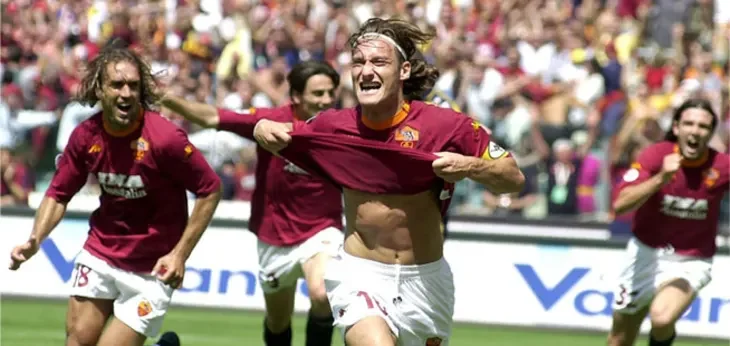
Roma have won three men’s Serie A titles: 1941-42, 1982-83 and 2000-01. Their last Scudetto came in 2001. Here is the complete record, and the football behind three very different championship teams.
Three titles, three different Roma teams
Roma have won three men's Serie A championships: 1941-42, 1982-83 and 2000-01. The club's most recent Scudetto is therefore the one secured in June 2001, not the European trophy won in 2022. Both Roma's own honours register and the league's club record identify the same three winning seasons. This article's record check is dated September 5, 2026. Roma's official honours and Lega Serie A's Roma record provide the reference points.
| Season | Coach | Roma points | Runner-up |
|---|---|---|---|
| 1941-42 | Alfred Schaffer | 42 | Torino, 39 |
| 1982-83 | Nils Liedholm | 43 | Juventus, 39 |
| 2000-01 | Fabio Capello | 75 | Juventus, 73 |
The dates do more than answer a trivia question. Forty-one years separate the first championship from the second, and eighteen separate the second from the third. Those are different football generations, not successive chapters of one uninterrupted dynasty. For a supporter, each title has its own cast, atmosphere and decisive match. For anyone studying the football, each also demands a separate explanation of how Roma became more consistent than their rivals.
One obvious trap is to read the points column as a ranking of the champions. The first two titles came under the old two-points-for-a-win system; the third came when victories were worth three. Raw totals cannot settle which side was stronger. Even the winning margin needs context: a four-point advantage in one scoring system does not mean quite the same thing in another. Comparing the teams is more useful when it focuses on balance, decisive contributions and the way a side handled its particular title race.
There is another distinction worth keeping clean. A Scudetto is the Italian league championship, not shorthand for every major trophy a club wins. Roma's Italian cups, Supercoppe and European successes belong in the honours cabinet, but they do not increase this league total. Nor should the men's record silently absorb championships won by the women's team. A good historical count states its competition and team before doing any arithmetic.
Our reading of these three champions is that Roma found different solutions to the same league problem: turning outstanding individuals into a side that could repeat its performance across a campaign. That is why the goalkeeper, the midfielder setting the rhythm and the substitute changing a crucial match belong in the story alongside the headline scorer. The three-title answer is short. Understanding how those titles were won is where the football becomes interesting.
1941-42: Amadei and the first championship
Roma's first champions were Alfred Schaffer's side, built around a reliable defensive base and Amedeo Amadei's threat at the other end. The club history identifies goalkeeper Guido Masetti as a central figure in that defensive security and describes a team dangerous on the counterattack. Amadei contributed eighteen league goals. It was also a geographical breakthrough: the championship finally went to a club outside northern Italy. Roma's account of the first Scudetto places those elements at the centre of the campaign.
Amadei's role and the defensive platform
The striker's role matters as much as his total. Amadei had played on the wing before Schaffer placed him in the middle of the attack. Roma's Hall of Fame profile emphasises his acceleration and powerful shooting. Put those qualities in a central position and a counterattacking side has an obvious outlet: someone who can threaten the space beyond defenders and finish the move himself. That is a football interpretation of the documented role change, not a claim that surviving records provide modern sprint or expected-goals data. The club's Amadei profile explains the attributes behind his reputation.
Behind that central outlet, the season record shows why Amadei did not have to win the championship on his own. Roma won sixteen matches, drew ten and lost four across a thirty-game campaign. Those four defeats were fewer than any other side suffered. Under the two-point system, avoiding defeat protected the position the goals had created. The draws were not automatically evidence of timid football; in the final arithmetic, a team difficult to beat had left fewer openings for its challengers.
The run-in: contributions beyond the star
Defensive security gave Roma a platform; their late winning run turned it into a championship. Roma took six victories from their final seven league matches, then beat Modena 2-0 on June 14, 1942 to finish the job. Renato Cappellini and Ermes Borsetti scored in that clincher, an important reminder that the decisive afternoon did not require an Amadei goal. A championship side needs contributions outside its most famous name precisely because opponents know where its main threat lies. Roma's anniversary match account records both the run-in and the final victory.
Another striking episode came on May 31. Roma overwhelmed Ambrosiana 6-0 while Torino lost 3-1 to Venezia, taking the Giallorossi back to the summit. The club's photographic archive preserves Miguel Angel Pantò celebrating during that win. Read together with the final record, it shows a race with movement, not a coronation arranged months in advance. The 1942 archive documents that turning point.
For today's fan, the fairest appreciation is therefore specific: Schaffer found a productive role for an exceptional attacker, Masetti anchored a side that lost rarely, and the team accelerated when the title was available. We do not need to dress that achievement in an unverified modern formation or invent a tactical chalkboard. The evidence already describes a recognisable championship combination: defensive dependability, speed in attack and a strong finish.
1982-83: Liedholm's balanced champions
How defensive recruitment released the playmakers
The second championship is often remembered through Paulo Roberto Falcão, and understandably so. But the most revealing explanation of the team comes from a less glamorous decision. In assistant coach Luciano Tessari's recollection, signing Pietro Vierchowod allowed Agostino Di Bartolomei to operate in front of the defence. That is a concrete example of team-building: improve one position and you can release another player's strengths. Tessari's first-hand account offers more insight than a list of celebrated names.
Vierchowod spent only one season at Roma, yet that season mattered enormously. The club's separate profile of players shared with Juventus describes Liedholm looking for a strong defender to reduce the burden on Di Bartolomei. The point is not that defensive work disappeared. It was redistributed. A coach does not always improve a playmaker by buying another creative player; sometimes the better addition is the defender who makes the existing structure more secure. That is our interpretation of the recruitment logic described by the club. Roma's Vierchowod account identifies the problem he was recruited to solve.
There was quality throughout the side: Franco Tancredi in goal, Sebastiano Nela and Aldo Maldera in the defensive group, Carlo Ancelotti and Herbert Prohaska among the midfield options, and Bruno Conti providing an attacking threat from out wide. Falcão and Di Bartolomei did not have to supply every skill themselves. The attraction of this Roma is the fit between the parts, rather than the fantasy of eleven players all trying to be the principal creator.
Pruzzo's clincher and the separate European final
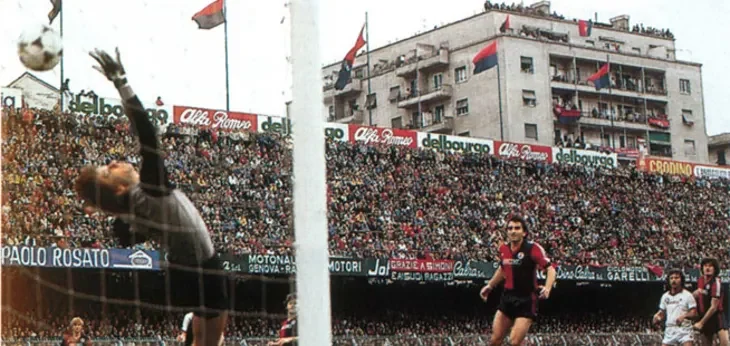
That structure found its decisive finish through Roberto Pruzzo, the centre-forward whose goals connected the team-building to the title. He scored twelve league goals in the title season, including the goal at Genoa on the penultimate matchday that made Roma champions with a game remaining. A forward's value is not exhausted by whether he wins the scoring crown. Here the season total and the timing of his most consequential goal belong together: Pruzzo converted the team's work into the point that ended the long wait. Roma's Pruzzo retrospective sets out his contribution.
The 1983 success should also be separated from the heartbreak that followed. Roma reached the European Cup final the next season and drew 1-1 with Liverpool at the Olimpico before losing the shootout. Pruzzo again scored, but this time his equaliser did not lead to a trophy. UEFA's account makes clear that this was the 1983-84 European campaign, not the match that decided the 1982-83 Italian title. UEFA's final history keeps the competitions and seasons straight.
That distinction changes how we judge Liedholm's champions. The later defeat cannot retrospectively turn the Scudetto into an incomplete achievement. In the league, Roma had solved the central problem of complementarity: players could perform different jobs without the team losing its identity. The title belongs to that collective achievement, with Falcão's class and Pruzzo's finish made possible by a structure that also deserves to be remembered.
2000-01: how Capello assembled the last title side
Gabriel Batistuta supplied the obvious upgrade: twenty goals in twenty-eight Serie A appearances during his first league campaign with Roma. But Fabio Capello's champions were not simply a team that bought a scorer and waited. Their attacking structure gave Francesco Totti room to connect play, provided width through Cafu and Vincent Candela, and accommodated forwards with different qualities. UEFA's Batistuta retrospective places his goals within that wider cast.
Wing-backs and Totti: creating central access
The shape in the final-day win over Parma was a 3-4-1-2: three centre-backs, two central midfielders, the two wing-backs, Totti behind Batistuta and Vincenzo Montella. The important relationship was between width and central access. If an opponent narrowed to crowd Totti and the strikers, Roma's wide players could advance; if defenders moved out to meet them, the central attackers had more room to combine. That is our tactical reading of the documented setup, not a claim that every attack followed an identical pattern.
The opening goal against Parma made that relationship visible. Candela advanced into the area and supplied Totti, who finished. Roma's next goal involved the opposite flank: Cafu released Batistuta, whose shot was saved before Montella converted the rebound. The wing-backs were not decorative names placed on the edges of a formation graphic. They were participants in the actions that put Roma in command of the decisive match. Roma's tactical review of the clincher reconstructs those moves.
Supporting roles and decisive substitutes
The final-day formation explains one match; Capello's later descriptions of his players reveal the options needed across the campaign. He identifies Marco Delvecchio's work on the left as a source of balance and Damiano Tommasi's running as central to the midfield. He recalls Emerson becoming important after missing the opening months through injury. A memorable starting eleven is a useful introduction, but it cannot describe all thirty-four league games. Coaches need ways to protect their best players, cope with absences and alter the demands placed on opponents. Capello's own player-by-player assessment makes the supporting roles explicit.
The clearest demonstration came away to Juventus on May 6. Roma were two goals down when Hidetoshi Nakata replaced Totti. Nakata scored from distance, then forced the save from which fellow substitute Montella equalised for 2-2. The lesson is not that the captain was dispensable. It is that even an attack built around an exceptional number ten benefits from a coach willing to change its immediate rhythm. A different threat produced a different problem for Juventus. Roma's Nakata retrospective details both interventions.
The season behind the final-day celebration
Those different options produced sustained results. Across the season, Batistuta's twenty league goals were supplemented by thirteen each from Totti and Montella. Roma finished unbeaten at home, with twelve wins and five draws, and added ten victories away. Those are the figures of a side with several routes to points, not merely one explosive afternoon. They also explain why the final-day celebration must be read against the work that preceded it. The club's statistical anniversary feature provides the league-only totals.
On June 17, 2001, the front three all scored as Roma beat Parma 3-1 and finished two points above Juventus. Totti opened, Montella followed and Batistuta added the third. That symmetry makes a wonderful ending, but the deeper story is less tidy and more instructive: wing-backs creating, midfielders covering, substitutes rescuing and a coach choosing between talented options. Roma's final-day account records the moment the campaign became the club's third Scudetto.
Why 2001 remains the last Scudetto
Roma's last Serie A title remains the 2000-01 championship in the official record checked for this article. That is a statement about first place, not a claim that every subsequent side was uncompetitive. The difference matters when a long wait becomes the only lens through which supporters are asked to see a club. A championship count is exact; an assessment of the football requires more detail.
Near misses and points-table context
The next season is the immediate example. On the final day of 2001-02, Roma beat Torino 1-0 with an Antonio Cassano goal and finished on seventy points. Juventus ended on seventy-one, while Inter slipped to third after losing to Lazio. Roma had not defended the title, but the margin was a single point. Describing that campaign as simply another year without a Scudetto discards almost everything that made its conclusion so tense. UEFA's contemporary final-day report records the three-way finish.
The 2016-17 season offers a different lesson. Roma collected eighty-seven points from thirty-eight matches and secured second place with a late Diego Perotti winner against Genoa. It was a club-record points total at the time, yet Juventus finished on ninety-one. The achievement and the limitation are both real: Roma had produced an outstanding total, but another team had done better. Roma's qualification report and the club's final-table account establish the numbers.
That comparison also explains why eighty-seven cannot simply be placed above seventy-five and called proof that the later team was superior to the 2001 champions. The later season contained four additional matches. Points per game would make the arithmetic fairer, but even that would not reproduce the strength of opponents or the pressures of each race. The productive question is what a side achieved against its actual competition, not what a different decade's total might have won.
Why the 2022 trophy does not change the count
The question changes when a different competition enters the discussion. That is the issue with 2022, a year that sometimes appears in searches for Roma's league titles. José Mourinho's team won the inaugural Europa Conference League, beating Feyenoord 1-0 in Tirana through Nicolò Zaniolo's goal. It was a major UEFA trophy and a genuine new chapter in the club's history. It was not the Champions League, and it was not Serie A. Correcting that distinction does not diminish the celebration; it gives the achievement its proper name. UEFA's final report identifies the competition and result.
The three Scudetti consequently remain distinct landmarks: Amadei's first champions, Liedholm's carefully balanced side and Capello's multi-layered attack. They are worth studying as football teams, not merely as dates ending a drought. For current matches, use the Serie A Schedule match hub; for the historical answer, keep the line clear: three men's league championships, with the latest won in 2001. The next one will require a new winning campaign, not a reinterpretation of a different trophy.
Join the discussion
Comments
Sign in with Google to comment. Keep the conversation useful and football-focused. New comments are reviewed before they appear.
Loading comments…