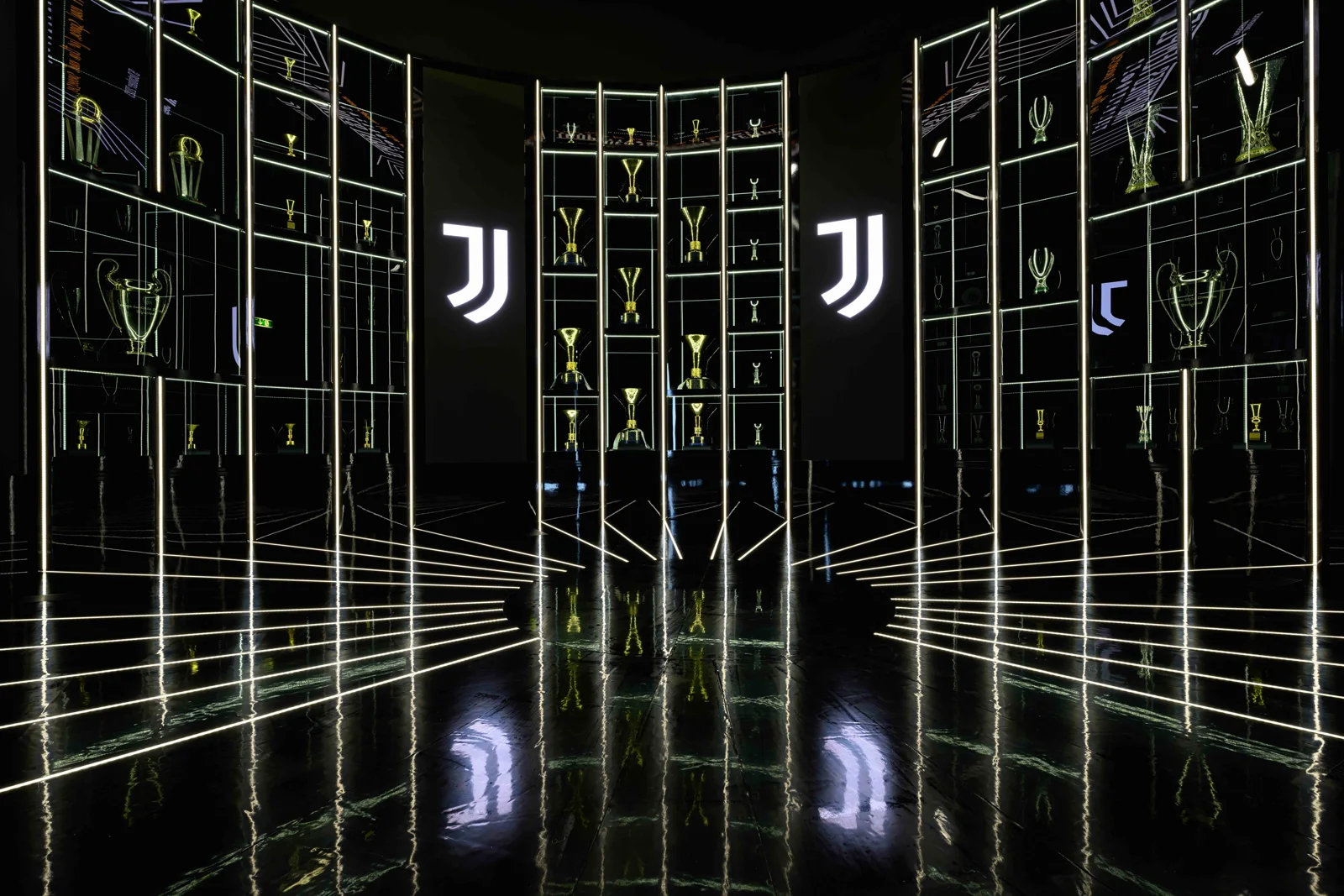
Juventus have 36 official Italian top-flight titles, most recently in 2019-20. Their record includes nine consecutive championships from 2011-12 to 2019-20. The winning years reveal several distinct dynasties, while the familiar 36-versus-38 debate comes from the two Calciopoli-era seasons.
How many Serie A titles have Juventus officially won?
Juventus have won 36 officially recognised Italian men's top-flight championships. Their latest is the 2019-20 title, the ninth in an uninterrupted run that began in 2011-12. UEFA's club facts record 36 league titles with 2020 as the most recent winning year, and the league's current honours list confirms that subsequent completed seasons have produced other champions.
Why 36 and 38 describe different records
The disagreement concerns recognition, not the arithmetic: the competing number, 38, counts two seasons Juventus finished first on the pitch but do not hold in the official honours record: 2004-05 and 2005-06. This is the source of the familiar argument, rather than a disagreement about whether to include an obscure nineteenth-century competition. When a supporter says 38, the calculation usually restores those two results to the club's total. When a league record says 36, it follows the final recognised championships.
The two seasons must also be described separately. The 2004-05 championship was revoked and remains unassigned; the 2005-06 championship was not awarded to Juventus and is recorded as Inter's. UEFA's contemporary reporting documented the removal of the two titles during the Calciopoli proceedings. Later appeals did not turn them back into recognised Juventus championships; a 2019 FIGC decision records another unsuccessful challenge concerning the 2006 allocation.
For a football history article, the sensible method is to keep the two questions visible. Who finished first before disciplinary decisions is a question about the season's original sporting results. Who officially holds the title is a question about the championship record. They are connected, but they are not interchangeable. A table comparing Juventus with Milan, Inter or Roma must use the same official basis for every club, otherwise the comparison changes its rules halfway through.
Why the single-group Serie A total is 34
Even after settling the disciplinary distinction, the era being counted needs its own definition. The familiar total covers Italian top-flight championships across different historical formats, including the period before the national single-group Serie A began in 1929. Juventus' 1905 and 1925-26 titles belong to that broader history. If someone explicitly asks only about the single-group era, the total is 34. That narrower figure is legitimate when labelled correctly; silently switching between 34 and 36 is not.
Finally, the count concerns the senior men's league. Coppa Italia trophies, European Cups, Supercoppe, the Serie B championship and Juventus Women's honours answer different questions. Juventus' success across those competitions is part of the club's history, but adding them into a Serie A total makes the answer less informative. The attraction of 36 is precisely that it measures one clearly defined achievement across a remarkably long span of football.
Juventus' winning seasons and the first great dynasties
The complete list is best read in blocks. Juventus' first title arrived in 1905 and their second in 1925-26, before the single-group national league. Five consecutive championships followed in the early 1930s. Another major period developed after the Second World War, before the longer cycles associated with the 1970s, 1980s, 1990s and the nine-title run of the 2010s. The gaps between those periods matter: even Italian football's most successful league club did not win continuously across its entire history.
| Period | Winning seasons | Titles |
|---|---|---|
| Before single-group Serie A | 1905; 1925-26 | 2 |
| 1930s | 1930-31; 1931-32; 1932-33; 1933-34; 1934-35 | 5 |
| 1949-61 | 1949-50; 1951-52; 1957-58; 1959-60; 1960-61 | 5 |
| 1966-78 | 1966-67; 1971-72; 1972-73; 1974-75; 1976-77; 1977-78 | 6 |
| 1980s | 1980-81; 1981-82; 1983-84; 1985-86 | 4 |
| 1994-2003 | 1994-95; 1996-97; 1997-98; 2001-02; 2002-03 | 5 |
| Nine consecutive titles | 2011-12; 2012-13; 2013-14; 2014-15; 2015-16; 2016-17; 2017-18; 2018-19; 2019-20 | 9 |
Early formats and the five-title dynasty
The earliest rows require a change of perspective: the club name is familiar, but the competition format is not. Juventus' historical account describes the 1925-26 campaign ending with a national final against Alba Roma, won 12-1 on aggregate. That is plainly not the format of a modern 38-match Serie A season. Both achievements count as national championships, but evaluating the demands of each requires understanding how the title was decided.
The five-title sequence from 1930-31 to 1934-35 is the first unmistakable dynasty in the modern league format. Its significance is structural: the club established repeated success at the beginning of the new national competition, rather than merely collecting an isolated early championship. When Juventus later returned to five consecutive titles in the 2010s, that older sequence supplied a historical reference point. Nine in a row eventually exceeded it, but did not erase it.
The first star and a new attacking partnership
By 1957-58, the landmark was less about the format of the competition than the reshaping of Juventus' attack. The tenth championship brought the first star, while the attacking combination of John Charles, Omar Sivori and Giampiero Boniperti gave the achievement a recognisable football character. The club's account of that period links the 1958 breakthrough to further championships in 1960 and 1961. The star is the shorthand; the productive partnership explains why supporters remember the team itself.
Boniperti's changing role is particularly revealing. In its retrospective on his playing career, Juventus describe him moving into a deeper area and supplying Charles and Sivori. That is a useful example of renewal through a different division of labour. An established scorer did not have to disappear for new attacking talent to flourish; he could become part of the mechanism that made the new partnership effective.
This is why the winning-years table should be the beginning of the story rather than the whole article. It tells us when Juventus were champions. The teams behind it show how the club repeatedly changed the relationships between experience, imported talent and collective structure. Counting seasons identifies the scale of success; understanding those adjustments gives each period a footballing identity beyond a number in the honours list.
Trapattoni and Lippi: building champions in different eras
Giovanni Trapattoni and Marcello Lippi account for eleven of Juventus' official championships between them: six for Trapattoni and five for Lippi. The useful comparison is not an argument over which man was more essentially Juventus. Their achievements show that the club could sustain winning structures under different conditions, with different personnel and different football demands. Continuity did not require every successful side to look identical.
Trapattoni: consistency in the two-point era
Trapattoni's results first need to be read in the scoring system of his era. His first championship season, 1976-77, produced 51 points from a possible 60 alongside the UEFA Cup. Juventus' account of the period preserves that points total, which immediately requires a scoring-system explanation: victories were worth two points. Comparing 51 directly with a modern three-points-for-a-win total would make an outstanding campaign appear ordinary. The meaningful question is how much of the available return the team secured, not whether its raw number looks small today.
The club's Trapattoni profile emphasises his tactical pragmatism. That description is more useful than simply calling the side defensive. A pragmatic coach must fit individual strengths together and decide where risk is acceptable. The six championships across 1977-86 indicate a method capable of surviving changes in the squad and the opposition. The accompanying European honours add context, but the league titles remain a separate measure of consistency over a domestic season.
Lippi: renewal, rotation and a shared core
Lippi's task began with renewal rather than defending an existing title sequence: his 1994-95 breakthrough came after a nine-year wait for the Scudetto. Juventus sealed it with a 4-0 win over Parma on 21 May 1995, with Fabrizio Ravanelli scoring twice and Didier Deschamps and Gianluca Vialli also on target. The variety of the scorers is a fitting snapshot of a side whose contribution extended beyond a single star. New faces and an emerging Alessandro Del Piero helped give the team a fresh identity, while established forwards still carried considerable responsibility.
The deeper evidence of Lippi's approach appears in UEFA's contemporary 2003 profile. It describes a nucleus of players who knew his demands across both spells in charge, and documents his willingness to rotate. Resting five important players for the title-clinching draw against Perugia illustrates the practical value of that depth. The team could pursue another competition without treating every league selection as an emergency.
That is a more revealing explanation of repeated championships than invoking an abstract winning mentality. Experienced players gave the coach shared reference points; adaptable roles allowed him to change the side without starting again from zero. The two elements reinforce each other. Continuity without adjustment becomes rigidity, while adjustment without common understanding can become confusion. Lippi's success offers a concrete example of balancing the two.
Both eras also resist a simple equation between domestic and European achievement. A league title rewards the accumulation of results over months; a European knockout tie can turn on a much smaller sequence of events. Juventus could be exceptional in one setting and fall short in another. Recognising that difference makes the Scudetto record more precise, while leaving room to assess the team's wider season honestly.
How Juventus sustained nine consecutive Serie A titles
The nine-title sequence runs from 2011-12 to 2019-20, inclusive. Antonio Conte won the first three, Massimiliano Allegri the next five and Maurizio Sarri the ninth. That distribution is the first reason the achievement deserves more than a photograph of one famous team. It crossed coaching changes, altered attacking partnerships and several stages of squad development. Calling it one side winning nine times makes the continuity sound much simpler than it was.
Conte: an unbeaten reset and the 102-point peak
The first stage was rebuilding a reliable domestic standard. Conte's opening season supplied that reset. Juventus completed the league campaign unbeaten, with the title arriving in the first season of their new stadium. The club's 2011-12 retrospective describes the manager's return and the early victory over Milan that helped establish Juventus as serious challengers. This was a restoration of competitive authority: a former captain supplied a clear framework, while the team had to demonstrate that it could maintain its level against the reigning champions and the rest of the division.
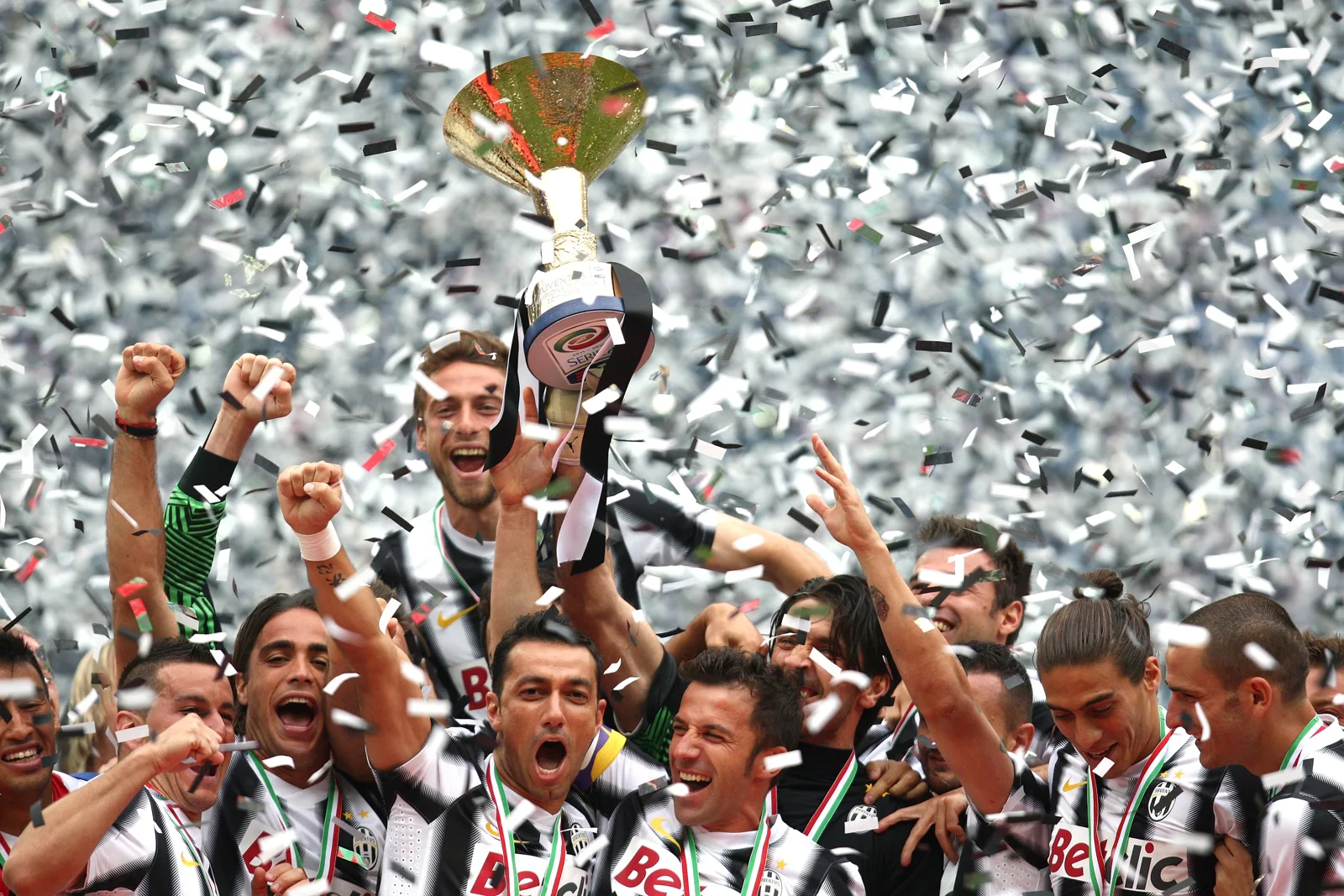
The 2013-14 total of 102 points shows how far that domestic machine developed. Juventus' history of the comeback records the league record and the third consecutive title. The important distinction is between building a champion and repeatedly increasing its return. Once opponents understood Juventus' basic strengths, the side still had to convert expectations into points. An established structure can make a team easier to recognise without making it easier to stop.
Allegri: adapt the shape, keep the foundation
Once that foundation existed, Allegri faced a different problem: preserving success without preserving every detail. UEFA's 2015 analysis contrasts Conte's 3-5-2 with Allegri's greater flexibility, including a move to 4-3-1-2 to accommodate Andrea Pirlo, Paul Pogba, Arturo Vidal and Claudio Marchisio. The football consequence is understandable: altering the defensive line and midfield arrangement changes where the team can create an extra passing option and how it connects to the forwards.
That was adaptation from an inherited foundation, rather than a clean break. Players already accustomed to one another could learn different relationships without abandoning all their common reference points. At the same time, the system needed to fit the available quality. Keeping a formation simply because it had won previously would have treated yesterday's answer as a permanent rule. Allegri's five consecutive Juventus titles are evidence that adjustment could coexist with sustained domestic control.
Chiellini and Sarri: continuity without an unchanged team
Changes of shape and coach did not remove the value of individual continuity. Juventus' account of the ninth title identifies Giorgio Chiellini as the player who made at least one league appearance in every season of the run. That is not the same as saying he played every match or carried every championship equally. It is a narrower, revealing link between teams that otherwise changed substantially. The dynasty had a human thread without being frozen around one unchanging eleven.
Sarri's arrival for the final championship underlines the point. Nine consecutive titles were an institutional sequence, not the property of a single tactical doctrine. The coaches did not ask precisely the same things, and the players were not all the same age or at the same career stage. Juventus' achievement was to keep producing the league's winning total while those variables moved. That makes the run exceptional without requiring us to pretend every season was equally convincing.
Juventus' last Serie A title: the complicated 2019-20 season
Juventus last became Serie A champions on 26 July 2020, when a 2-0 home win over Sampdoria secured the 2019-20 championship. The unusual date belongs to the pandemic-interrupted season, not to a different summer competition. The club's post-match reaction records the ninth consecutive Scudetto under Maurizio Sarri. For anyone searching simply for Juventus' last title, that is the league answer as of September 2026.
The summer clincher and the final one-point margin
Understanding that July date requires the circumstances of the final instalment, which made it unlike the first eight. Football stopped, resumed and finished in a compressed summer period, with the familiar relationship between players and a full stadium disrupted. Juventus' contemporary championship reflection acknowledges uncertainty and the effect of the health emergency. The trophy was the same domestic prize, but the rhythm and setting of its pursuit had changed dramatically.
The final league record was 83 points, one ahead of Inter. That narrow final margin needs to be read alongside the timing of the clincher: Juventus secured the championship with two matches still to play. A final table describes the completed season, whereas the decisive match identifies when the title became mathematically certain. Confusing the two can turn the campaign into a last-day duel it was not. Both facts help describe the season without forcing them into the wrong narrative.
What the Scudetto did not settle
Winning the league settled the team championship, not every other comparison within the season. Cristiano Ronaldo scored 31 league goals, a major contribution but not the competition's leading total: Ciro Immobile finished with 36. The season's final standings and scoring table make that distinction clear. Juventus' championship and Ronaldo's individual scoring season are related achievements, but neither should be used to rewrite the other. The strongest scorer on the champion team does not automatically win the Capocannoniere award.
Nor did the league title settle every question about Juventus' football. Their European season ended against Lyon, who advanced on away goals after a 2-2 aggregate draw despite Juventus winning the second leg 2-1. UEFA's match report captures that separate disappointment. It is possible to recognise the difficulty of winning another domestic championship and still judge parts of the wider campaign as unsatisfactory.
This is where the nine-in-a-row record becomes more interesting than a slogan. It does not require nine flawless seasons, nine identical teams or nine years without serious criticism. It requires finishing as the recognised champion nine times consecutively. The run combined dominant campaigns with less convincing ones, and its final year shows why a title count should introduce analysis rather than replace it.
Subsequent cup wins do not reset the league date. Juventus' recent history includes domestic cup success after 2020, but a Coppa Italia is not another Scudetto. For current results, the Juventus team page provides the changing match picture. The historical benchmark remains clear: 36 official top-flight championships, with a nine-season sequence ending in 2019-20 that future Juventus sides can measure themselves against but cannot inherit as a result.
Join the discussion
Comments
Sign in with Google to comment. Keep the conversation useful and football-focused. New comments are reviewed before they appear.
Loading comments…