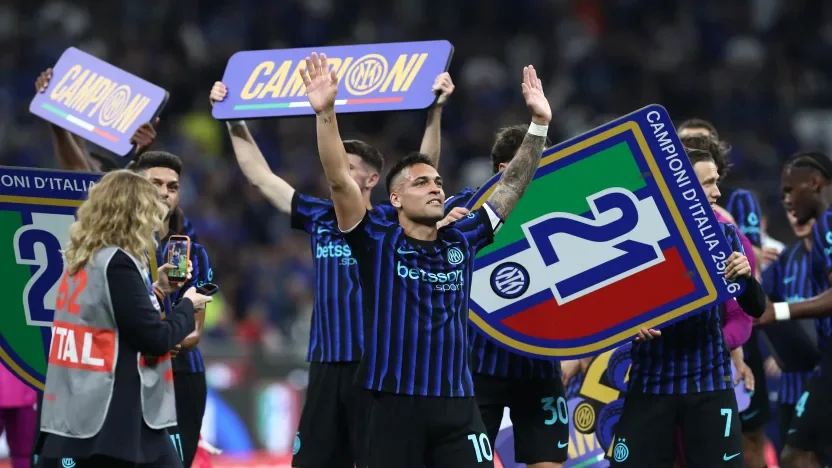
Inter Milan have won twenty-one Italian league titles, with the latest coming in 2025–26 under Cristian Chivu. The complete record stretches from 1909–10 to the championship secured against Parma on 3 May 2026. Behind those years are very different teams: Meazza's goals, Grande Inter's inventive roles, the five-title run of the 2000s and a modern core that has won under three coaches.
Every Inter league title: the complete winning years
Inter have twenty-one recognised Italian league championships through 2025–26. The club's official honours page and Lega Serie A's roll of honour agree on the complete list below. It includes the national championships played before the single-division Serie A format began in 1929–30. Inter's first two titles belong to that earlier competition, not to a separate collection of trophies that should be added again.
| Period | Winning seasons | Titles |
|---|---|---|
| Early national championships | 1909–10, 1919–20 | 2 |
| First Serie A decade | 1929–30, 1937–38, 1939–40 | 3 |
| Post-war breakthrough | 1952–53, 1953–54 | 2 |
| Grande Inter | 1962–63, 1964–65, 1965–66 | 3 |
| Further twentieth-century titles | 1970–71, 1979–80, 1988–89 | 3 |
| Five consecutive championships | 2005–06, 2006–07, 2007–08, 2008–09, 2009–10 | 5 |
| Latest winning generation | 2020–21, 2023–24, 2025–26 | 3 |
The grouping makes an important feature visible: Inter's history is a succession of strong teams rather than one uninterrupted age of dominance. The five-title sequence ending in 2010 is their longest run. Elsewhere, exceptional sides emerge after gaps, sometimes inheriting key players from the previous champions and sometimes changing the face of the club. The gaps are part of the story because they explain the pressure attached to each return.
The two stars associated with Inter have precise places in this chronology. The 1965–66 title was the tenth; the 2023–24 championship was the twentieth. The latest victory takes the total to twenty-one, but does not bring another star, which marks each completed group of ten league titles. That distinction separates a recent season's achievement from the much longer accumulation represented on the badge.
The 2005–06 championship is included because it was officially awarded to Inter after the Calciopoli decisions. Its route into the record is different from the other four titles in that sequence, and deserves explanation rather than omission. It does not turn the subsequent seasons into one administrative event: those campaigns involved fresh squads, new matches and their own competitive challenges, culminating in the narrow league race of 2009–10.
Nor should the twenty-one be confused with Inter's European Cup and Champions League successes. These are Italian league championships, including those won in years when the team also succeeded elsewhere. A treble season contributes one Scudetto to this list. For a supporter exploring the history, the next step is to move beyond the trophy room and ask what made the different champions work: who created their chances, who provided balance, and which changes transformed a talented squad into Italy's best league team.
From Meazza to Grande Inter: talent given a winning structure
Meazza's goals and Foni's framework
Inter won the first single-division Serie A championship in 1929–30, playing under the name Ambrosiana. Giuseppe Meazza finished as the competition's leading scorer with thirty-one goals, but the clinching match offered a reminder that even a team with an outstanding goalscorer needs other contributions. Giuseppe Viani and Leopoldo Conti scored in the 2–0 victory over Juventus on 29 June 1930. Árpád Weisz's champions scored eighty-five league goals across the campaign.
That is a striking opening to the modern-format story of a club so often discussed through its defensive traditions. Meazza gave the team a prolific attacking reference, and the championship was secured with a game remaining. Inter's early Serie A success was not a prototype that every later champion copied. It belonged to its own coach, generation and football environment, long before the systems most closely associated with the club took shape.
Alfredo Foni's 1952–53 champions ended a thirteen-year wait with a more explicitly defensive structure. The club archive identifies catenaccio as the organising system, while the results show repeated narrow victories: 1–0 against Como, Atalanta, Milan, SPAL and Triestina during the first half of the season. Yet the squad also contained István Nyers, Benito Lorenzi and Lennart Skoglund. Defensive organisation was a framework for talented attackers, not evidence that attacking talent was unnecessary.
Herrera's complementary roles
The next great generation took shape under Helenio Herrera, whose first league title followed in 1962–63. Young Giacinto Facchetti and Sandro Mazzola became central figures, and Mazzola scored the winner away to Juventus on 28 April. That result gave the emerging Grande Inter a decisive success against a direct competitor. The important development was not simply a coach finding a reliable formation: younger players were becoming capable of deciding the largest matches within it.
Facchetti offers the clearest challenge to a one-dimensional account of Herrera's football. The club's profile explains how a former forward was turned into a full-back who attacked the spaces created by the men ahead of him. When a defender arrives from deeper, an opponent must decide whether to follow the runner and leave another area exposed. That extra movement can change an attack without requiring the team to sacrifice its defensive starting structure.
Inter added the 1964–65 and 1965–66 championships, the latter delivering the first star. The 1966 season archive records Facchetti's ten goals and the 4–1 win over Lazio that secured the title. A defender contributing that much to the attack captures why Grande Inter should be remembered as a team of complementary roles, not reduced to a word for defending.
1971, 1980 and 1989: three different ways to rebuild a champion
Revivals under Invernizzi and Bersellini
The 1970–71 title did not begin with the smooth authority of a settled favourite. Inter changed coach after a disappointing start, replacing Heriberto Herrera with Giovanni Invernizzi. The season archive records a team that recovered to challenge Milan, with Roberto Boninsegna scoring twenty-four goals in twenty-eight league appearances. A squad containing several Grande Inter veterans had found a new attacking focal point rather than simply trying to reproduce the past.
Mario Corso and Sandro Mazzola scored in the 2–0 return-derby victory, and a 5–0 win over Foggia eventually secured the championship. The blend of familiar names and Boninsegna's finishing gave that recovery substance. Changing a coach can alter the atmosphere, but a title challenge still needs a reliable supply of goals. Inter had a striker capable of making the revival visible on the scoreboard week after week.
Eugenio Bersellini's 1979–80 champions followed a steadier route. They won both league derbies and beat Juventus 4–0, with Alessandro Altobelli scoring a hat-trick. Altobelli finished with fifteen league goals and Evaristo Beccalossi with seven. Those headline results gave the season its memorable peaks, while the championship was finally confirmed by a 2–2 draw against Roma on 27 April. The point was enough because the earlier work had created the advantage.
Trapattoni's recruitment-led record
Recruitment supplied the next transformation in 1988–89, when the scale of the achievement became part of its name: the record-breaking Scudetto. Giovanni Trapattoni's team finished with fifty-eight points from thirty-four matches, under the two-points-for-a-win system. Twenty-six victories and six draws explain that total. Comparing fifty-eight directly with a modern champion's points would miss the exceptional consistency of a side that lost only twice.
The club's retrospective describes how Lothar Matthäus, Andreas Brehme, Ramón Díaz and Nicola Berti joined a core containing Walter Zenga, Riccardo Ferri, Giuseppe Bergomi and Aldo Serena. Brehme supplied crossing and goals from the left; Matthäus gave the midfield a powerful attacking presence. These were additions that created complementary routes forward while retaining the established defensive players.
Matthäus's free-kick against Napoli on 28 May delivered the title with four matches remaining. Inter eventually scored sixty-seven and conceded nineteen. That balance is the strongest shorthand for the team: not simply a famous goalkeeper behind famous foreign signings, but an attack and defence working to the same competitive level. The 1971 revival, the 1980 campaign and the 1989 recruitment-led transformation each produced one title, but they were very different solutions to the same challenge.
Five in a row: from the 2006 award to Milito's finish in Siena
From the 2006 award to Mancini's dominance
Inter's longest championship sequence begins with a title awarded after the season, not with a clinching goal. FIGC's official record of the later proceedings identifies 26 July 2006 as the date of the award of the 2005–06 championship to Inter. That is why it appears in the recognised total. The subsequent title-winning seasons should then be examined as football campaigns in their own right.
Roberto Mancini's 2006–07 side supplied an emphatic one. They finished with ninety-seven points, thirty wins and only one defeat. A run of seventeen consecutive league victories was the engine of that dominance. The scale of the run changed the pressure on the chasing teams: keeping pace required winning almost every week, while a single draw could feel like a significant setback.
The season archive records three Inter players reaching double figures in league goals: Zlatan Ibrahimović, Hernán Crespo and Marco Materazzi. A defender appearing alongside two forwards is a useful clue to the team's range of scoring sources. The burden did not fall on one striker solving every difficult match. Inter also won both derbies, 4–3 and 2–1, combining their consistency against the league with success in the fixture that carries its own local pressure.
Final-day tests at Parma and Siena
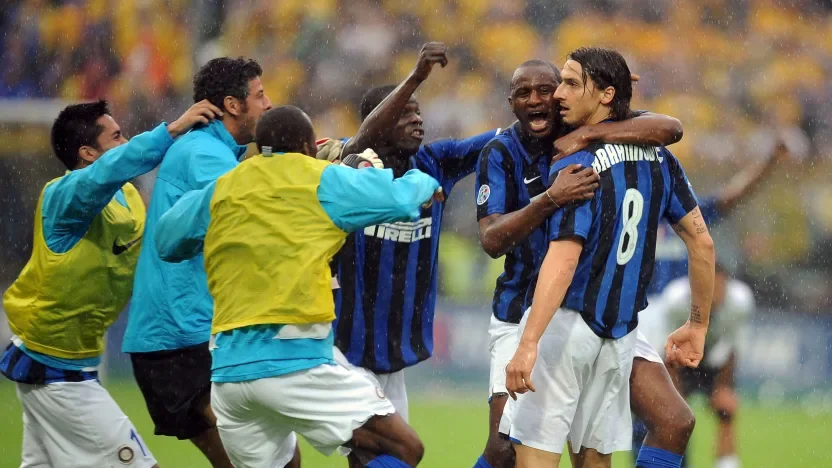
The next title replaced that overwhelming advantage with the pressure of a final-day decision. On 18 May 2008, away to Parma on the final day, Ibrahimović came off the bench in the second half and scored twice in a 2–0 victory. Lega's account of that championship decider recalls the simultaneous contest with Roma's result at Catania. The third consecutive title was secured, but the tense afternoon was a long way from the previous season's overwhelming points advantage.
José Mourinho extended the sequence with the 2008–09 championship, then faced another final-day contest in 2009–10. Inter arrived at Siena two points ahead of Roma. By half-time, Roma were winning at Chievo while Inter remained level. As UEFA's contemporary report explains, the breakthrough came when Javier Zanetti carried the ball past two opponents and supplied Diego Milito for the fifty-seventh-minute winner.
That goal is often remembered as one part of the treble, but the league context deserves its own attention. Inter could not treat Siena as a ceremonial stop before the European final. They needed to win, and a veteran captain's progressive run created the opening for their decisive finisher. Five consecutive titles can look inevitable when placed next to each other in a table. The matches that completed the sequence show just how much problem-solving was still required.
Conte's breakthrough and Inzaghi's second-star team
Conte's rehearsed forward partnership
The 2020–21 championship ended the eleven-year gap after Mourinho's last league title. Antonio Conte's Inter had a recognisable attacking partnership in Romelu Lukaku and Lautaro Martínez, but their own account of the season places considerable weight on work done away from the public eye. In a joint interview published by the club, Lautaro described long conversations about movement after Lukaku arrived. Their understanding was something developed, not simply the automatic result of selecting two good forwards.
Lukaku identified the win over Sassuolo as a turning point when the team became more compact. He also recalled preparing the return derby against the Primavera side and discussing Lautaro's movement behind Simon Kjær. Those details matter because they connect the partnership with the team's structure. Compactness helps players support each other when possession changes; rehearsed forward movements give the first pass out of pressure a destination.
The lesson is not that every goal can be drawn on a training board. Defenders react, passes vary and players still need to execute under pressure. But a forward who knows where his partner wants to move can release the ball earlier, before the opening closes. Conte's championship had individual force at its heart, yet the players' recollections also describe the shared preparation that helped turn that force into repeatable attacking combinations.
Inzaghi's second-star balance
Simone Inzaghi's 2023–24 champions brought a different attacking balance to an even more symbolic landmark: the twentieth Scudetto. They secured it by beating AC Milan 2–1 on 22 April, with Francesco Acerbi and Marcus Thuram scoring. Winning the second star in the derby ensured that the clinching match would be remembered independently of the final table. Five matches remained, underlining how far ahead the team had moved.
The completed-season figures were formidable: ninety-four points, eighty-nine goals scored and twenty-two conceded. Lautaro led the league with twenty-four goals, while Thuram and Hakan Çalhanoğlu each contributed thirteen. Inter also scored nine goals following open-play sequences of at least ten passes. Their attacking quality could survive a patient move through several players; it did not depend exclusively on reaching the front two as quickly as possible.
This is where the second-star side gains an identity beyond its trophy count. A team can be secure without being passive, and fluent without losing its defensive organisation. Inter's scoring spread and low goals-conceded total show those aims coexisting across a full season. Conte's champions and Inzaghi's champions were connected by important players, but the more useful continuity was their clarity of roles: each team gave its strongest footballers a framework in which their qualities reinforced one another.
Inter's latest Scudetto: Cristian Chivu's 2025–26 champions
The final numbers of Chivu's champions
Inter's most recent league title is the 2025–26 championship, secured on 3 May 2026. Cristian Chivu's team beat Parma 2–0 at San Siro, with Marcus Thuram and Henrikh Mkhitaryan scoring. The completed campaign, rather than the table on the night of the celebrations, ended with eighty-seven points, eleven ahead of Napoli. It was Inter's third championship in six seasons.
The attacking total provides the clearest connection with the recent winning teams: Inter scored eighty-nine league goals, matching their championship campaigns of 2020–21 and 2023–24. The club's final statistical review records Lautaro with seventeen goals and Federico Dimarco with eighteen assists. Inter's principal finisher and leading provider occupied very different starting positions, a reminder of how much creation came from outside the forward line.
The comeback at Como and the core that carried on
The 4–3 win at Como on 12 April shows the recovery work behind that comfortable final advantage. Inter were two goals down before Thuram scored just before half-time, then equalised early in the second half. Denzel Dumfries supplied the next two goals. The match report describes his first as a header and his second as a left-footed finish. The victory moved Inter nine points clear with six games remaining.
Dumfries's brace shows why a wing-back can become much more than the player assigned to provide width. Once an attack reaches the opposite side or occupies the centre-backs, a runner arriving from the flank gives the defence another opponent to locate. At Como, that additional scoring presence helped turn a damaged position into three points. It would be wrong to present the whole campaign as effortless domination when one of its pivotal wins required such a substantial recovery.
There was continuity behind Chivu's achievement. Lautaro, Nicolò Barella, Alessandro Bastoni, Matteo Darmian and Stefan de Vrij were all part of the title-winning groups in 2021, 2024 and 2026, as the club's account of its three-time champions confirms. Their roles and minutes were not identical across the three seasons. What carried over was experience of the club's demands and of the work required to complete a league campaign.
That is the strongest ending to Inter's title history so far: a familiar core finding another way to win under a different coach. The twenty-first championship belongs beside the previous twenty, but it has its own attacking patterns, difficult matches and decisive contributors. The full list records when Inter were champions. The teams behind it explain why those seasons remain worth revisiting long after the next fixture appears on the Serie A schedule.
Join the discussion
Comments
Sign in with Google to comment. Keep the conversation useful and football-focused. New comments are reviewed before they appear.
Loading comments…