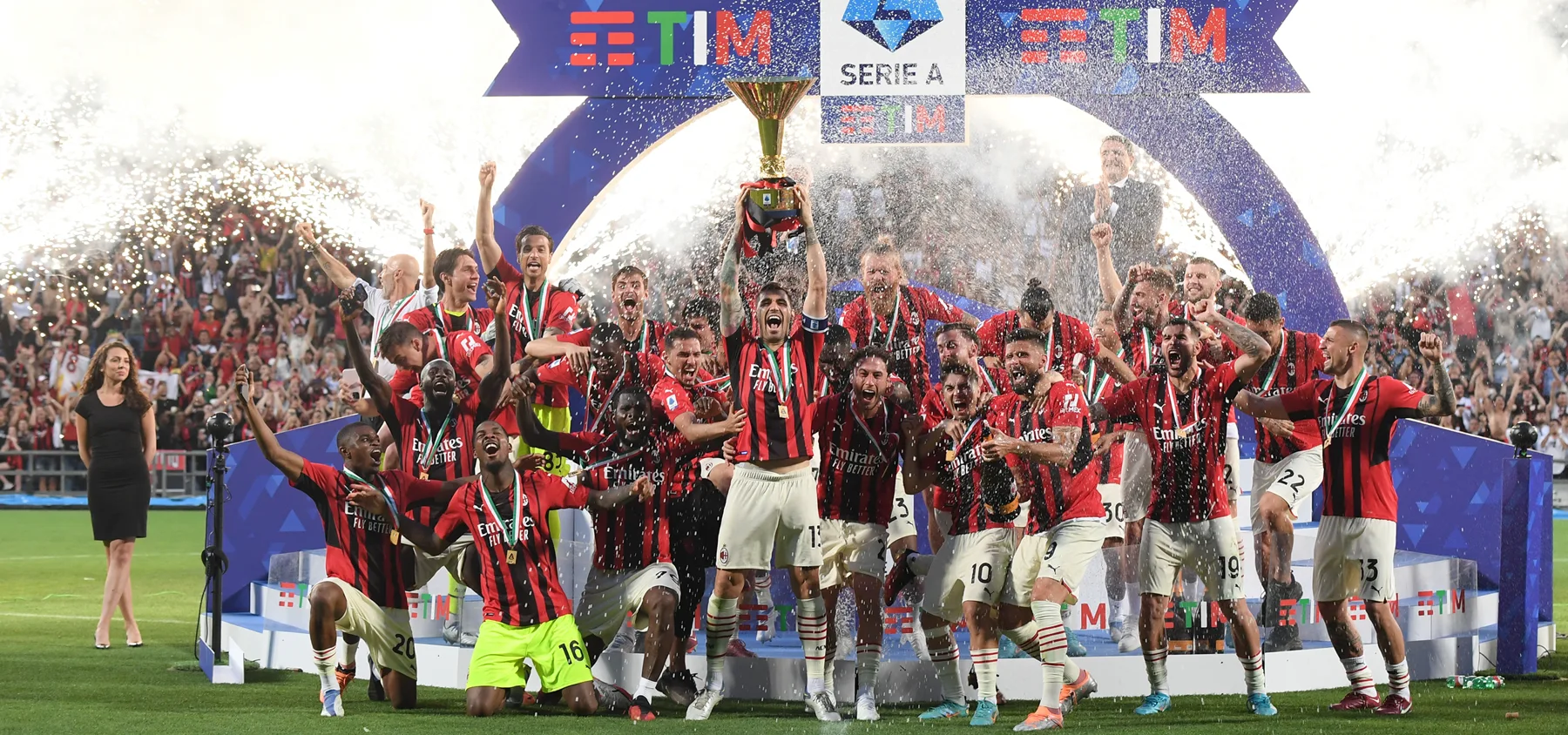
AC Milan have won 19 Italian top-flight league titles, most recently in 2021–22. That total includes three championships before the modern single-division Serie A began in 1929. The winning years tell several different stories: early pioneers, a first star, Sacchi’s collective revolution, Capello’s sustained success and a modern revival. Here is how to read the record, and why the teams behind it mattered.
How many Serie A titles have AC Milan won?
AC Milan have won 19 Italian top-flight championships. Their most recent Scudetto is the 2021–22 title, secured under Stefano Pioli. That remains the latest entry as of 5 September 2026, when the club's official league-title archive and the Lega Serie A roll of honour are read together. The number refers to AC Milan, the Rossoneri; it does not include Inter's championships.
The standard total includes the national championships of 1901, 1906 and 1907. Those came before the single national Serie A league began in 1929–30. If a statistical comparison deliberately starts with that modern format, Milan have 16 titles within its scope. Nineteen and sixteen therefore answer different questions. For the ordinary question “How many league titles have Milan won?”, nineteen is the appropriate all-history answer.
| Period | Winning seasons | Titles |
|---|---|---|
| Early national championship | 1901, 1906, 1907 | 3 |
| 1950s | 1950–51, 1954–55, 1956–57, 1958–59 | 4 |
| 1960s and 1970s | 1961–62, 1967–68, 1978–79 | 3 |
| Sacchi and Capello | 1987–88, 1991–92, 1992–93, 1993–94, 1995–96 | 5 |
| Later championship teams | 1998–99, 2003–04, 2010–11, 2021–22 | 4 |
The gaps are as revealing as the clusters. Milan's record contains a long wait after 1907, a concentrated run in the 1950s and another dominant period in the early 1990s. It is not a story of one uninterrupted machine. Different presidents, coaches and player groups rebuilt the ability to win, sometimes after years when the club's reputation outweighed its domestic results.
Nor should league championships be folded into Milan's European trophy count. The official honours collection separates competitions for a reason. European Cups and Champions Leagues help explain the club's international identity, but they are not additional Scudetti. A team can be extraordinarily successful in Europe without dominating every domestic season. That distinction is especially valuable when assessing coaches whose greatest nights came in continental finals.
The list also suggests a better historical question than simply whether Milan were “great” in a particular decade: what made each winning side function? Some championships came from a squad sustaining familiar patterns, others from a coach changing the balance or giving emerging players room to grow. The following eras show how the same badge produced quite different answers to the league's most demanding problem: being good enough, often enough, across an entire campaign.
From the pioneers to the first star
Milan's first championship arrived on 5 May 1901, with a 3–0 win over Genoa. The official account of that title belongs to a football world very different from today's league: a young club, a small national competition and none of the weekly global exposure now associated with the shirt. It is the beginning of the honours list, but it should not be judged using the resources or competitive structure of a modern 38-game campaign.
1951: Gre-No-Li needed balance
The next great chapter was a revival, not the continuation of an uninterrupted dynasty. The victories of 1906 and 1907 did not establish permanent supremacy: Milan waited until 1951 for another championship. By then, the Swedish combination of Gunnar Gren, Gunnar Nordahl and Nils Liedholm had given the attack its famous Gre-No-Li identity. Yet the club's season history emphasises that attacking brilliance alone had not solved the previous campaign's imbalance. Strengthening the defensive side of the team was part of turning a thrilling challenger into a champion.
That is a more useful lesson than presenting the Swedish trio as three names that automatically produced a trophy. An attack can create excellent moments while the team's distances leave it vulnerable when possession changes. Improving the structure behind creative players does not necessarily diminish their influence; it can make their good work survive on the scoreboard. The 1951 title was ultimately settled on a day Milan lost to Lazio, because Inter also lost. Even a revival remembered through stars and goals still depended on the mathematics of a season.
1979: the first star and a changing generation
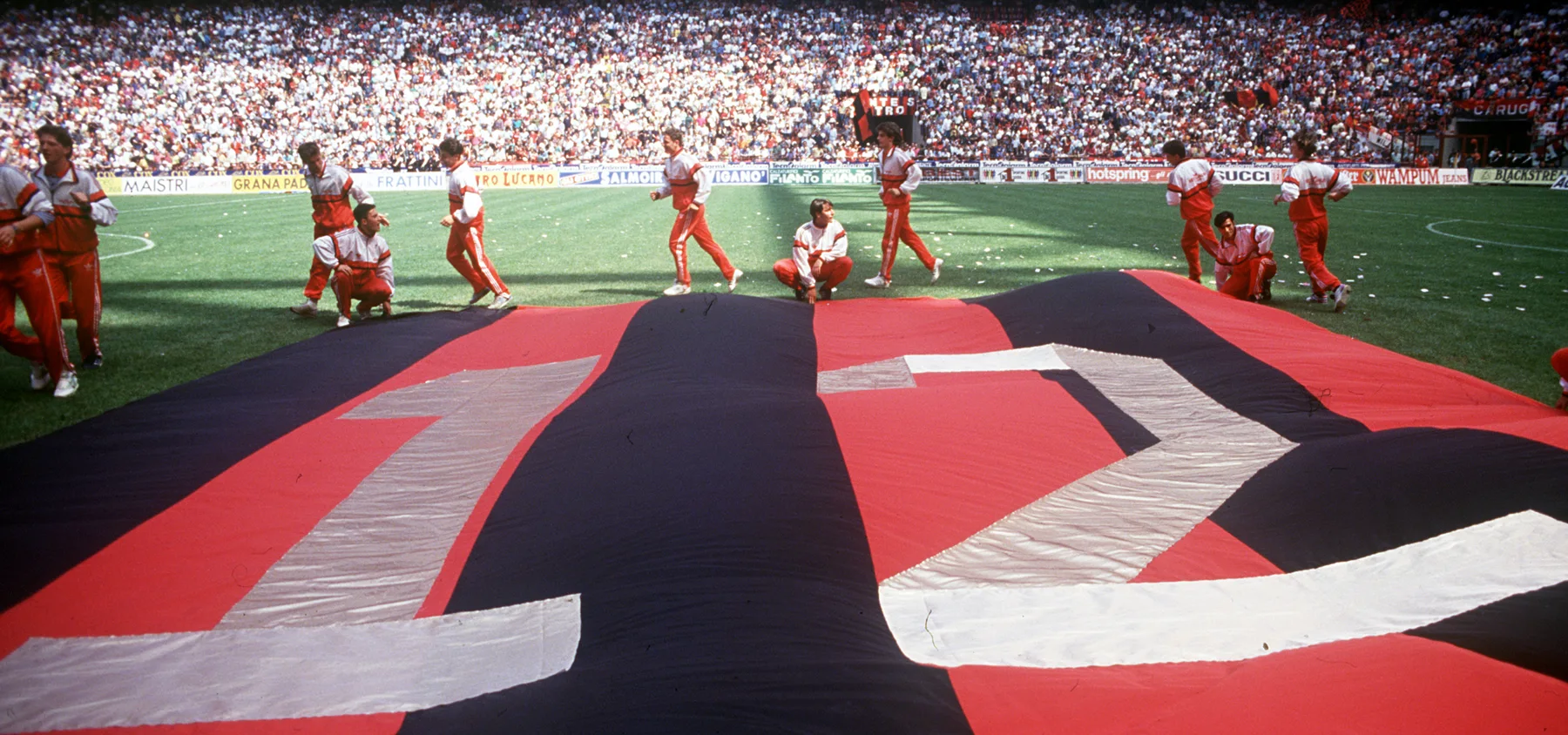
By 1978–79, the historical significance was cumulative: Milan's tenth championship brought the first star. Nils Liedholm was now the coach, and the official season account highlights his trust in the young Franco Baresi as libero. Gianni Rivera, whose Milan career had stretched across an earlier generation of triumphs, finished with another league winner's medal. The team connected different ages of the club within one dressing room rather than making a clean break between them.
There is a reason supporters remember this title through both a symbol and individual faces. A tenth championship makes a cumulative claim about the institution; a young defender establishing himself points towards what comes next. Rivera's farewell and Baresi's emergence gave the achievement a human scale. They also caution against reading a title-winning squad as a finished product. Some players are reaching the end of their contribution, others are only beginning it, and a coach must make those timelines work together. Across the journey from 1901 to the first star, Milan repeatedly had to create a winning balance rather than merely inherit one.
Sacchi's 1988 title changed more than the table
The 1987–88 championship ended a nine-year league wait and gave Arrigo Sacchi's project a result to match its ambition. It is remembered as the start of an era because Milan were changing how their players worked together. UEFA's retrospective on the team describes the collective pressure and zonal defensive line that became central to its identity. Franco Baresi's organisation mattered within that framework, not simply as an isolated display of great defending.
The underlying idea is easier to understand through distances than through nostalgia. If the forwards press while the midfield and defence remain too deep, an opponent can escape into the gaps. If the lines move together, the available receiving space becomes smaller. That demands shared timing and trust. It also changes what is asked of an outstanding individual: his positioning must help the player beside or behind him. Sacchi's Milan made the relationship between technique and collective movement part of the team's competitive advantage.
Napoli supplied the title race's most compelling test. Milan won the home meeting 4–1 in January, then travelled to the San Paolo on 1 May 1988 and won 3–2. The club's anniversary account identifies two goals from Pietro Paolo Virdis and one from Marco van Basten. That away victory is remembered because it changed the race against the reigning champions in their own stadium. It was a tangible expression of a challenger taking control, not merely an attractive tactical theory.
It is important to keep the personnel attached to the correct season. Ruud Gullit and Van Basten were part of this title-winning team; the fully formed Dutch trio familiar from the following European triumphs belongs to a later stage. Van Basten also missed much of the league campaign through injury, as the Italian season history explains. Virdis's contribution should not disappear just because later memories are dominated by bigger global names. A title is won by the players available during that campaign, not by the strongest retrospective composite squad.
Nor does the subsequent European success make the Scudetto a minor preliminary. A league season required the approach to survive different opponents and less celebrated afternoons. The 1988 title gave Milan proof that their methods could accumulate results as well as produce exceptional matches. Its historical importance comes from both elements: the immediate achievement of finishing first and the durable footballing identity that followed. The trophy count records one championship; the influence of that team reaches considerably further.
Capello turned excellence into a domestic dynasty
The unbeaten season and the 58-game run
Fabio Capello's first league championship as Milan coach was emphatic: the team completed 1991–92 unbeaten, scoring 74 goals, with Marco van Basten contributing 25. Those figures in the official season account immediately complicate the familiar contrast between an adventurous Sacchi and a supposedly joyless successor. Capello inherited outstanding players and an established understanding, but his first title-winning side was capable of overwhelming opponents as well as controlling them.
There are two separate unbeaten achievements to keep straight. The entire 34-match league season was one; the wider run stretching across campaigns was another. Milan's 1992–93 retrospective records 58 consecutive league games without defeat before Parma ended the sequence in March 1993. Describing the club as having an “unbeaten season” understates the longer run, while calling all 58 games a single season distorts the format. Both records deserve their correct frame.
1994: a different route to control
The unbeaten records establish the scale of the run; the later titles show how Capello adapted when the attacking resources changed. He won three successive Scudetti from 1991–92 through 1993–94, then added another in 1995–96. Four titles in five seasons is the clearest domestic expression of the dynasty. Yet the teams did not need to win every campaign through identical strengths. By 1993–94, the absence of Van Basten changed the attacking equation. The club's Italian account emphasises the midfield balance provided by Marcel Desailly alongside Demetrio Albertini and a defence that conceded only 15 goals in 34 league matches.
That number becomes more meaningful when you consider how a midfield protects a back line. Recovering possession is only one part of the job. Denying an easy central pass can force the opponent into a slower route; positioning behind an attack can stop a turnover becoming an immediate run at the centre-backs. Desailly's physical presence and Albertini's use of the ball offered different qualities within the same structure. The inference is that defensive security was a team property, not simply four famous defenders winning every duel independently.
The broader achievement was adaptation without surrendering the capacity to finish first. A coach maintaining success has to recognise when an old strength has weakened, which roles can be redistributed and how much change the squad can absorb. Capello's league record is compelling because it stretches beyond one ideal selection or one spectacular afternoon. His Milan could score freely in one championship and make scarce goals sufficient in another. For supporters comparing the great Rossoneri eras, that range deserves as much attention as the repeated appearance of the same names on the honours list.
Reinventing the champions in 1999, 2004 and 2011
1999: Zaccheroni's late surge
The 1998–99 title was a comeback story within the season itself. Alberto Zaccheroni's team won its final seven league matches and finished one point above Lazio, according to the official championship history. The final step was a 2–1 victory at Perugia. This was not the gradual confirmation of a side that had spent months beyond its rivals' reach. It was a sustained late surge, with every result needed to keep the pressure alive.
Zaccheroni also offered a different arrangement of Milan's attacking talent. The club's retrospective on the Empoli match describes a 3-4-1-2 with Zvonimir Boban behind Oliver Bierhoff and George Weah. The significance of that shape lies in the relationships: a creative player linking midfield to two forwards, with width supplied from outside them. It gave Milan a route to attack that did not require recreating an earlier coach's formation simply because that formation had once won trophies.
2004: Ancelotti strengthens European champions
Carlo Ancelotti's 2003–04 champions started from a different position, having already conquered Europe. Kaká and Cafu added fresh qualities, while Andriy Shevchenko supplied the header against Roma that secured the league title. The club's account records a final total of 82 points. Here the challenge was to improve an established elite team, not recreate Zaccheroni's late rescue of a title race.
That starting point changes how the achievement should be judged. A European triumph does not remove the need to solve a different opponent every league weekend. Milan's continental reputation should not obscure this domestic campaign: sustaining a title-level return is its own accomplishment, even for players already associated with major finals. Reinforcement can be a form of renewal without requiring a wholesale break with a successful side.
2011: Allegri reshapes the squad
Allegri's 2010–11 champions involved a more visible reshaping of the playing group. The championship brought Massimiliano Allegri's first Scudetto with Milan. Zlatan Ibrahimović and Robinho were important additions, while January arrivals included Mark van Bommel and Antonio Cassano. As the official season record confirms, a goalless draw at Roma delivered the title and Milan again finished on 82 points. The identical total should not make the campaigns interchangeable: the 2004 league had 34 matches per team, while the 2011 competition had 38.
Together these championships resist a single formula for Milan success. Zaccheroni's late acceleration, Ancelotti's refinement of European champions and Allegri's reshaping of the squad involved different starting conditions. What they share is an effective fit between the players available and the jobs they were asked to perform. For a supporter evaluating a new Milan side, the historical lesson is practical: resemblance to a famous predecessor is less useful than whether the current team can create chances, protect itself when attacks fail and keep doing both under the changing demands of a league season.
Milan's last Scudetto: the complete team behind 2021–22
Sassuolo: the clincher and Leão's contribution
Milan's most recent league championship remains 2021–22. Stefano Pioli's side completed it by beating Sassuolo 3–0 on 22 May 2022, with two goals from Olivier Giroud and another from Franck Kessié. The club's report from Reggio Emilia records a commanding first half and an eventual total of 86 points. The league's current roll of honour still lists that season as Milan's nineteenth and latest title through the completed 2025–26 campaign.
Rafael Leão was fundamental to the decisive afternoon, but his contribution deserves precise description. The match report places him in the creation of all three goals; the club's separate MVP assessment credits him with two assists. Those descriptions should not be silently converted into a claim that the latter source records three assists. What is beyond the numerical distinction is his influence on the opportunities Milan created: his work helped connect possession to the players who finished the moves.
That connection shows why the winger's role was larger than a personal scoring total. A forward can change a match by recovering the ball, advancing it or finding a teammate after drawing defensive attention. Giroud and Kessié supplied the finishes, but their opportunities emerged from actions elsewhere in the attack. The final-day report also describes recoveries high up the pitch before goals. This was not simply a team waiting for isolated moments of inspiration; it was making Sassuolo defend immediately after losing possession.
The defensive platform behind the title
The decisive afternoon explains how Milan finished the job; the defensive record explains how they kept putting themselves in position to win it. The club's post-season statistical review records 18 clean sheets, with Mike Maignan responsible for 17 of them, and only nine goals conceded during the second half of the league season. Those figures give the attacking achievements their proper setting. A side that regularly keeps the opposition out does not always need a spectacular scoreline to win. It can turn a relatively small number of successful attacking actions into a valuable run of results.
Defensive reliability should not be interpreted as a goalkeeper acting alone, any more than attacking creativity belongs only to a winger. The players ahead of the back line influence the passes an opponent can attempt. The defenders' positioning influences the space a goalkeeper must protect. Maignan, Kalulu and Tomori formed part of the final-day defensive unit, while the work farther forward helped determine what reached them. These relationships make the clean-sheet record a team achievement even when one player's individual quality remains crucial.
The nineteenth title therefore has a clear identity within Milan's longer history. It was not Sacchi's side reproduced or Capello's dynasty resumed, but Pioli's group finding a workable balance between disruption, creativity, finishing and protection. That is why the Sassuolo celebration means more when read alongside the season's defensive record. The present Serie A table measures a different campaign; 2021–22 remains the fixed historical answer to when Milan last completed the job.
Join the discussion
Comments
Sign in with Google to comment. Keep the conversation useful and football-focused. New comments are reviewed before they appear.
Loading comments…